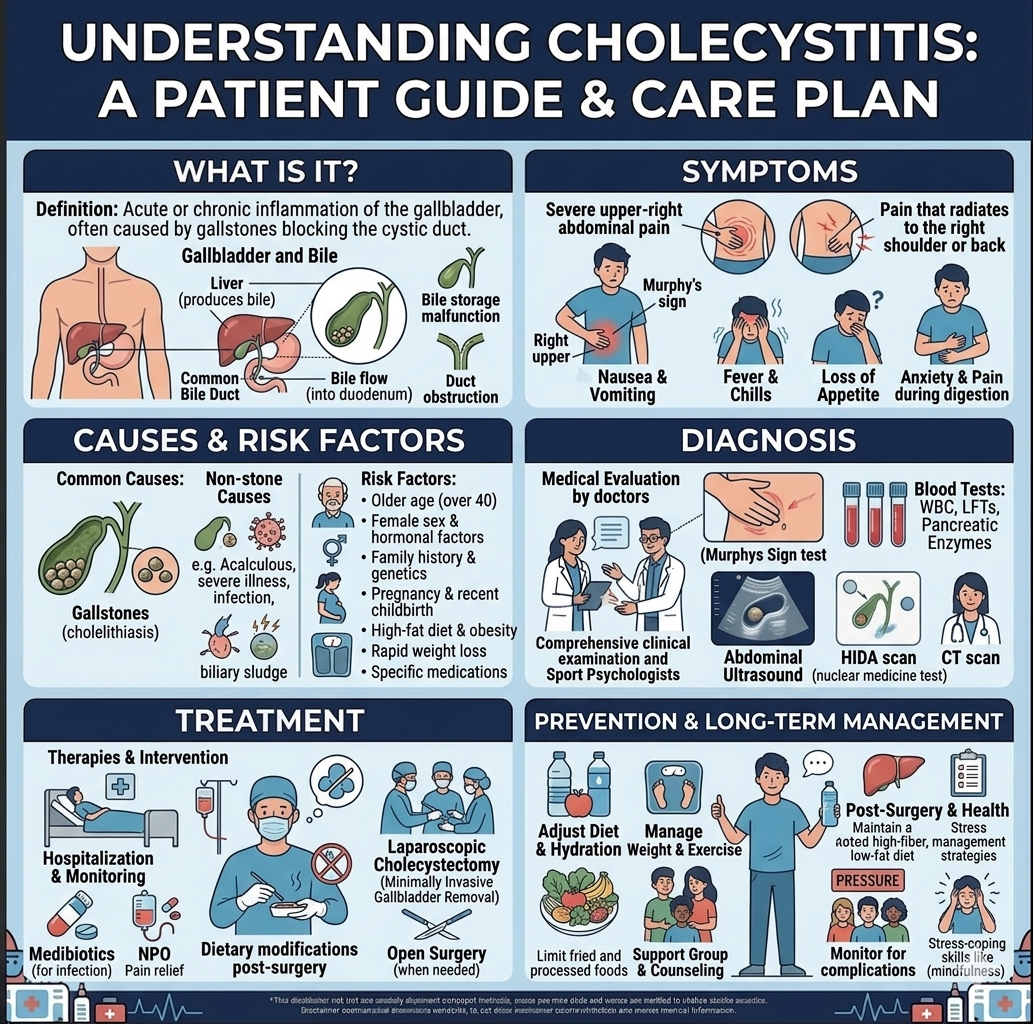
Cholecystitis (pronounced ko-luh-sis-TIE-tis) is the medical term for inflammation, or swelling and irritation, of the gallbladder. The gallbladder is a small, pear-shaped organ located under your liver on the right side of your abdomen. Its main job is to store and release bile, a digestive fluid produced by the liver, into the small intestine to help break down fats in food. Most often, this inflammation happens when gallstones block the tube leading out of the gallbladder. This blockage causes bile to build up, leading to pain and swelling. Less common causes include tumors, bile duct issues, severe illnesses, or infections. If left untreated, cholecystitis can lead to serious, life-threatening complications, often requiring surgery to remove the gallbladder.
Understanding the Condition
Cholecystitis: Gallbladder Inflammation Explained
Understanding the Condition
Common Symptoms
Severe Belly Pain: Sharp, intense pain usually felt in the upper right or central part of your abdomen.
Spreading Pain: The pain may extend to your right shoulder or back.
Tenderness: Your belly area might feel very sensitive or painful when touched.
Triggered by Meals: Symptoms often worsen after eating, especially large or fatty meals.
Consultation Guide
Which Specialist to Meet
You should first consult with your primary care physician if you experience symptoms that concern you. Depending on their assessment, they may refer you to a gastroenterologist (a doctor specializing in digestive system disorders) or a general surgeon, especially if surgery is being considered.
Preparations Before Your Visit
Before your appointment, it's helpful to: write down all your symptoms, including when they started and how severe they are; note any recent illnesses, stress, or major life changes; list all medications, vitamins, and supplements you currently take; prepare a list of questions to ask your doctor; and be ready to discuss your medical history, including family history. If severe belly pain prevents you from finding comfort, seek emergency care immediately.
Book a doctor visit near me
Dietary Modifications: A low-fat diet can reduce symptom severity, especially for mild cases, by preventing intense gallbladder contractions triggered by large, fatty meals. (Duration: Ongoing, as needed to manage symptoms.)
Pain Management: Over-the-counter pain relievers or prescribed stronger medication can manage discomfort. Warm compresses may also provide relief. (Duration: As needed for symptom relief, usually short-term while addressing the underlying cause.)
Gallbladder Removal (Cholecystectomy): This is the most common and definitive treatment for cholecystitis, especially when caused by gallstones or if symptoms are severe and recurrent. The gallbladder is not an essential organ; the body can digest food without it. This surgery is usually performed using a minimally invasive laparoscopic technique (small incisions), though open surgery (one larger incision) may be necessary in complex cases. (Duration: Surgery takes 1-2 hours; hospital stay 1-2 days for laparoscopic, longer for open. Full recovery 1-4 weeks.)
Monitor for Post-Surgery Symptoms: After gallbladder removal, recovery is generally good, but some may experience digestive changes like diarrhea. Discuss any persistent symptoms with your doctor.
Consultation Guide
Cholecystitis (pronounced ko-luh-sis-TIE-tis) is the medical term for inflammation, or swelling and irritation, of the gallbladder. The gallbladder is a small, pear-shaped organ located under your liver on the right side of your abdomen. Its main job is to store and release bile, a digestive fluid produced by the liver, into the small intestine to help break down fats in food. Most often, this inflammation happens when gallstones block the tube leading out of the gallbladder. This blockage causes bile to build up, leading to pain and swelling. Less common causes include tumors, bile duct issues, severe illnesses, or infections. If left untreated, cholecystitis can lead to serious, life-threatening complications, often requiring surgery to remove the gallbladder.
Maintain a Healthy Weight: Being overweight or obese raises gallstone risk, the main cause of cholecystitis. Aim for a healthy weight through balanced eating and regular activity.
Lose Weight Slowly: If weight loss is needed, do so gradually (1-2 pounds/week) and under medical guidance.
Diagnostic Procedures
An abdominal ultrasound is a common, non-invasive imaging test that uses high-frequency sound waves to create live images of organs and structures inside your abdomen, including the gallbladder, liver, and bile ducts. It's often the initial test for gallstones and gallbladder inflammation.
What to Expect
You will lie on an examination table. A clear gel will be applied to your abdomen to help the sound waves travel. A technician will then press a small handheld device called a transducer against your skin, moving it over the area. The transducer sends and receives sound waves, which are converted into images on a computer screen. The procedure is typically painless, though you might feel slight pressure from the transducer. It usually takes about 15-30 minutes. You may be asked to fast for several hours before the test to get clearer images.
CT Scan (Computed Tomography Scan)
A CT scan uses specialized X-ray equipment and computer processing to create detailed cross-sectional images (like slices) of bones, blood vessels, and soft tissues inside your body. It offers detailed views, helping identify inflammation, blockages, or other abnormalities, especially if complications are suspected.
What to Expect
You will lie on a motorized table that slides into a large, donut-shaped machine. The machine will rotate around you, taking multiple X-ray images. You will need to lie still during the scan, and you might be asked to hold your breath briefly at certain times. Depending on the area being scanned, a contrast dye may be given through an injection into a vein or taken by mouth to highlight certain structures. The scan itself is painless, but the machine can be noisy. The entire procedure typically lasts 10-30 minutes.
HIDA Scan (Hepatobiliary Iminodiacetic Acid Scan)
A HIDA scan, also known as a cholescintigraphy scan, is a nuclear medicine imaging test that tracks the flow of bile from your liver, through your bile ducts, to your gallbladder, and into your small intestine. It helps assess the function of your gallbladder and bile ducts, showing if there are blockages or if your gallbladder is not emptying properly.
What to Expect
A small amount of a safe radioactive tracer will be injected into a vein in your arm. This tracer travels to your liver and mixes with bile. A special camera, called a gamma camera, will then be placed over your abdomen to take images as the tracer moves through your liver, gallbladder, and bile ducts. The camera detects the tracer's radiation in your body, not emitting its own. You will lie still on a table during this process. The scan may take 1-4 hours, or sometimes longer, depending on how quickly the tracer moves. You may be given a medication during the scan to stimulate your gallbladder to contract and release bile, allowing doctors to measure its emptying rate. Fasting before the test is usually required.
Treatment Options
Medications
Antibiotics: If an infection is present or suspected alongside the inflammation, antibiotics will be prescribed to fight the bacterial infection. (Duration: Typically 7-14 days, as directed by your doctor.)
Intravenous Fluids: In severe cases, if eating/drinking is difficult due to pain/nausea, intravenous fluids can prevent dehydration. (Duration: Varies depending on severity and hydration status, usually 1-3 days in a hospital setting.)
Surgical Procedures
Prevention & Long-Term Wellbeing
Home Remedies & Lifestyle Adjustments
Prevention
Adopt a Healthy Eating Plan: A diet rich in fruits, vegetables, whole grains, and low in unhealthy fats prevents gallstones. Limit processed, fried, and fatty foods.
Long-Term Wellbeing
Regular Check-ups: Maintain a healthy lifestyle and regular check-ups to monitor digestive health and address issues promptly.
Tags & Topics
Notice an error or need an update?
Help us keep medical information accurate. Report incorrect info or suggest an edit.


