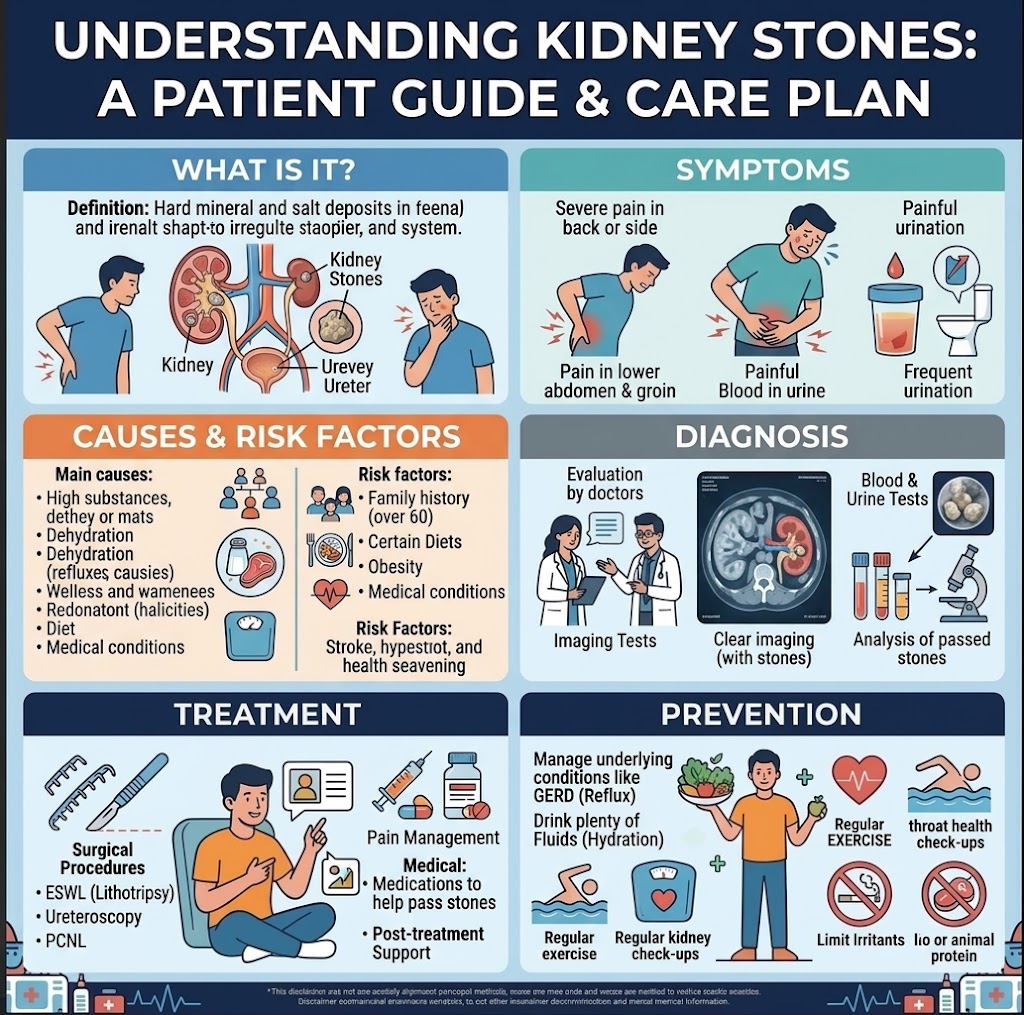
Kidney stones are hard masses made of minerals and salts that form inside the kidneys. They can travel through the urinary tract, causing significant pain. Often, stones develop when urine is too concentrated, allowing crystal-forming substances to clump together. While painful, prompt treatment usually prevents lasting damage. Treatment options, including pain relief, increased fluids, or surgery, depend on the stone's size, location, and type. Diet, body weight, certain health conditions, and some medications can increase risk. Prevention strategies like dietary changes or specific medicines can help those prone to stones.
Understanding the Condition
Common Symptoms
Severe Pain: Sharp pain in the side and back, below the ribs, spreading to the lower abdomen and groin. This pain comes in waves and varies in intensity.
Urination Discomfort: Pain or burning during urination; frequent, urgent need to urinate; urinating often in small amounts.
Urine Changes: Pink, red, or brown urine (due to blood); cloudy or foul-smelling urine.
Nausea and Vomiting: Feeling sick to your stomach and throwing up.
Fever and Chills: May indicate an infection is present.
Consultation Guide
Which Specialist to Meet
Prepare a list of all your symptoms, including onset and severity. Bring a complete list of all medications, vitamins, and supplements you are currently taking. Be ready to discuss your medical history and lifestyle. If you pass a stone, try to collect it for analysis.
Book a doctor visit near me
Regular Medical Follow-ups: Essential for individuals with a history of stones to monitor health, review prevention strategies, and address any new symptoms promptly with your doctor.
Consultation Guide
An intravenous (IV) line will be inserted for contrast dye injection (may cause a warm flush or metallic taste). X-ray pictures are taken as the dye moves through your urinary system. Takes 30-60 minutes.
Intravenous Pyelogram (IVP)
Diagnostic Procedures
A urine sample test to detect issues like infection or kidney disease, checking urine appearance, concentration, and content (e.g., blood, protein).
What to Expect
You'll provide a mid-stream urine sample in a sterile cup for lab analysis. It's quick and non-invasive.
Ultrasound (Sonography)
Uses sound waves to create images of kidneys and bladder, helping visualize stones, kidney swelling, and urine flow.
What to Expect
You'll lie down while gel is applied to your skin. A handheld transducer moves over the area, sending sound waves. The procedure is painless, typically 15-30 minutes.
Uses X-rays and a computer for detailed cross-sectional images of internal body structures, highly effective for detecting kidney stones.
What to Expect
You'll lie on a table that slides into a large, donut-shaped machine. You must remain still and may be asked to hold your breath briefly. Takes 10-30 minutes.
A specialized CT scan of the urinary tract (kidneys, ureters, bladder). Contrast dye is injected to highlight these structures, assessing their function and identifying stones or blockages.
What to Expect
An X-ray exam of the urinary tract where injected contrast dye allows visualization of the system's structure and function. Less common now due to newer tests like CT urograms.
What to Expect
Contrast dye is injected into an arm vein. X-ray images are taken at timed intervals as the dye passes through your kidneys, ureters, and bladder. You may experience a warm sensation from the dye. Takes about an hour.
What to Expect
Involves providing a blood sample or cheek swab for DNA analysis. Risks are minimal for these collection methods. Discussion with a genetic counselor is important.
Treatment Options
Kidney Stones: Understanding, Treatment, and Prevention
Understanding the Condition
Medications
Ureter Relaxants: Medications designed to relax the muscles in the ureter, making it easier for a kidney stone to pass with less pain. (Duration: Typically prescribed for a few days to several weeks, until the stone passes.)
Stone-Specific Medications: Various medications are used to control mineral and salt levels in urine (e.g., diuretics, citrate compounds, uric acid reducers, specific vitamin supplements, thiol drugs, or other prescription medicines). These are tailored to prevent different stone types (calcium, uric acid, struvite, cystine) or manage rare genetic conditions. Antibiotics may also be used for infection-related stones. (Duration: Often long-term for prevention; antibiotics are short-term for infection, sometimes long-term low-dose for recurrence prevention.)
Surgical Procedures
Adhere to Prescribed Medications: Take all prescribed medications as directed by your healthcare professional. These medicines are designed to control urine mineral and salt levels, significantly reducing the risk of specific stone types.
Prevention & Long-Term Wellbeing
Start with your primary care doctor. They may refer you to a urologist (urinary tract specialist), a nephrologist (kidney disease specialist), or a registered dietitian.
Preparations Before Your Visit
Examines your DNA for genetic changes predisposing you to specific stone types (e.g., cystine stones), guiding prevention strategies.
Home Remedies and Lifestyle Adjustments
Pain Management and Hydration: For small stones, pain relievers (over-the-counter or prescription) and significant water intake can help the stone pass naturally by diluting urine and flushing the stone. (Duration: Pain relief as needed; increased hydration until stone passes, often long-term for prevention.)
Percutaneous Nephrolithotomy: For larger stones, a surgeon makes a small incision in your back and uses specialized instruments to directly access and remove stones from the kidney. (Duration: A single procedure; recovery typically takes several days to a few weeks.)
Prevention
Stay Hydrated: Drink enough water daily to produce clear, light-colored urine, aiming for about 2 liters of urine. Increase fluid intake in hot climates or with frequent exercise.
Adopt a Kidney-Friendly Diet: Limit foods high in oxalate (e.g., rhubarb, spinach, nuts, chocolate) if prone to calcium oxalate stones. Reduce sodium (salt) and excessive animal protein. Consult a dietitian for a personalized eating plan.
Manage Calcium Intake: Dietary calcium is generally beneficial for health and typically does not increase stone risk. However, discuss calcium supplements with your doctor, as they may be linked to a higher risk; if prescribed, take them with meals.
Stone Type Identification: If you pass a stone, try to collect it for analysis. Knowing its type helps your doctor tailor the most effective and personalized prevention plan for you.
Tags & Topics
Notice an error or need an update?
Help us keep medical information accurate. Report incorrect info or suggest an edit.


