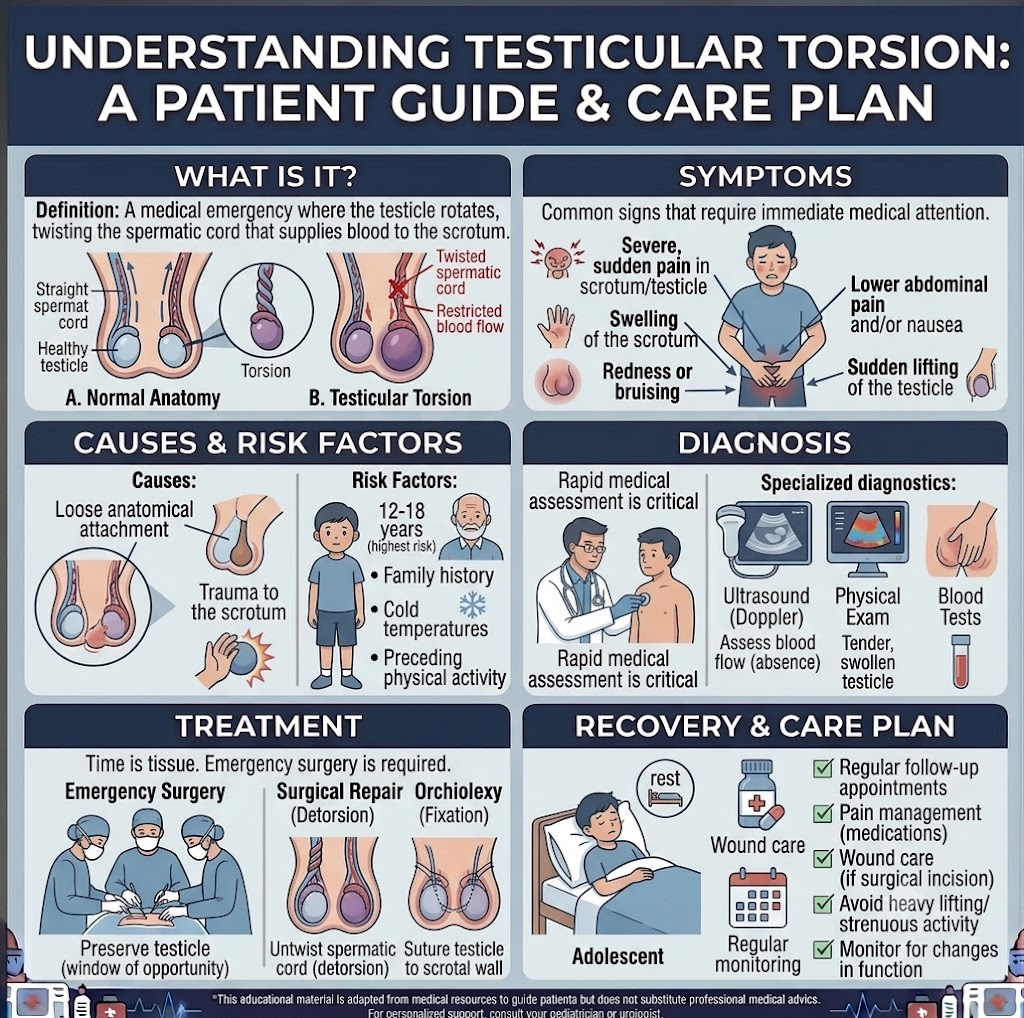
Testicular torsion is a critical condition where a testicle twists inside the scrotum, causing the spermatic cord to also twist. This cord supplies blood to the testicle. When twisted, blood flow is severely reduced or completely cut off, leading to sudden, severe pain and swelling. This is an urgent medical emergency that requires immediate treatment to save the testicle.
Understanding the Condition
Common Symptoms
A test of your urine can help rule out other conditions that might have similar symptoms, such as a urinary tract infection (UTI) or an infection of the testicle (epididymitis).
Emergency Detorsion and Orchidopexy: This is an urgent surgical procedure to untwist the spermatic cord and restore blood flow to the testicle. After untwisting, the testicle is stitched to the inside of the scrotum (a procedure called orchidopexy) to prevent it from twisting again. The other testicle is also typically secured to prevent a similar issue in the future. (Duration: Typically a 30-60 minute procedure; however, the critical factor is how quickly it's performed after symptoms begin, ideally within 4-6 hours.)
Consultation Guide
The doctor will gently touch and feel the affected area. This may cause discomfort or increase existing pain due to the condition, but it is a crucial step in the diagnostic process.
Doppler Ultrasound of the Scrotum
You will lie on an examination table. A special gel will be applied to your scrotum, and a handheld device (transducer) will be moved gently over the area. This procedure is generally painless, though the pressure from the transducer might cause slight discomfort if you are already experiencing pain.
Diagnostic Procedures
Testicular Torsion: A Medical Emergency
Understanding the Condition
Testicular torsion is a critical condition where a testicle twists inside the scrotum, causing the spermatic cord to also twist. This cord supplies blood to the testicle. When twisted, blood flow is severely reduced or completely cut off, leading to sudden, severe pain and swelling. This is an urgent medical emergency that requires immediate treatment to save the testicle.
Sudden, Severe Testicle Pain: Pain typically appears without warning and can be intense, often affecting one side of the scrotum. Young boys may wake up with this pain in the middle of the night or early morning.
Scrotum Swelling: The affected side of the scrotum, the loose bag of skin holding the testicles, may become noticeably enlarged due to reduced blood flow and inflammation.
Consultation Guide
Which Specialist to Meet
Due to the emergency nature of testicular torsion, you should immediately go to an emergency room. There, you will be assessed by emergency physicians, and a urologist (a specialist in male reproductive and urinary tract issues) will likely be consulted or perform the necessary surgery.
Preparations Before Your Visit
A doctor will carefully examine the scrotum, testicles, abdomen, and groin area to check for swelling, tenderness, and the position of the testicle.
What to Expect
This imaging test uses sound waves to create detailed pictures of the testicle and measure the blood flow to it. Reduced or absent blood flow to the affected testicle is a strong indicator of torsion.
What to Expect
What to Expect
You will be asked to provide a urine sample in a sterile cup. This sample will then be sent to a laboratory for analysis.
Orchiectomy (Testicle Removal): If blood flow has been cut off for too long (generally more than 6-12 hours) and the testicle is severely damaged beyond repair, it may need to be surgically removed. This is done to prevent complications like infection. (Duration: Typically a 30-60 minute procedure.)
Immediate Medical Attention: The most crucial preventative measure against severe damage or loss of a testicle is to seek emergency medical care immediately for any sudden or severe testicle pain. Prompt treatment significantly increases the chances of saving the testicle.
Post-Surgical Follow-up: After surgery for testicular torsion, regular follow-up appointments with a urologist are important to monitor healing, assess the health of the testicle, and ensure a full recovery.
Self-Awareness: While recurrence after successful orchidopexy (surgical fixation) is rare, it's always important to remain aware of any unusual pain, swelling, or changes in the scrotal area and report them to a doctor if they occur.
Treatment Options
As this is an emergency, no specific preparation is needed other than seeking immediate medical care. If possible, avoid eating or drinking anything, as you may require urgent surgery.
Book a doctor visit near me
Surgical Procedures
Prevention & Long-Term Wellbeing
Prevention
Tags & Topics
Notice an error or need an update?
Help us keep medical information accurate. Report incorrect info or suggest an edit.


