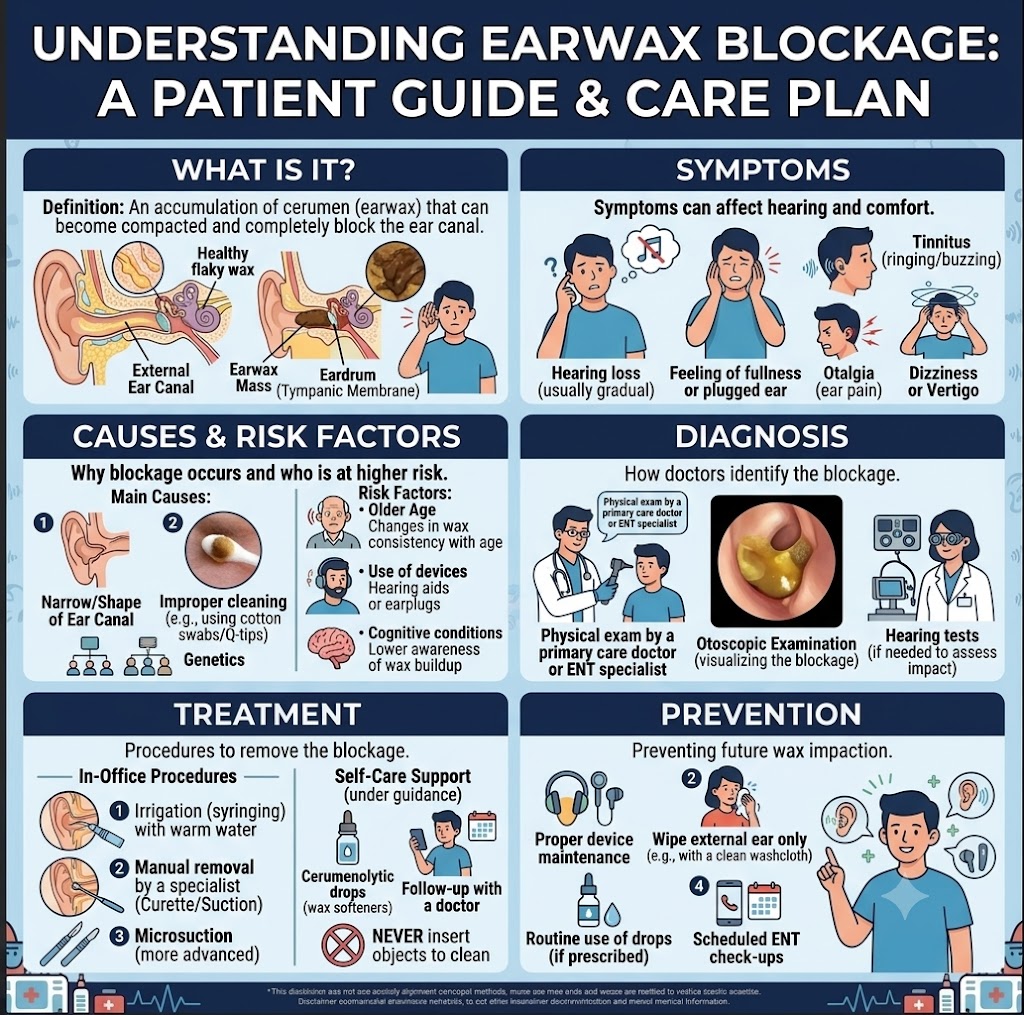
Earwax, medically known as cerumen, is a natural and essential substance produced by glands in your outer ear canal. It serves as a protective shield, trapping dust, dirt, and microorganisms while slowing bacterial growth. Typically, old earwax naturally migrates to the ear opening, where it washes away or falls out. However, when your body produces too much earwax, or if the wax is pushed deep into the ear canal, it can accumulate, harden, and create a blockage. When this occurs, safe medical evaluation and removal are necessary to prevent hearing issues or discomfort.
Understanding the Condition
Understanding Earwax Blockage: Causes, Symptoms, and Safe Removal
Understanding the Condition
Earwax, medically known as cerumen, is a natural and essential substance produced by glands in your outer ear canal. It serves as a protective shield, trapping dust, dirt, and microorganisms while slowing bacterial growth. Typically, old earwax naturally migrates to the ear opening, where it washes away or falls out. However, when your body produces too much earwax, or if the wax is pushed deep into the ear canal, it can accumulate, harden, and create a blockage. When this occurs, safe medical evaluation and removal are necessary to prevent hearing issues or discomfort.
Common Symptoms
Muffled Hearing or Hearing Loss: A gradual or sudden decrease in your ability to hear, often feeling like your ear is plugged or underwater.
Earache or Feeling of Fullness: A dull ache, mild discomfort, or a persistent sensation of pressure and fullness inside the affected ear.
Before your visit, write down all your symptoms and how long you have experienced them. Do not insert cotton swabs, ear candles, or any sharp objects into your ear, as this can compress the wax or damage your eardrum. Make sure to inform your doctor if you have a history of a ruptured eardrum, ear surgery, current ear pain, or fluid drainage.
Book a doctor visit near me
Consultation Guide
Tinnitus: An annoying ringing, buzzing, roaring, or humming sound in the ear that is not caused by an external noise.
Dizziness or Vertigo: A feeling of instability, lightheadedness, or a spinning sensation, which happens because the ear canal blockage can affect your equilibrium.
Itching or Odorless Discharge: A persistent itch deep inside the ear canal, occasionally accompanied by a mild, non-painful discharge as the ear tries to reject the buildup.
Consultation Guide
Which Specialist to Meet
You should consult a primary care physician, a family medicine doctor, or an Otolaryngologist (an Ear, Nose, and Throat, or ENT specialist) for severe or recurring blockages.
Preparations Before Your Visit
Diagnostic Procedures
Otoscopy (Visual Ear Examination)
A quick, non-invasive examination where a doctor uses a specialized lighted magnifier called an otoscope to look directly into your ear canal to check for wax buildup, inflammation, or eardrum damage.
What to Expect
During the examination, you will sit still while the doctor gently pulls your outer ear back and upward to straighten your ear canal. They will slowly insert the smooth, tapered tip of the otoscope. You might feel a slight pressure, but the procedure is entirely painless and takes only a minute or two.
A test that measures how well your eardrum moves. It is typically performed if your hearing remains muffled after the earwax is removed, helping rule out middle ear fluid or damage.
What to Expect
A small, soft probe is placed at the opening of your ear canal. The device will change the air pressure in your ear and play a quiet tone. You will feel a sensation similar to the pressure change during a flight, and you must remain quiet and avoid swallowing for a few seconds.
Treatment Options
Home Remedies and Softening Agents
Wax-Softening Drops: Applying a few drops of mineral oil, baby oil, glycerin, or hydrogen peroxide-based over-the-counter drops into the ear canal to break down and soften hardened wax. (Duration: 1 to 5 days, applied twice daily.)
In-Office Clinical Procedures
Ear Irrigation (Ear Syringing): A trained healthcare provider uses a syringe or electronic irrigator to gently flush the ear canal with warm saline or water, washing out the softened wax. (Duration: 10 to 15 minutes per ear.)
Manual Removal (Micro-suction or Curette): Direct physical removal of the wax by a doctor using specialized tools, such as a curette (a tiny, curved loop tool) or a gentle suction device while looking through an ear microscope. (Duration: 5 to 15 minutes.)
Prevention & Long-Term Wellbeing
Prevention and Safe Ear Care
Avoid Cotton Swabs: Never insert cotton swabs, hairpins, or any small items into your ear canal. This pushes the earwax deeper, packing it tightly against your eardrum and risking permanent hearing damage.
Weekly Softening Maintenance: If you are prone to excess earwax, apply one or two drops of mineral oil or baby oil once a week to keep the wax soft, enabling it to migrate out of the ear naturally.
Regular Professional Cleanings: If you wear hearing aids, use earplugs regularly, or have narrow ear canals, schedule preventive ear checks with your healthcare provider every 6 to 12 months to clear buildup before it becomes a complete blockage.
Tags & Topics
Notice an error or need an update?
Help us keep medical information accurate. Report incorrect info or suggest an edit.


