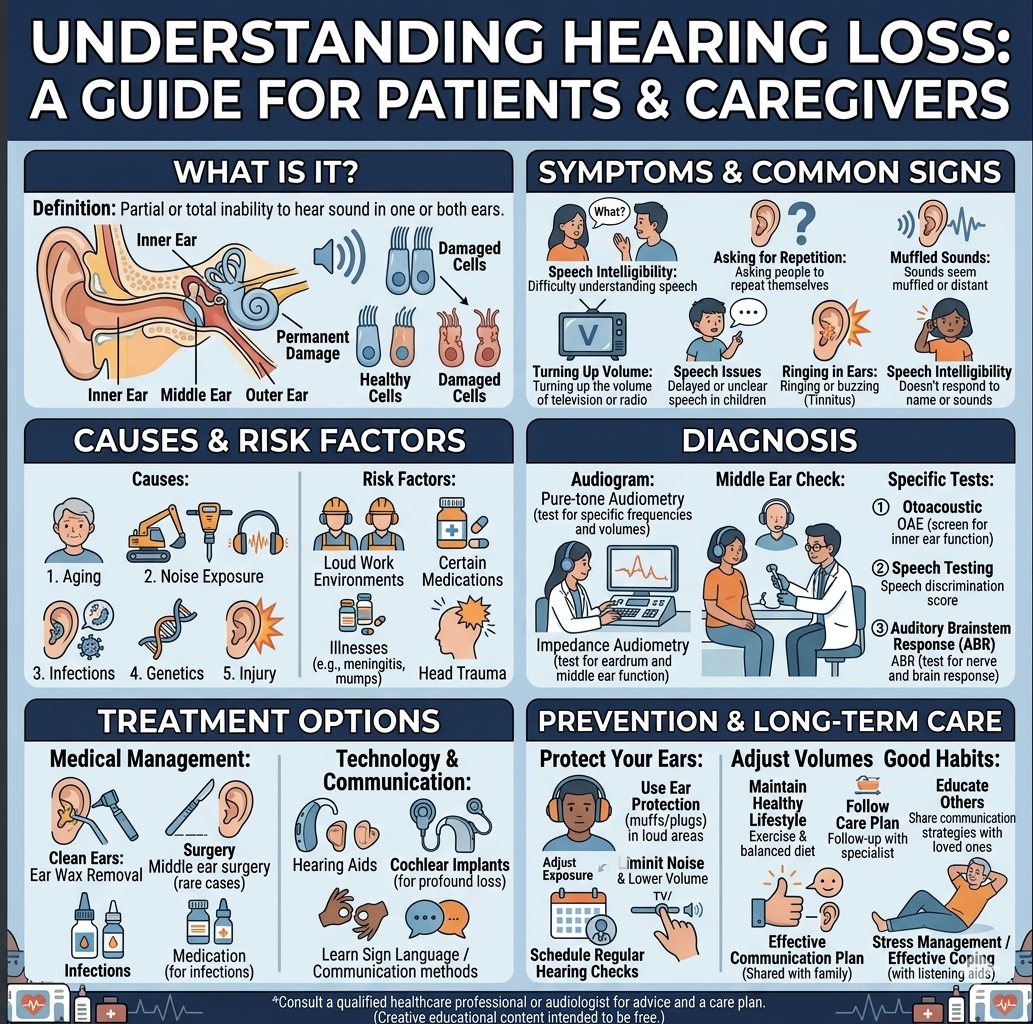
Hearing loss refers to a reduced ability to hear sounds. It is a common condition, especially as people age, with more than half of individuals over 75 experiencing some degree of age-related hearing decline, medically known as presbycusis. Hearing happens when sound waves travel through the outer ear, making the eardrum vibrate. These vibrations are amplified by three small bones in the middle ear and then move to the inner ear, where tiny hair cells convert them into electrical signals for the brain to interpret as sound. Hearing loss can be temporary or permanent and is broadly categorized into three types:* **Conductive hearing loss:** Occurs when sound waves cannot effectively reach the inner ear, often due to problems in the outer or middle ear.* **Sensorineural hearing loss:** Results from damage to the inner ear (cochlea) or the nerve pathways that carry sound signals to the brain.* **Mixed hearing loss:** A combination of both conductive and sensorineural hearing loss.While lost hearing typically cannot be fully restored, various treatments and strategies can significantly improve a person's ability to hear.
Understanding the Condition
Understanding Hearing Loss
Understanding the Condition
Common Symptoms
Muffled Sounds: Speech and other sounds may seem muffled or unclear.
Difficulty Understanding Speech: Struggling to understand spoken words, especially in noisy environments or when multiple people are talking.
Trouble with Consonants: Difficulty hearing high-pitched sounds or specific consonant sounds (like 's' or 'f'), making words hard to distinguish.
Frequent Requests for Repetition: Often asking others to speak more slowly, clearly, or loudly.
Increased Volume Needs: Needing to turn up the volume of the television, radio, or other audio devices to hear them.
Before your appointment, prepare a list of your symptoms, including when they started and how they affect your daily life. Note any recent illnesses, loud noise exposure, or medications you are taking (including over-the-counter drugs and supplements). Also, consider writing down any questions you have for the doctor or audiologist regarding your hearing, potential causes, and treatment options.
Book a doctor visit near me
Consultation Guide
Social Withdrawal: Avoiding social gatherings or conversations because hearing difficulties make them challenging or frustrating.
Annoyance by Background Noise: Finding background noise particularly bothersome or making it even harder to hear conversations.
Ringing in the Ears (Tinnitus): Experiencing a ringing, buzzing, or hissing sound in the ears, which can sometimes accompany hearing loss.
Sudden Hearing Loss: A rapid loss of hearing, especially in just one ear, requires immediate medical attention.
Consultation Guide
Which Specialist to Meet
You should start by consulting your primary care doctor. They can often identify the cause of some temporary hearing loss, such as earwax blockage, or refer you to a specialist. For more complex or persistent hearing loss, you may be referred to an **audiologist** (a hearing healthcare professional who diagnoses and manages hearing loss and balance problems) or an **otolaryngologist** (an ENT doctor, a medical doctor who specializes in ear, nose, and throat conditions, including surgical options).
Preparations Before Your Visit
Earwax Removal: For conductive hearing loss caused by excessive earwax buildup, a doctor can safely remove the blockage. Sometimes, over-the-counter ear drops can soften earwax for easier removal, but professional removal is often safest. (Duration: Immediate relief after removal; drops may take a few days.)
Assistive Listening Devices: These include personal sound amplification products (PSAPs), telephone amplifiers, and TV listening devices, which can make specific sounds louder. (Duration: Used as needed, long-term.)
Hearing Aids: These small electronic devices amplify sound to make it louder and clearer. Modern hearing aids are digital and customizable, tailored to an individual's specific hearing loss pattern. They consist of a microphone to pick up sound, an amplifier to make it louder, a computer chip to process sound, and a speaker to deliver it to the ear. Many styles are available, including behind-the-ear, in-the-canal, and completely-in-the-canal options, often with rechargeable batteries. (Duration: Long-term use, typically worn daily. Devices typically last 3-7 years before needing replacement.)
Surgery for Conductive Hearing Loss: Surgical options can address certain causes of conductive hearing loss, such as repairing a ruptured eardrum (tympanoplasty), removing unusual bone growths or tumors in the middle ear, or correcting problems with the small bones of the middle ear. (Duration: Recovery time varies based on the specific procedure, typically weeks to months.)
Be Mindful of Recreational Noise: Activities like hunting, snowmobiling, motorcycling, or attending loud concerts can cause significant hearing damage. Always wear hearing protectors during these activities or take frequent breaks from the noise.
Regular Hearing Screenings: If you are frequently exposed to loud noises or have a family history of hearing loss, consider periodic hearing checks to detect any changes early and take steps to prevent further loss.
Long-Term Wellbeing & Management
Stay Socially Engaged: Hearing loss can lead to social isolation and depression. Actively participate in conversations, use communication strategies (e.g., facing the speaker, asking for clarification), and seek support groups to maintain social connections.
Address Related Health Risks: Hearing loss is linked to an increased risk of falls and cognitive decline (loss of thinking skills). Managing hearing loss through devices and therapies can potentially mitigate these risks and support overall brain health.
Regular Check-ups and Adjustments: If you use hearing aids or have cochlear implants, regular follow-up appointments with your audiologist are crucial to ensure optimal performance, make necessary adjustments, and address any changes in your hearing.
Educate Family and Friends: Inform those around you about your hearing challenges and how they can help facilitate communication, such as speaking clearly, facing you, and reducing background noise.
Diagnostic Procedures
A doctor will visually inspect your outer ear and eardrum using a special lighted instrument called an otoscope to check for blockages like earwax, infection, or structural issues.
What to Expect
The doctor will look inside your ear canal and at your eardrum. This is usually a quick and painless procedure, though you might feel a slight pressure if earwax is being examined.
Basic Hearing Screening (Tuning Fork Test)
A tuning fork test can help determine if hearing loss is conductive (related to the outer or middle ear) or sensorineural (related to the inner ear or nerve). A vibrating tuning fork is placed near your ear or on the bone behind your ear.
What to Expect
The doctor will strike a tuning fork and hold it at different positions, asking you to indicate when you hear the sound or stop hearing it. This helps compare how you hear sounds through air versus through bone.
Audiometry (Pure-Tone and Speech Tests)
This is a comprehensive hearing test conducted by an audiologist. You'll wear headphones in a soundproof booth, and different tones (pure-tone audiometry) and spoken words (speech audiometry) will be played at varying volumes into each ear. You respond by pressing a button or repeating words.
What to Expect
You will sit in a quiet booth wearing headphones. The audiologist will play a series of beeps, tones, and words at different pitches and loudness levels. You will be asked to signal when you hear a sound, or to repeat the words you hear. This test determines the softest sounds you can hear at various pitches and how well you understand speech.
This test measures how well your eardrum and middle ear are working. A small probe is placed in your ear canal to change the air pressure and measure the eardrum's movement.
What to Expect
A small, soft tip will be placed in your ear, which will create slight changes in air pressure. You might feel a gentle pressure or hear a brief tone. This test helps detect fluid in the middle ear, eardrum perforation, or problems with the middle ear bones.
Monitor Workplace Noise: If your job involves constant loud noise (e.g., farming, construction, factory work), ensure you use appropriate hearing protection and adhere to workplace safety guidelines. Regular hearing tests may be recommended.
Treatment Options
Hearing loss refers to a reduced ability to hear sounds. It is a common condition, especially as people age, with more than half of individuals over 75 experiencing some degree of age-related hearing decline, medically known as presbycusis. Hearing happens when sound waves travel through the outer ear, making the eardrum vibrate. These vibrations are amplified by three small bones in the middle ear and then move to the inner ear, where tiny hair cells convert them into electrical signals for the brain to interpret as sound. Hearing loss can be temporary or permanent and is broadly categorized into three types:* **Conductive hearing loss:** Occurs when sound waves cannot effectively reach the inner ear, often due to problems in the outer or middle ear.* **Sensorineural hearing loss:** Results from damage to the inner ear (cochlea) or the nerve pathways that carry sound signals to the brain.* **Mixed hearing loss:** A combination of both conductive and sensorineural hearing loss.While lost hearing typically cannot be fully restored, various treatments and strategies can significantly improve a person's ability to hear.
Home Remedies & Other Therapies
Cochlear Implants: For individuals with severe-to-profound sensorineural hearing loss who don't benefit from hearing aids, a cochlear implant may be an option. This surgically implanted electronic device bypasses damaged parts of the inner ear and directly stimulates the hearing nerve, sending electrical signals to the brain. (Duration: Permanent implant. Requires a recovery period after surgery (several weeks) and extensive rehabilitation (months to years) to learn to interpret the new sounds.)
Surgical Procedures
Prevention & Long-Term Wellbeing
Prevention
Protect Your Ears from Loud Noise: Avoiding exposure to dangerously loud sounds is the most effective way to prevent noise-induced hearing loss. Use earplugs or noise-canceling earmuffs when exposed to loud environments, such as concerts, sporting events, construction sites, or when using power tools. Turn down the volume when listening to music, especially through headphones.
Tags & Topics
Notice an error or need an update?
Help us keep medical information accurate. Report incorrect info or suggest an edit.


