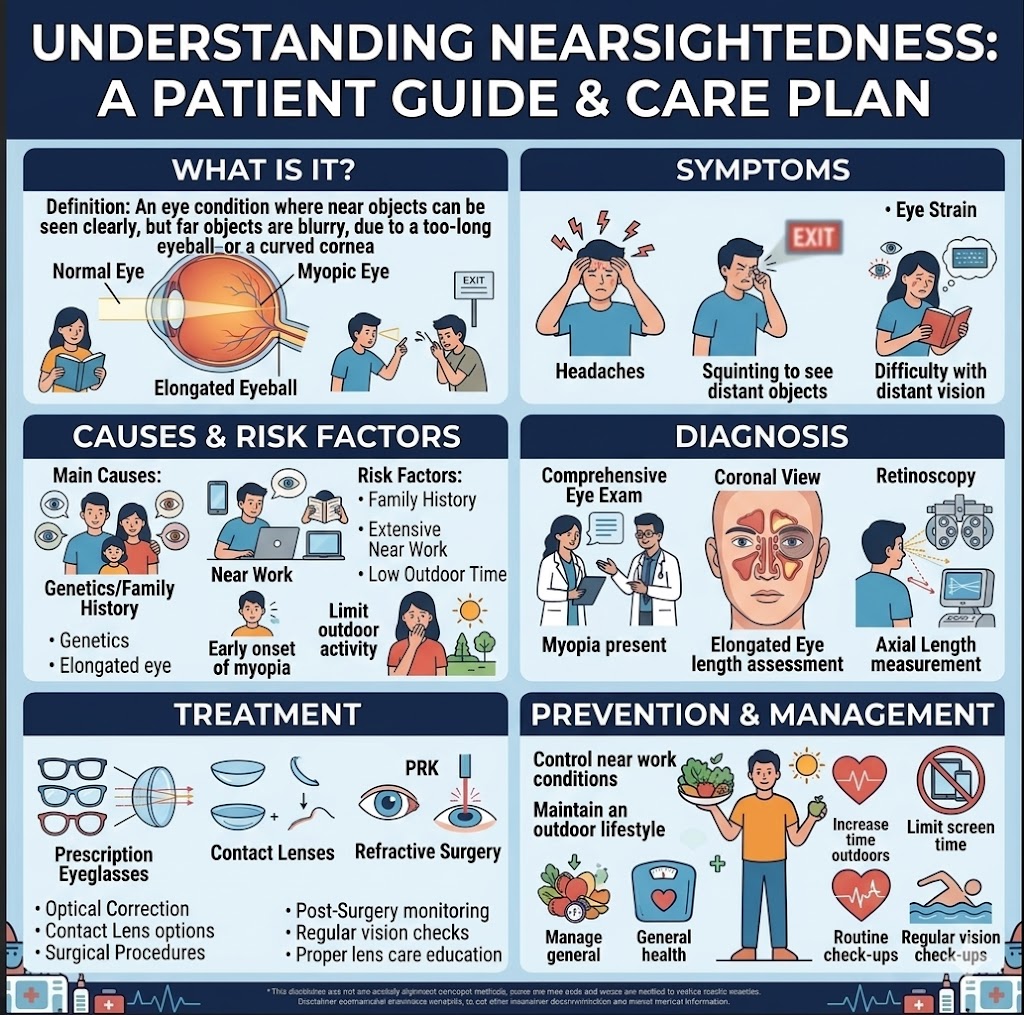
Nearsightedness, also called myopia, is a common vision condition where objects close by look clear, but distant objects appear blurry. This happens because the eye's shape, or parts of it, cause light rays to focus in front of the retina (the light-sensitive tissue at the back of the eye) instead of directly on it. Myopia typically develops during childhood or adolescence, often stabilizing in early adulthood. It often runs in families and can be corrected with glasses, contact lenses, or surgery.
Understanding the Condition
Nearsightedness (Myopia): Understanding Blurry Distant Vision
Understanding the Condition
Common Symptoms
Distant Objects Appear Blurry: Difficulty seeing things far away, like road signs, movie screens, or school whiteboards.
Frequent Squinting: Partially closing eyelids to try and see more clearly, which can also lead to eye strain.
Eye Strain and Headaches: Often experienced due to the effort of trying to focus on distant objects.
For Children: Children may not be aware of blurry vision, but might sit very close to screens, hold books close, blink or rub their eyes often, or seem unaware of distant objects. School-age children might struggle with schoolwork related to seeing the board or projected images.
Night Myopia: Blurry vision specifically in dim light, such as while driving at night, even if daytime vision is clear.
Consultation Guide
Which Specialist to Meet
Before your visit, bring any current eyeglasses or contact lenses you use. Prepare a list of any vision symptoms you've experienced, your medical history, current medications, and any questions you have for the doctor.
Book a doctor visit near me
Monitor for Complications: Be aware of symptoms that could indicate serious eye problems associated with severe nearsightedness, such as sudden flashes of light, new 'floaters', or a shadow or 'curtain' in your vision (signs of retinal detachment). Seek immediate medical attention if these occur.
Consultation Guide
Nearsightedness, also called myopia, is a common vision condition where objects close by look clear, but distant objects appear blurry. This happens because the eye's shape, or parts of it, cause light rays to focus in front of the retina (the light-sensitive tissue at the back of the eye) instead of directly on it. Myopia typically develops during childhood or adolescence, often stabilizing in early adulthood. It often runs in families and can be corrected with glasses, contact lenses, or surgery.
Drops will be put into your eyes, which will cause your pupils to enlarge after about 20-30 minutes. Your vision will be blurry and light-sensitive for several hours, so plan for someone to drive you home and bring sunglasses.
Corneal Topography / Keratometry
Diagnostic Procedures
You should consult an eye care specialist. An optometrist provides primary vision care, including eye exams and prescribing corrective lenses. An ophthalmologist is a medical doctor who specializes in eye and vision care, performing eye exams, diagnosing and treating eye diseases, and performing eye surgery.
Preparations Before Your Visit
Comprehensive Eye Exam
A series of tests to evaluate your overall eye health and vision, which can confirm nearsightedness.
What to Expect
This typically involves checking your vision (visual acuity), determining your exact prescription (refraction test), and examining the front and back structures of your eye.
This test measures how clearly you see by asking you to read letters from a chart placed at a standard distance.
What to Expect
You will sit or stand at a specific distance from a chart and read lines of letters, usually with one eye covered at a time.
This test helps your eye doctor determine the precise lens prescription needed to correct your vision using a device with various lenses.
What to Expect
You will look through a device while the doctor switches different lenses in front of your eyes, asking which lens combination makes the letters on the chart clearest.
Slit-Lamp Examination
A microscope with a bright light, called a slit lamp, is used to examine the cornea, iris, and lens at the front of your eye in detail for any abnormalities.
What to Expect
You'll rest your chin and forehead on supports on the slit lamp. The doctor will shine a light into your eye and look through the microscope. This test is painless.
Eye drops are used to widen (dilate) your pupils, allowing the doctor a clearer view of the retina, optic nerve, and blood vessels at the back of your eye to check for underlying health issues.
What to Expect
These tests measure the curvature and shape of your cornea, the clear front surface of your eye, creating a detailed map. This is crucial for contact lens fitting and planning refractive surgery.
What to Expect
You will place your chin on a rest and look into a device. A light will be projected onto your eye, and its reflection will be analyzed. The test is quick and painless.
Treatment Options
Eyeglasses: Lenses crafted to bend light and focus it correctly onto your retina, providing clear distant vision. Available in various styles and materials. (Duration: Worn as needed, either continuously or for specific tasks like driving. Prescriptions are typically updated annually or biennially.)
Contact Lenses: Thin, small lenses placed directly on the surface of the eye to correct vision. They offer a wider field of view than glasses. (Duration: Worn daily, extended wear, or replaced periodically (e.g., daily, weekly, monthly) as prescribed. Requires proper cleaning and care.)
Refractive Surgical Procedures
LASIK Eye Surgery (Laser-Assisted In Situ Keratomileusis): A common laser eye surgery where a surgeon creates a thin flap on the cornea, reshapes the underlying corneal tissue with a laser to correct the eye's focusing power, and then repositions the flap. (Duration: The procedure itself takes only minutes per eye. Recovery involves a few days for initial healing, with vision stabilizing over several months. Effects are generally long-lasting.)
Other Laser Surgeries (e.g., PRK): Similar to LASIK, these procedures (like Photo Refractive Keratectomy) use a laser to reshape the cornea. The main difference lies in how the outer corneal layer is managed before laser treatment. (Duration: Minutes per eye. Recovery varies; PRK generally has a longer initial recovery than LASIK (days to a week), with vision improving over weeks to months. Effects are permanent.)
Implantable Lenses (Phakic Intraocular Lenses): A small, flexible, corrective lens is surgically placed inside the eye, in front of the natural lens, to enhance focus. This is often an option for individuals with very high nearsightedness or thin corneas unsuitable for laser surgery. (Duration: The procedure takes about 15-30 minutes per eye. Vision often improves rapidly, sometimes within a day. The implant is designed to be permanent but can be removed if needed.)
Myopia Control Therapies (Primarily for Children to Slow Progression)
Low-Dose Atropine Eye Drops: Daily eye drops used to help relax the focusing mechanism of the eye, which can slow the progression of nearsightedness in children. (Duration: Typically prescribed for several years, depending on the child's age and progression rate, under regular monitoring.)
Orthokeratology (Ortho-K): Special rigid contact lenses worn overnight to gently and temporarily reshape the cornea. When removed in the morning, the corrected corneal shape provides clear vision throughout the day without glasses or contacts. (Duration: Worn nightly. Requires daily cleaning and regular replacement of lenses as per schedule (usually annually).)
Specialty Multifocal Lenses (Glasses or Contacts): These lenses are designed with different powers in various areas to help reduce eye strain and control the progression of myopia in children. (Duration: Worn daily, similar to regular corrective lenses. Prescription adjustments are made as needed, typically over several years during childhood and adolescence.)
Prevention & Long-Term Wellbeing
Prevention
Increase Outdoor Time: Encourage children and adolescents to spend more time outdoors (at least 90 minutes daily), as exposure to natural light may help reduce the risk of nearsightedness development and progression.
Manage Close-Up Activities: Limit prolonged periods of reading, screen use, or other near-vision tasks. Take regular breaks using the 20-20-20 rule: every 20 minutes, look at something 20 feet away for 20 seconds.
Regular Eye Exams: Schedule comprehensive eye exams for children starting from infancy and continuing throughout school-age years to detect and manage nearsightedness early.
Long-Term Monitoring and Management
Adhere to Corrective Prescriptions: Wear eyeglasses or contact lenses as prescribed and ensure your prescriptions are up-to-date through regular eye exams.
Proper Lens Care: Follow strict hygiene guidelines for contact lenses to prevent infections and maintain eye health.
Maintain General Eye Health: Protect your eyes from harmful UV light with sunglasses, eat a balanced diet rich in eye-healthy nutrients (e.g., leafy greens, fish), and avoid smoking.
Tags & Topics
Notice an error or need an update?
Help us keep medical information accurate. Report incorrect info or suggest an edit.


