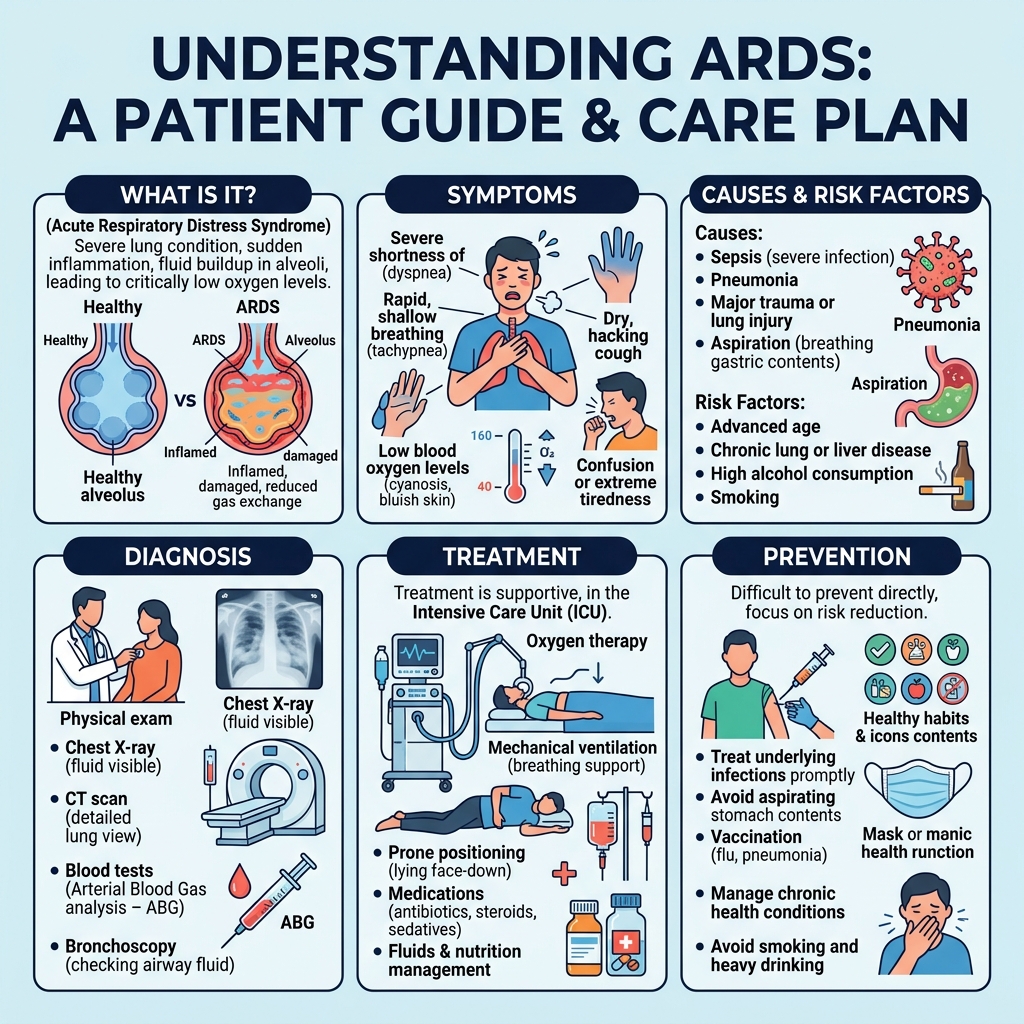
Acute Respiratory Distress Syndrome (ARDS) is a severe lung condition where the lungs become inflamed, causing fluid to leak into the tiny air sacs (alveoli). This fluid prevents enough oxygen from entering the bloodstream, depriving vital organs of the oxygen they need to function. ARDS typically affects individuals who are already critically ill or severely injured, often developing within hours to days of the initial event. It is a life-threatening condition; while some survivors recover fully, many experience lasting lung damage or other long-term health challenges.
Understanding the Condition
Acute Respiratory Distress Syndrome (ARDS)
Understanding the Condition
Acute Respiratory Distress Syndrome (ARDS) is a severe lung condition where the lungs become inflamed, causing fluid to leak into the tiny air sacs (alveoli). This fluid prevents enough oxygen from entering the bloodstream, depriving vital organs of the oxygen they need to function. ARDS typically affects individuals who are already critically ill or severely injured, often developing within hours to days of the initial event. It is a life-threatening condition; while some survivors recover fully, many experience lasting lung damage or other long-term health challenges.
Common Symptoms
Severe Shortness of Breath: Extreme difficulty breathing, often feeling like you cannot get enough air.
Labored and Rapid Breathing: Breathing that is unusually fast, shallow, and requires significant effort.
Chest Discomfort: Pain, tightness, or a heavy sensation in the chest.
Fast Heart Rate: The heart beating significantly quicker than its usual rhythm.
Confusion and Extreme Tiredness: Mental fogginess, difficulty thinking clearly, and profound exhaustion.
Consultation Guide
Which Specialist to Meet
If you are experiencing symptoms suggestive of ARDS, you will likely be cared for by critical care specialists, often in an intensive care unit (ICU). Pulmonologists (lung specialists) are also key members of the care team. For initial sudden or severe breathing issues, immediate emergency medical attention is necessary.
Preparations Before Your Visit
A quick and painless test that records the electrical signals of your heart. It helps assess your heart's rhythm and rate, and can detect signs of a heart attack or other heart problems that might contribute to or mimic ARDS symptoms, ensuring proper cardiac function during treatment.
Medications: Various medications may be used, including antibiotics to treat underlying infections, sedatives to keep patients comfortable on the ventilator, and potentially other drugs to manage inflammation or support heart function. (Duration: As needed, based on specific symptoms and underlying causes, typically during hospitalization.)
Prone Positioning: Turning the patient onto their stomach for several hours a day. This position can help distribute air and blood more evenly in the lungs, improving oxygen levels and lung function. (Duration: Periodically throughout the critical phase, as determined by the medical team, often for 12-18 hours at a time.)
Regular Medical Follow-up: Ongoing appointments with pulmonologists and other specialists to monitor lung function, address lingering symptoms, and manage potential long-term complications, ensuring continuous care.
Consultation Guide
You will lie on a motorized table that slides into a large, donut-shaped machine. You may hear humming or buzzing noises. You might be asked to hold your breath at certain times. Sometimes, a contrast dye is injected into a vein to highlight specific areas, which might cause a warm sensation or a metallic taste. The procedure usually takes 10-30 minutes.
A non-invasive test that uses sound waves (ultrasound) to create live images of your heart. It shows the heart's chambers and valves and how blood flows through them, helping to assess heart function and rule out heart-related causes of breathing problems that might mimic or worsen ARDS.
Diagnostic Procedures
A common imaging test that uses a small amount of radiation to create pictures of your heart, lungs, blood vessels, airways, and the bones of your chest and spine. It helps detect issues like fluid in or around the lungs, a collapsed lung, or inflammation, which are characteristic of ARDS.
What to Expect
You will stand or sit in front of an X-ray plate, and a technician will ask you to hold your breath for a few seconds while the images are taken. It is a quick and generally painless procedure. You may need to remove jewelry or clothing with metal fasteners before the test.
CT Scan (Computerized Tomography Scan)
A more detailed imaging test that combines multiple X-ray images taken from different angles. A computer then processes these images to create cross-sectional 'slices' of your body, showing bones, blood vessels, and soft tissues with greater clarity than a standard X-ray, allowing for a more precise assessment of lung damage.
What to Expect
What to Expect
You will lie on an exam table. A technician will apply a special gel to your chest and then move a device called a transducer over your chest. This transducer sends and receives sound waves. You may be asked to change positions or hold your breath briefly. The test is generally painless and takes about 30-60 minutes.
Electrocardiogram (ECG or EKG)
What to Expect
Sticky patches called electrodes will be attached to your chest and sometimes your arms and legs. Wires connect these patches to a machine that records your heart's electrical activity. You will lie still for a few minutes. The test is quick, typically taking about 5-10 minutes, and involves no discomfort.
Treatment Options
Given that ARDS often strikes critically ill individuals, direct preparation may not always be possible. If conscious and able, be ready to provide your medical history, a list of any medications you are taking, and details about your current illness or injury. Family members may need to provide this information on your behalf if you are unable.
Book a doctor visit near me
Supportive Care and Procedures
Mechanical Ventilation: A breathing machine (ventilator) delivers oxygen and helps the lungs work by gently pushing air into them through a tube inserted into the windpipe. This supports breathing and allows the lungs to rest and heal. (Duration: Typically for the duration of the severe lung injury, which can range from several days to weeks, or even longer in severe cases, until lung function improves.)
Fluid Management: Careful management of intravenous fluids to ensure vital organs are nourished without adding too much fluid to the lungs, which could worsen swelling. (Duration: Throughout the critical phase of illness, adjusted daily based on the patient's condition.)
Aggressive Management of Underlying Conditions: Prompt and effective treatment of severe infections (like sepsis or pneumonia) or serious injuries is crucial to prevent ARDS from developing or worsening.
Avoidance of Lung Irritants: Limiting exposure to smoke, chemical fumes, and other harmful substances can reduce the risk of lung injury. Quitting smoking and moderating alcohol intake are also important for overall lung health.
Pulmonary Rehabilitation: Structured exercise and education programs designed to improve lung function, reduce breathing difficulties, and enhance overall quality of life for those recovering from ARDS and persistent lung issues.
Psychological Support: Seeking help for depression, anxiety, or post-traumatic stress disorder (PTSD) that can follow critical illness like ARDS. Counseling, support groups, and sometimes medication can be beneficial.
Cognitive Rehabilitation: Strategies and exercises, often guided by neuropsychologists or occupational therapists, to address memory, attention, and thinking problems that can occur after ARDS due to low oxygen levels or sedatives.
Prevention & Long-Term Wellbeing
Extracorporeal Membrane Oxygenation (ECMO): For very severe cases where traditional ventilation isn't enough, ECMO acts as an artificial lung and heart outside the body. Blood is pumped out, oxygenated, carbon dioxide is removed, and then the blood is returned to the body, allowing the patient's lungs and heart to rest and recover. (Duration: Can range from a few days to several weeks, depending on the severity of lung damage and recovery progress.)
Rehabilitation: Once stable, patients begin physical therapy, occupational therapy, and speech therapy to regain strength, mobility, and function lost during critical illness and prolonged bed rest. (Duration: Starts in the hospital and continues for weeks to months after discharge, often in an outpatient setting or at home.)
Prevention and Long-Term Wellbeing
Nutritional Support: Maintaining a healthy, balanced diet to support overall recovery, boost the immune system, and help rebuild muscle strength, which can be significantly impacted by prolonged illness and hospitalization.
Tags & Topics
Notice an error or need an update?
Help us keep medical information accurate. Report incorrect info or suggest an edit.


