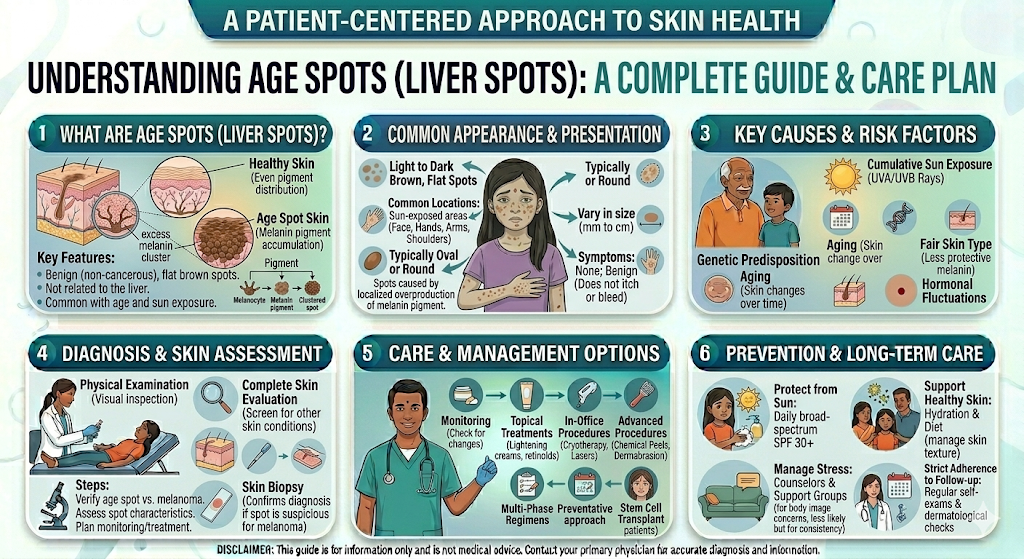
Age spots are flat, dark areas that appear on the skin. They are commonly called sunspots or solar lentigines, though they are also sometimes referred to as liver spots. These spots vary in size and usually show up on parts of the body that get the most sun exposure, such as the face, hands, shoulders, and arms.
Understanding the Condition
Age spots are flat, dark areas that appear on the skin. They are commonly called sunspots or solar lentigines, though they are also sometimes referred to as liver spots. These spots vary in size and usually show up on parts of the body that get the most sun exposure, such as the face, hands, shoulders, and arms.
Consultation Guide
Age spots are a common result of a lifetime of sun exposure, particularly in adults over 50, but they can affect younger people who spend a lot of time in the sun. If your skin tends to sunburn easily, you are more likely to develop them. Age spots are essentially a way your skin tries to protect itself from further sun damage. They do not require medical treatment, but because they can sometimes resemble cancerous growths, it is important to have any new or changing spots checked by a doctor. For cosmetic reasons, age spots can be lightened or removed. Unlike freckles, age spots do not fade away without sun exposure.
You should consult a doctor who specializes in skin conditions, such as a dermatologist or a dermatologic surgeon.
When to See a Specialist: While true age spots are harmless, you should have any new skin changes evaluated by a doctor. This is especially important if a spot is black or has changed in appearance, as these changes can be signs of melanoma, a serious form of skin cancer.
Preparations Before the Visit: Note any new or changing skin spots, especially if a spot grows, changes color, or begins to bleed.
Book a doctor visit near me
Diagnostic Procedures
Diagnostics: Detailed Description of Procedures
A doctor can often diagnose age spots simply by looking at your skin. However, to rule out more serious conditions like skin cancer (melanoma), a small sample of the spot may be removed and tested in a lab. This procedure is called a skin biopsy.
A skin biopsy is a procedure where cells or a small sample of skin tissue are removed from your body so they can be examined in a laboratory.
What to Expect
The type of biopsy used depends on the size and location of the area being tested. The doctor will numb the area so you do not feel pain during the procedure.
Shave Biopsy: The doctor uses a scalpel or razor blade to gently scrape off the surface layer of the skin. The goal is to remove the irregular tissue for lab testing. Stitches are usually not needed.
Punch Biopsy: A round-tipped cutting tool is used to remove a deeper layer of skin tissue for testing. Stitches may be needed to close the wound, depending on the size of the sample.
Excisional Biopsy: A scalpel is used to cut out the entire irregular area of skin, along with a small amount of surrounding healthy skin. Stitches are generally required to close the wound.
Disclaimer: This article provides general health information and is not intended to be a substitute for professional medical advice, diagnosis, or treatment. Always consult your treating physician or another qualified healthcare provider with any questions you may have regarding a medical condition.
To report an error in the article, please send an email to errors@medicalwriter.com.
Treatment Options
True age spots do not require treatment, but if you want to lighten or remove them for cosmetic reasons, several options are available.
Skin Lightening Products: Topical products may be prescribed or recommended to help lighten the spots. These typically work by improving skin tone and texture. Duration: Requires regular use for a period of weeks or months before any improvement is noticed.
Procedures and Therapies
Laser Resurfacing: This procedure uses an energy-based device to break down the pigment in the age spots and improve the overall look and feel of the skin. It can be done using various devices and methods, often with a fractional laser which shortens recovery time and reduces the risk of side effects. Duration: You will likely need more than one treatment session.
Surgical Procedures
Excisional Removal (Used for Suspicious Lesions): For suspicious lesions that may be pre-cancerous, the entire spot may be surgically cut out along with a small margin of surrounding healthy skin. Duration: Stitches are typically required to close the wound and allow it to heal.
Prevention & Long-Term Wellbeing
Home Remedies and Prevention
Consistent Sun Protection: This is the most important step for preventing age spots and keeping them from getting worse. You should regularly use sunscreen and avoid the sun, especially during the peak hours of the day. Duration: Ongoing and indefinite.
Chemical Peel: A chemical solution is applied to the skin to remove the top layers, resulting in smoother skin. The depth of the peel can vary from light to deep. Duration: Light or medium peels may require more than one session to achieve desired results. Deeper peels provide more dramatic results but require a longer recovery time.
Dermabrasion: A fast-spinning tool is used to gently scrape off the top layer of skin. As the skin heals, the new layer that grows back is typically smoother, making the spots less noticeable. Duration: Your skin will be discolored and highly sensitive for a few weeks. The skin usually returns to its typical color in about three months.
Tags & Topics
Notice an error or need an update?
Help us keep medical information accurate. Report incorrect info or suggest an edit.


