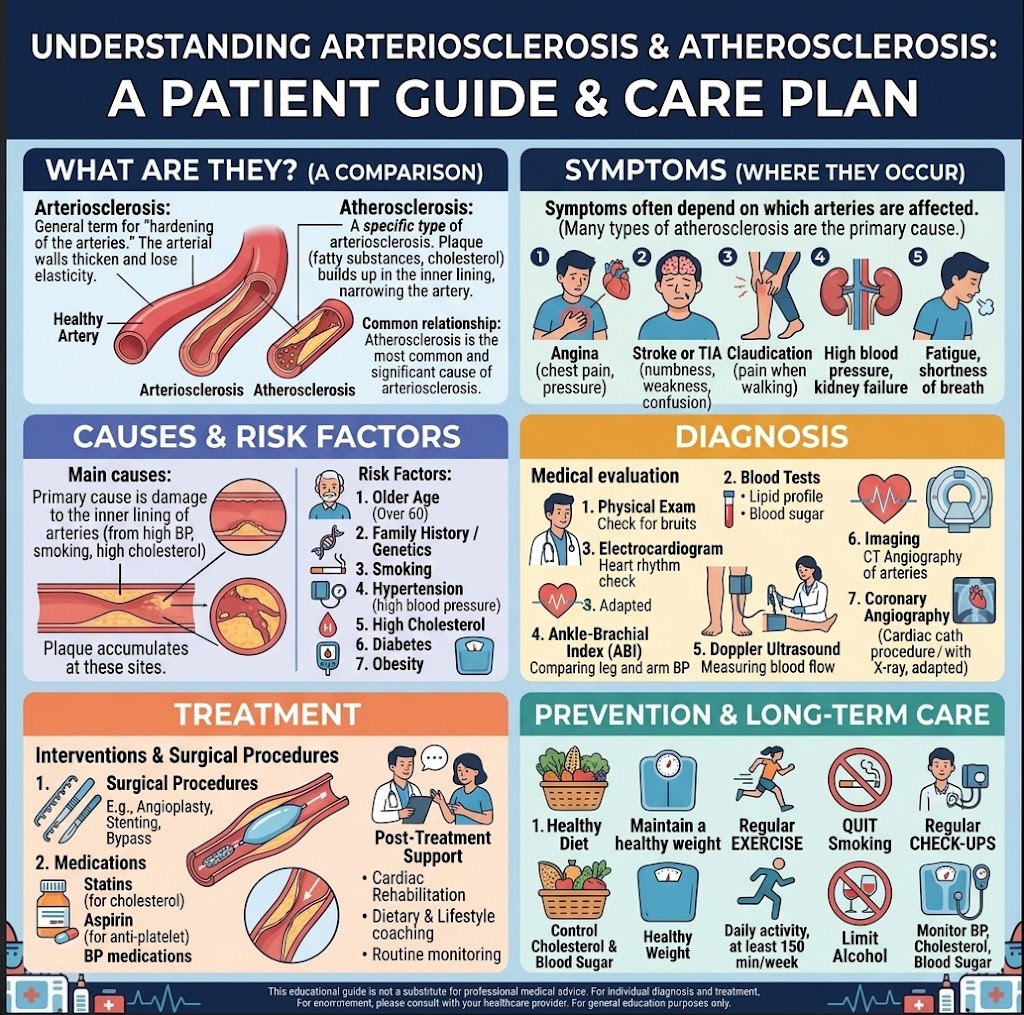
Arteriosclerosis is a general term for when arteries, the blood vessels carrying oxygen and nutrients from your heart to your body, become thick and stiff. Normally, arteries are flexible. When their walls harden, it's often called "hardening of the arteries." Atherosclerosis is a specific and common type of arteriosclerosis. It involves the buildup of fatty substances, cholesterol, and other materials on and within the artery walls, forming what is known as plaque. This plaque can narrow arteries, restricting blood flow. It can also rupture, leading to blood clots that further block blood flow or travel to other parts of the body. While frequently associated with the heart, atherosclerosis can affect arteries anywhere in the body. It is a treatable condition, and healthy lifestyle choices are key to its prevention.
Understanding the Condition
Artery Hardening and Plaque Buildup: Understanding Atherosclerosis
Understanding the Condition
Arteriosclerosis is a general term for when arteries, the blood vessels carrying oxygen and nutrients from your heart to your body, become thick and stiff. Normally, arteries are flexible. When their walls harden, it's often called "hardening of the arteries." Atherosclerosis is a specific and common type of arteriosclerosis. It involves the buildup of fatty substances, cholesterol, and other materials on and within the artery walls, forming what is known as plaque. This plaque can narrow arteries, restricting blood flow. It can also rupture, leading to blood clots that further block blood flow or travel to other parts of the body. While frequently associated with the heart, atherosclerosis can affect arteries anywhere in the body. It is a treatable condition, and healthy lifestyle choices are key to its prevention.
Common Symptoms
Mild Stages: Atherosclerosis typically causes no symptoms when it is mild.
Advanced Stages: Symptoms usually appear only when an artery becomes significantly narrowed or blocked, reducing blood flow to organs and tissues. A blood clot can also suddenly block flow. If in Heart Arteries (Coronary Artery Disease): You may experience chest pain or pressure, known as angina. If in Brain Arteries (Carotid Artery Disease): Symptoms might include sudden numbness or weakness in an arm or leg, difficulty speaking or slurred speech, temporary vision loss in one eye, or facial muscle drooping. These are signs of a transient ischemic attack (TIA), which is a warning for a stroke. If in Arm and Leg Arteries (Peripheral Artery Disease - PAD): You might feel leg pain during walking, called claudication. Blood pressure in the affected limb may also be lower. If in Kidney Arteries: Can lead to high blood pressure or, over time, kidney failure.
Emergency Symptoms: Seek immediate medical help for chest pain or symptoms resembling a TIA or stroke, such as sudden numbness/weakness in limbs, speech difficulties, sudden vision loss, or facial drooping.
Consultation Guide
Which Specialist to Meet
You should first consult your primary care physician. Depending on symptoms and test results, you may be referred to specialists such as a cardiologist (heart), neurologist (brain/stroke), vascular specialist (blood vessels throughout the body), or nephrologist (kidney).
Preparations Before Your Visit
Before your visit, prepare a detailed list of your symptoms, including when they started and how often they occur. Bring a complete list of all medications, supplements, and vitamins you are taking. Be ready to discuss your medical history, including any family history of heart disease or stroke, and any lifestyle habits like diet and exercise. Prepare any questions you have for the doctor.
Book a doctor visit near me
Consultation Guide
Address Sleep Apnea: Seek diagnosis and treatment for sleep apnea, as it is a recognized risk factor.
Stress Reduction: Practice techniques like meditation or yoga to effectively manage stress, which can impact heart health.
Regular Check-ups: Attend routine medical check-ups to monitor risk factors and detect any issues early.
Diagnostic Procedures
Ankle-Brachial Index (ABI)
Compares ankle to arm blood pressure. A low ABI suggests narrowed or blocked leg arteries (Peripheral Artery Disease - PAD). Can be done with exercise.
What to Expect
Blood pressure cuffs are applied to arms and ankles. A healthcare professional uses a handheld ultrasound device to listen to blood flow for pressure readings while you lie flat. The test is quick and generally painless.
Cardiac Catheterization
A thin tube (catheter) is guided through a blood vessel to the heart for detailed imaging of arteries; it can also be used to open blockages.
What to Expect
Local anesthetic numbs an area (usually groin or wrist). The catheter is inserted and guided to the heart using X-rays. Dye may be injected to show vessels. You are typically awake but often sedated. Pressure might be felt, but no pain. The procedure takes 30 minutes to several hours.
CT Scan (Computed Tomography)
Uses X-rays and computer processing to create detailed cross-sectional images of internal structures, aiding diagnosis of blockages or damage.
What to Expect
You lie on a table that slides into a large, ring-shaped scanner. You may hear humming. You might be asked to hold your breath briefly. Contrast dye might be given intravenously or orally. The scan is painless and typically takes 10-30 minutes.
Electrocardiogram (ECG or EKG)
Records the heart's electrical signals to check its rhythm and rate; it helps detect heart attacks or irregular beats.
What to Expect
Sticky electrode patches are placed on your chest (and sometimes limbs) and connect to a machine. You simply lie still for a few minutes. The test is quick and painless.
What to Expect
You are monitored with electrodes and a blood pressure cuff during exercise. If you are unable to exercise, medication simulates the effects. Your heart rate, blood pressure, and breathing are continuously monitored. The active part of the test usually lasts 10-15 minutes.
Uses sound waves to create real-time images of internal structures and blood flow; it helps identify blockages or arterial wall changes.
What to Expect
A gel is applied to the skin over the area being examined. A handheld device (transducer) is moved over the area, sending and receiving sound waves. You will feel slight pressure from the transducer. The procedure is painless and usually takes 15-45 minutes.
Treatment Options
Shows how your heart functions during physical activity (e.g., treadmill or bike) or with medication. It reveals blood flow problems under strain.
Medications
Cholesterol-lowering Medications: To reduce 'bad' cholesterol levels and help stabilize plaque. (Duration: Long-term)
Blood Pressure Medications: To lower and control high blood pressure, reducing stress on arteries. (Duration: Long-term)
Blood-thinning Medications: To reduce the risk of blood clots forming. (Duration: Long-term)
Blood Sugar Control Medications: For individuals with diabetes, to manage blood sugar levels. (Duration: Long-term)
Medical Procedures and Surgeries
Angioplasty and Stent Placement: A balloon-tipped catheter is used to widen a blocked artery, often followed by placing a small mesh tube (stent) to keep it open. (Duration: Stent is permanent; procedure is one-time, with potential for repeat if new blockages form.)
Bypass Surgery: A surgical procedure to create a new path for blood flow around a blocked artery, using a healthy blood vessel from another part of the body. (Duration: Surgical solution, grafts can last many years; typically a one-time major surgery.)
Endarterectomy: Surgical removal of plaque from the inner lining of an artery, commonly performed on carotid arteries in the neck. (Duration: Surgical solution; typically a one-time procedure for a specific blockage.)
Thrombolytic Therapy: Medications administered to dissolve existing blood clots during an emergency. (Duration: Short-term, acute treatment)
Manage Chronic Conditions: Work closely with your doctor to control high blood pressure, high cholesterol, and diabetes through lifestyle and medication.
Prevention & Long-Term Wellbeing
Lifestyle Changes
Healthy Diet: Prioritize fruits, vegetables, whole grains, lean proteins, and healthy fats. Limit unhealthy fats, cholesterol, sodium, and added sugars. (Duration: Ongoing)
Regular Exercise: Aim for at least 150 minutes of moderate-intensity or 75 minutes of vigorous aerobic activity weekly. (Duration: Ongoing)
Weight Management: Achieve and maintain a healthy body weight to reduce cardiovascular strain. (Duration: Ongoing)
Smoking Cessation: Permanently stop all tobacco use, as it significantly damages arteries. (Duration: Permanent)
Prevention and Long-Term Monitoring
Quit Smoking: Eliminate all tobacco use, as it severely damages arteries and accelerates plaque buildup.
Balanced Nutrition: Adopt a diet rich in fruits, vegetables, whole grains, and lean proteins; low in unhealthy fats, cholesterol, and processed foods.
Regular Physical Activity: Engage in consistent exercise to strengthen the heart and improve blood circulation.
Maintain Healthy Weight: Manage body weight to lessen the strain on your cardiovascular system.
Tags & Topics
Notice an error or need an update?
Help us keep medical information accurate. Report incorrect info or suggest an edit.

