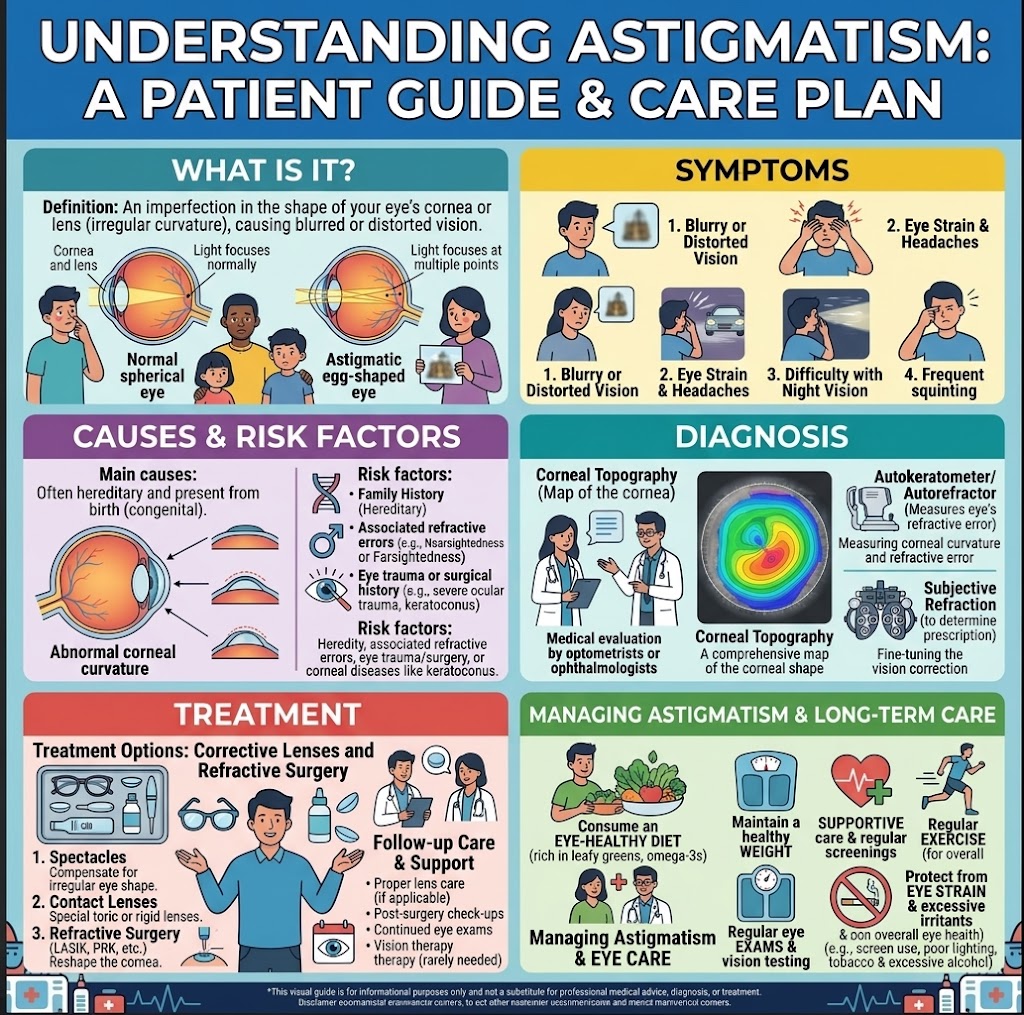
Astigmatism (pronounced "uh-STIG-muh-tiz-um") is a common and usually treatable eye condition that causes blurry or distorted vision at all distances. It happens when the front surface of the eye (cornea) or the lens inside the eye has an irregular, egg-like curve instead of a perfectly round shape like a ball. This irregular shape prevents light from bending evenly, causing images to focus incorrectly on the back of the eye and resulting in blurred vision. Astigmatism is often present from birth and can occur with nearsightedness or farsightedness. While mild cases may not need correction, more significant astigmatism can be effectively managed with corrective lenses or surgical procedures.
Understanding the Condition
Astigmatism: Understanding and Correcting Blurred Vision
Understanding the Condition
Common Symptoms
Blurry or Distorted Vision: Images appear unclear or stretched at all distances (near and far).
Eyestrain or Discomfort: A feeling of tiredness or strain in the eyes, often after reading or screen use.
Headaches: Frequent headaches, particularly after visual tasks.
Difficulty with Night Vision: Glare, halos, or starbursts around lights, especially at night.
Squinting: Habitually narrowing the eyes to try and see more clearly.
Consultation Guide
Which Specialist to Meet
If you experience symptoms affecting your daily life, consult an eye care professional. This could be an optometrist, who provides comprehensive vision exams and prescribes corrective lenses, or an ophthalmologist, who is a medical doctor specializing in eye diseases and surgery.
Preparations Before Your Visit
Before your visit, prepare by noting any vision changes, symptoms you've experienced, and any existing medical conditions or medications you take. Bring your current eyeglasses or contact lenses if you use them. Also, be ready to discuss your daily activities and how your vision impacts them.
Book a doctor visit near me
Awareness of Vision Changes: Pay attention to any new or worsening symptoms like increased blurriness, headaches, or difficulty seeing at night, and report them to your eye care professional promptly.
Consultation Guide
Astigmatism (pronounced "uh-STIG-muh-tiz-um") is a common and usually treatable eye condition that causes blurry or distorted vision at all distances. It happens when the front surface of the eye (cornea) or the lens inside the eye has an irregular, egg-like curve instead of a perfectly round shape like a ball. This irregular shape prevents light from bending evenly, causing images to focus incorrectly on the back of the eye and resulting in blurred vision. Astigmatism is often present from birth and can occur with nearsightedness or farsightedness. While mild cases may not need correction, more significant astigmatism can be effectively managed with corrective lenses or surgical procedures.
Diagnostic Procedures
This common test measures how clearly you see by reading letters or symbols on a chart from a specific distance.
What to Expect
You will sit or stand at a set distance from an eye chart and cover one eye at a time, reading the smallest line of letters you can see.
Used to determine your exact prescription for eyeglasses or contact lenses. The doctor uses a device with various lenses to find which ones sharpen your vision best.
What to Expect
You will look through a mask-like device (phoropter) with different lens combinations while focusing on an eye chart. You'll be asked which lens makes the letters clearer.
This test measures the curvature of the cornea, the clear front surface of your eye. It helps detect irregularities in its shape.
What to Expect
You will place your chin on a rest and look into a machine. A light ring is projected onto your cornea, and the instrument measures how the light is reflected to determine the curve.
Provides a detailed, three-dimensional map of your cornea's surface, revealing subtle irregularities and exact measurements of its curvature.
What to Expect
You will sit with your chin on a rest and look at a target light. The instrument projects a series of illuminated rings onto your cornea and uses a camera to capture detailed images, creating a precise map of its surface.
Treatment Options
Eyeglasses: Lenses specially ground to correct the irregular curvature of the eye, helping light focus properly. (Duration: Used as needed, often daily.)
Contact Lenses: Small, thin lenses worn directly on the eye to correct vision. Toric contact lenses are specifically designed for astigmatism. (Duration: Daily or extended wear, as prescribed by an eye care professional.)
Surgical Procedures
Prevention & Long-Term Wellbeing
Laser Vision Correction (e.g., LASIK, PRK): These procedures use a precise laser to reshape the cornea, the front surface of the eye, permanently correcting its irregular curvature. In LASIK, a thin flap is created on the cornea before reshaping; in PRK, the outer layer is removed and allowed to regrow after reshaping. (Duration: A single procedure with a recovery period of several days to weeks, providing long-term or permanent vision correction.)
Prevention and Long-Term Monitoring
Regular Eye Exams: Schedule comprehensive eye examinations at recommended intervals, especially important for children who may not recognize blurry vision. Early detection allows for timely correction and management.
Protective Eyewear: Wear appropriate protective eyewear during sports, household chores, or occupational activities that pose a risk of eye injury.
Manage Digital Eyestrain: Practice the '20-20-20 rule' (every 20 minutes, look at something 20 feet away for 20 seconds) and ensure proper lighting to reduce digital eye strain, which can exacerbate discomfort.
Proper Lens Care: If wearing contact lenses, follow strict hygiene guidelines for cleaning and storage to prevent eye infections and discomfort. Replace lenses as recommended.
Tags & Topics
Notice an error or need an update?
Help us keep medical information accurate. Report incorrect info or suggest an edit.


