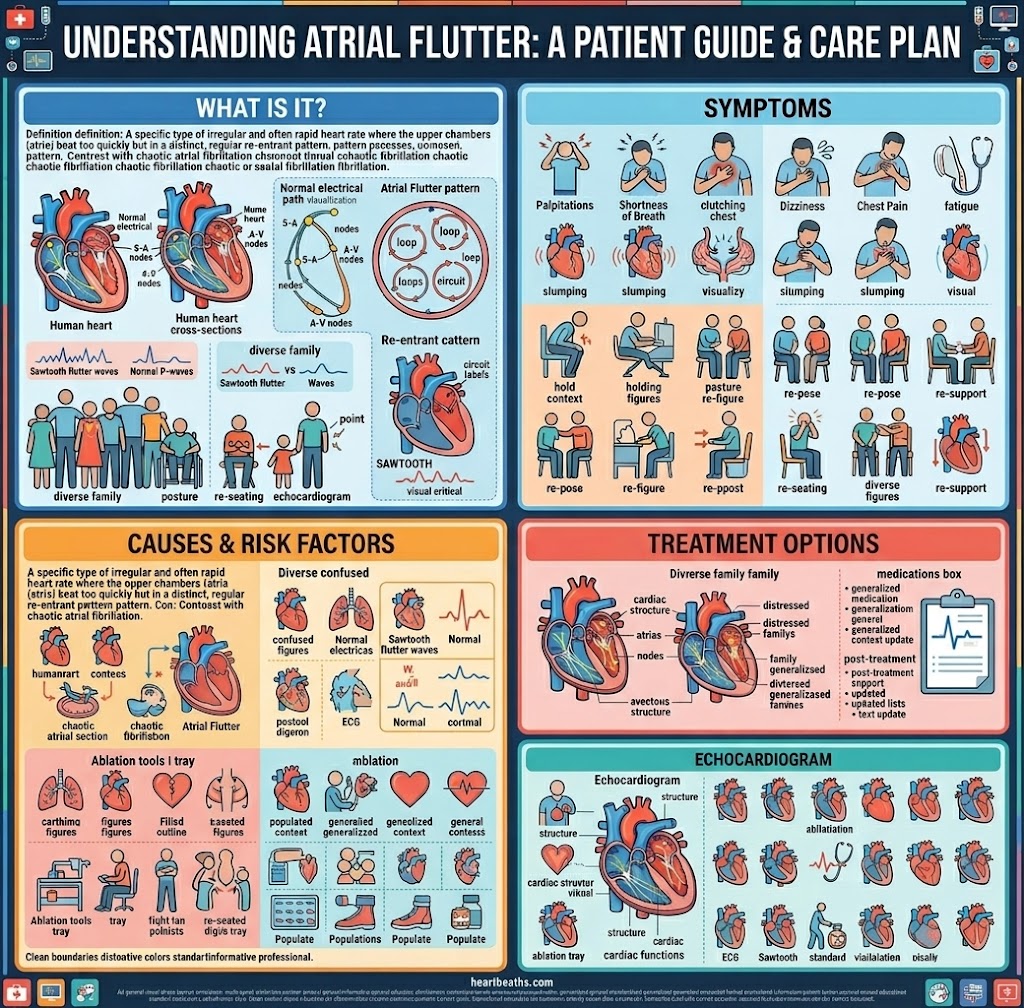
Atrial flutter is a type of irregular heart rhythm, known as an arrhythmia, where the heart's upper chambers beat too quickly but in a generally regular and organized pattern. It's similar to atrial fibrillation (AFib), but less chaotic. This condition arises from issues with the heart's electrical system, which can sometimes occur without noticeable symptoms. When symptoms do appear, they often include a rapid heartbeat or chest discomfort. Treatment typically involves medications and sometimes a heart procedure to restore a normal rhythm.
Understanding the Condition
Atrial Flutter: Understanding a Fast, Organized Heartbeat
Understanding the Condition
Atrial flutter is a type of irregular heart rhythm, known as an arrhythmia, where the heart's upper chambers beat too quickly but in a generally regular and organized pattern. It's similar to atrial fibrillation (AFib), but less chaotic. This condition arises from issues with the heart's electrical system, which can sometimes occur without noticeable symptoms. When symptoms do appear, they often include a rapid heartbeat or chest discomfort. Treatment typically involves medications and sometimes a heart procedure to restore a normal rhythm.
Common Symptoms
Rapid or Pounding Heartbeat: A feeling that your heart is racing, pounding, fluttering, or skipping beats in your chest.
Chest Pain: Discomfort or pain in the chest area.
Fainting or Lightheadedness: Feeling dizzy, lightheaded, or actually losing consciousness.
Shortness of Breath: Difficulty breathing or feeling winded easily.
Extreme Tiredness: Feeling unusually fatigued or lacking energy.
Consultation Guide
Which Specialist to Meet
If you experience symptoms, you should consult your primary care doctor, who may refer you to a heart specialist, known as a cardiologist. For emergency symptoms like severe chest pain or shortness of breath, seek immediate medical care.
Preparations Before Your Visit
Before your appointment, gather a list of all your symptoms, including when they started and how often they occur. List all medications, vitamins, and supplements you currently take, along with their dosages. Be prepared to share your complete medical history, including any other health conditions and family history of heart disease. Write down any questions you have for the doctor.
Book a doctor visit near me
Similar to an ECG, electrodes are placed on your chest and connected to a small, wearable recording device that you carry with you. You'll wear it during your normal daily activities, and you might be asked to keep a diary of your symptoms.
Uses sound waves to create moving pictures of your heart, showing its size, structure, and how blood flows through its chambers and valves.
Heart Rate Control Medicines: These medications help slow down your heart rate to a more normal pace, improving symptoms. (Duration: Typically long-term, ongoing as prescribed.)
Heart Rhythm Control Medicines: These drugs help restore and maintain a normal, steady heart rhythm. (Duration: Typically long-term, ongoing as prescribed.)
Blood Thinners: Used to reduce the risk of blood clots, which are a serious complication of atrial flutter and can lead to stroke. (Duration: Often long-term, as directed by your doctor.)
Cardioversion: A procedure that uses quick, low-energy electrical shocks to the chest to reset the heart to a normal rhythm. Sometimes, medicines can also be used for cardioversion. (Duration: Typically a brief procedure, lasting minutes, often requiring sedation.)
Atrial Flutter Ablation: Uses heat energy (radiofrequency) to create tiny scars in the heart's upper chamber. These scars block the faulty electrical signals causing the irregular heartbeat, helping to restore a normal rhythm. (Duration: Typically 2-4 hours, performed in a hospital setting.)
Diagnostic Procedures
Electrocardiogram (ECG or EKG)
A quick and painless test that records the electrical signals of your heart to show how fast or slow it's beating and if the rhythm is regular.
What to Expect
Small, sticky patches (electrodes) are placed on your chest, and sometimes arms or legs. Wires connect these patches to a machine that records your heart's electrical activity. You lie still during the short test.
A portable device that continuously records your heart's electrical activity, usually for 1 to 2 days, to catch irregular rhythms that might not show up during a regular ECG.
What to Expect
What to Expect
You'll lie on an examination table while a technician moves a wand-like device (transducer) across your chest. Gel is applied to your skin to help the sound waves travel. The test is painless and typically takes about 30-60 minutes.
A common imaging test that creates pictures of your heart, lungs, blood vessels, and bones in your chest. It can help identify problems with the heart's size or fluid in the lungs.
What to Expect
You will stand or sit in front of an X-ray plate, and a technician will ask you to hold your breath for a few seconds while the image is taken. It's a quick and painless procedure.
This test shows how your heart works under physical exertion. It helps detect blood flow issues in the heart that might not be apparent at rest.
What to Expect
What to Expect
You will receive medicine to help you relax. A doctor inserts the catheter, usually into a blood vessel in your groin, and guides it to your heart. X-ray images help guide the catheter. You may feel some pressure but generally no pain during the procedure.
Treatment Options
You'll walk on a treadmill or ride a stationary bike while your heart rate, blood pressure, and breathing are monitored. If you cannot exercise, medication can be given to simulate the effects of exercise on your heart.
Cardiac Catheterization
A procedure where a thin, flexible tube (catheter) is inserted into a blood vessel and guided to the heart to gather detailed information or perform treatments.
Medications
AV Node Ablation: This treatment uses heat energy to destroy a small amount of tissue in the AV node, the area between the heart's upper and lower chambers. This permanently blocks faulty electrical signals, but requires a pacemaker. (Duration: Typically 1-2 hours, followed by pacemaker implantation.)
Pacemaker: A small, battery-powered device surgically placed under the skin near the collarbone to send electrical impulses to keep the heart beating at a regular rate, especially after procedures like AV node ablation. (Duration: Permanent, with battery replacement needed every 5-10 years.)
Prevention & Long-Term Wellbeing
Quit Smoking: Eliminating tobacco use is crucial for overall heart health and reducing the risk of heart rhythm disorders.
Eat a Heart-Healthy Diet: Focus on fruits, vegetables, and whole grains. Limit salt, unhealthy fats, and processed foods to support heart function.
Exercise Regularly: Aim for at least 30 minutes of moderate-intensity activity most days of the week to strengthen your heart.
Maintain a Healthy Weight: Achieving and maintaining a healthy body weight reduces strain on your heart.
Limit Caffeine and Alcohol: Reducing or avoiding these substances can help prevent triggers for irregular heartbeats.
Manage Stress: Incorporate stress-reducing activities like meditation, yoga, or hobbies to support heart health.
Control Underlying Health Conditions: Work with your doctor to effectively manage conditions like high blood pressure, high cholesterol, and diabetes.
Prioritize Quality Sleep: Ensure you get 7 to 9 hours of sleep per night, as poor sleep can affect heart health.
Tags & Topics
Notice an error or need an update?
Help us keep medical information accurate. Report incorrect info or suggest an edit.

