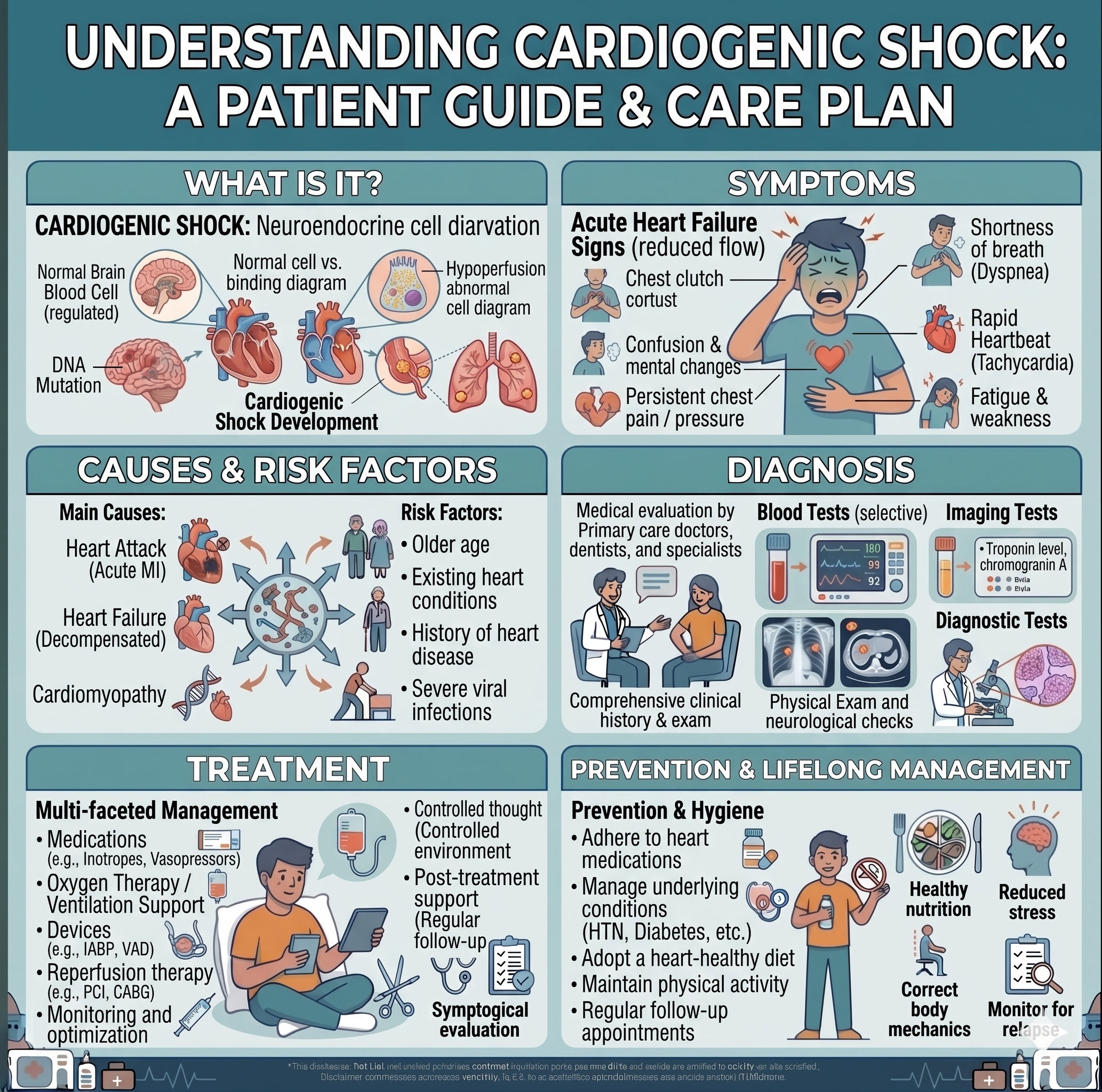
Cardiogenic shock is a severe and life-threatening condition where the heart suddenly becomes too weak to pump enough blood to meet the body's essential needs. It is most frequently triggered by a major or severe heart attack, which damages a significant part of the heart muscle, typically the lower left chamber. While rare, it is crucial to recognize its symptoms, as immediate medical treatment is vital for survival and to minimize heart damage.
Understanding the Condition
Cardiogenic Shock: A Critical Guide for Non-Medical Individuals
Understanding the Condition
Cardiogenic shock is a severe and life-threatening condition where the heart suddenly becomes too weak to pump enough blood to meet the body's essential needs. It is most frequently triggered by a major or severe heart attack, which damages a significant part of the heart muscle, typically the lower left chamber. While rare, it is crucial to recognize its symptoms, as immediate medical treatment is vital for survival and to minimize heart damage.
Common Symptoms
Symptoms of Cardiogenic Shock: If someone is experiencing cardiogenic shock, they may show signs such as: quickly breathing, severe shortness of breath, a sudden rapid heartbeat, loss of consciousness (fainting), a weak pulse, very low blood pressure, excessive sweating, and pale skin.
Symptoms of a Heart Attack (often precedes Cardiogenic Shock): Since cardiogenic shock often follows a severe heart attack, it's important to recognize heart attack symptoms, which include: chest pain that lasts more than 15 minutes and can range from mild to severe (though some may have no chest pain), discomfort in other areas like the arms, back, neck, jaw, or stomach, shortness of breath, a cold sweat, nausea, or lightheadedness. Symptoms can be less obvious in some individuals, particularly women, who might experience nausea or brief, sharp pain in the neck, arm, or back rather than typical chest pain.
Consultation Guide
Which Specialist to Meet
In an emergency, no preparation is needed other than immediately calling for help. Do not drive yourself. For follow-up appointments, prepare by noting all your symptoms, recent health changes, and a list of any medications you are currently taking. Be ready to discuss your medical history and any family history of heart disease.
Book a doctor visit near me
Supportive Medications: In an emergency, various medications are used to support blood pressure, strengthen heart contractions, manage irregular heartbeats, and alleviate symptoms. These medicines help stabilize the patient while further diagnostic and interventional treatments are prepared. (Duration: Administered immediately in an emergency, often intravenously. Ongoing medication regimens will be tailored to the individual's condition and may be required for life to manage underlying heart disease and prevent future events.)
Advanced Surgical Options
Recognize Warning Signs: Be aware of symptoms that could indicate worsening heart conditions or potential complications. Report any new or worsening symptoms, such as chest pain, shortness of breath, or swelling, to your healthcare provider immediately.
Consultation Guide
Regular Health Check-ups: Undergo routine medical check-ups to monitor your heart health, including blood pressure, cholesterol levels, and blood sugar. Early detection and management of risk factors are crucial.
Diagnostic Procedures
This routine test measures the pressure of blood inside your arteries as your heart pumps. It's essential for general health check-ups and screening for high blood pressure.
What to Expect
A cuff will be wrapped around your arm and inflated, creating a squeezing sensation for a few seconds. This is usually quick and relatively painless, though some find the pressure slightly uncomfortable.
Cardiac Catheterization
This procedure uses a thin, flexible tube (catheter) guided through a blood vessel to the heart. It provides detailed information about your heart muscle, valves, and blood vessels. During the procedure, doctors can sometimes open narrowed arteries or measure pressures within the heart.
What to Expect
You will receive a local anesthetic at the catheter insertion site (usually in your groin or wrist) to numb the area. You might feel some pressure as the catheter is inserted, but generally no pain. X-ray imaging will be used to guide the catheter. You may be given a mild sedative to help you relax.
A chest X-ray produces images of your heart, lungs, blood vessels, airways, and the bones of your chest and spine. It helps detect problems like fluid around the lungs, collapsed lungs, pneumonia, or heart enlargement.
What to Expect
You will stand or sit in front of an X-ray plate. You may be asked to hold your breath for a few seconds while the image is taken. The process is quick, painless, and the technician will step behind a protective shield during the brief exposure.
Echocardiogram (Echo)
An echocardiogram uses sound waves to create moving pictures of your heart. It shows how blood flows through the heart chambers and valves, helping to diagnose various heart conditions.
What to Expect
You will lie on an examination table. A special gel will be applied to your chest, and a handheld device (transducer) will be moved across your chest. You might hear 'whooshing' sounds as blood flow is measured. Sensors attached to your chest will monitor your heart rhythm during the test. The procedure is generally painless.
Electrocardiogram (ECG or EKG)
An ECG is a quick and common test that records the electrical signals of your heart. It shows how fast or slow your heart is beating and can help diagnose heart attacks or irregular heart rhythms.
What to Expect
Sticky patches called electrodes will be placed on your chest, and sometimes on your arms or legs. Wires connect these patches to a machine that records your heart's electrical activity. The test is quick, painless, and you simply need to lie still.
Treatment Options
If you suspect heart attack or cardiogenic shock, emergency medical attention is paramount. You will initially be seen by emergency medicine physicians and critical care specialists. Following stabilization, a cardiologist (a heart specialist) will manage your ongoing care. If complex procedures or surgery are needed, you may also consult with interventional cardiologists or cardiac surgeons.
Preparations Before Your Visit
Coronary Angioplasty and Stents: A procedure to open blocked blood vessels in the heart. A tiny balloon on a narrow tube (catheter) is used to widen the clogged artery, often followed by placing a small wire mesh tube (stent) to keep the artery open and improve blood flow. This is a common emergency treatment for heart attacks. (Duration: The procedure itself typically takes 1 to 2 hours. Hospital stay varies but recovery to normal activity can take several days to weeks. The stent remains permanently.)
Coronary Artery Bypass Surgery: This surgery creates new paths for blood to flow around blocked or partially blocked arteries in the heart. A healthy blood vessel from another part of the body (such as the chest or leg) is used to bypass the narrowed area, improving blood flow to the heart muscle. It can be an emergency treatment for severe heart attacks. (Duration: The surgery usually lasts 3 to 6 hours. Hospital stay is typically 5-7 days, with full recovery taking 6 to 12 weeks. The bypass is a permanent solution.)
Extracorporeal Membrane Oxygenation (ECMO): A life support technique where blood is pumped outside the body to a heart-lung machine. This machine removes carbon dioxide and adds oxygen to the blood before returning it to the body, allowing the heart and lungs to rest and heal. It's used for life-threatening heart and lung failure. (Duration: ECMO is a temporary measure, typically used for days to weeks, until the patient's heart and/or lungs recover sufficiently or other long-term treatments can be implemented.)
Ventricular Assist Device (VAD): A mechanical pump surgically implanted to help a weakened heart's lower chambers move blood to the rest of the body. Most commonly, it supports the left ventricle (LVAD). It can be a temporary solution while awaiting a heart transplant or a long-term treatment for chronic heart failure. (Duration: A VAD can be used for weeks or months as a bridge to transplant, or for the remainder of a patient's life as 'destination therapy' to improve quality of life.)
Heart Transplant: An operation to replace a failing heart with a healthier donor heart. This is typically reserved for individuals with severe heart failure that has not improved with other medications or surgeries. (Duration: The surgery itself takes 4 to 6 hours. Hospital stay can be several weeks, with full recovery taking 6 months to a year. Lifelong anti-rejection medications are necessary.)
Consistent Medical Follow-up: Regular visits with your cardiologist are essential to monitor your heart function, adjust medications, and manage any ongoing heart conditions. Adherence to prescribed treatment plans is vital.
Home Blood Pressure Monitoring: If recommended, regularly check your blood pressure at home and keep a record. Share these readings with your healthcare team to help them assess the effectiveness of your treatment and make necessary adjustments.
Prevention & Long-Term Wellbeing
Prevention of Heart Disease
Adopt a Heart-Healthy Lifestyle: Maintain a balanced diet rich in fruits, vegetables, and whole grains, limit saturated and trans fats, sodium, and added sugars. Engage in regular physical activity, aiming for at least 150 minutes of moderate-intensity exercise per week. Avoid smoking and limit alcohol consumption.
Manage Chronic Health Conditions: Work with your healthcare professional to effectively manage conditions like high blood pressure, high cholesterol, and diabetes, which significantly increase the risk of heart attack and subsequent cardiogenic shock.
Long-Term Monitoring and Recovery
Cardiac Rehabilitation: Participate in a structured cardiac rehabilitation program. This typically involves supervised exercise, education on heart-healthy living, and counseling to reduce stress and anxiety, promoting a strong recovery.
Tags & Topics
Notice an error or need an update?
Help us keep medical information accurate. Report incorrect info or suggest an edit.

