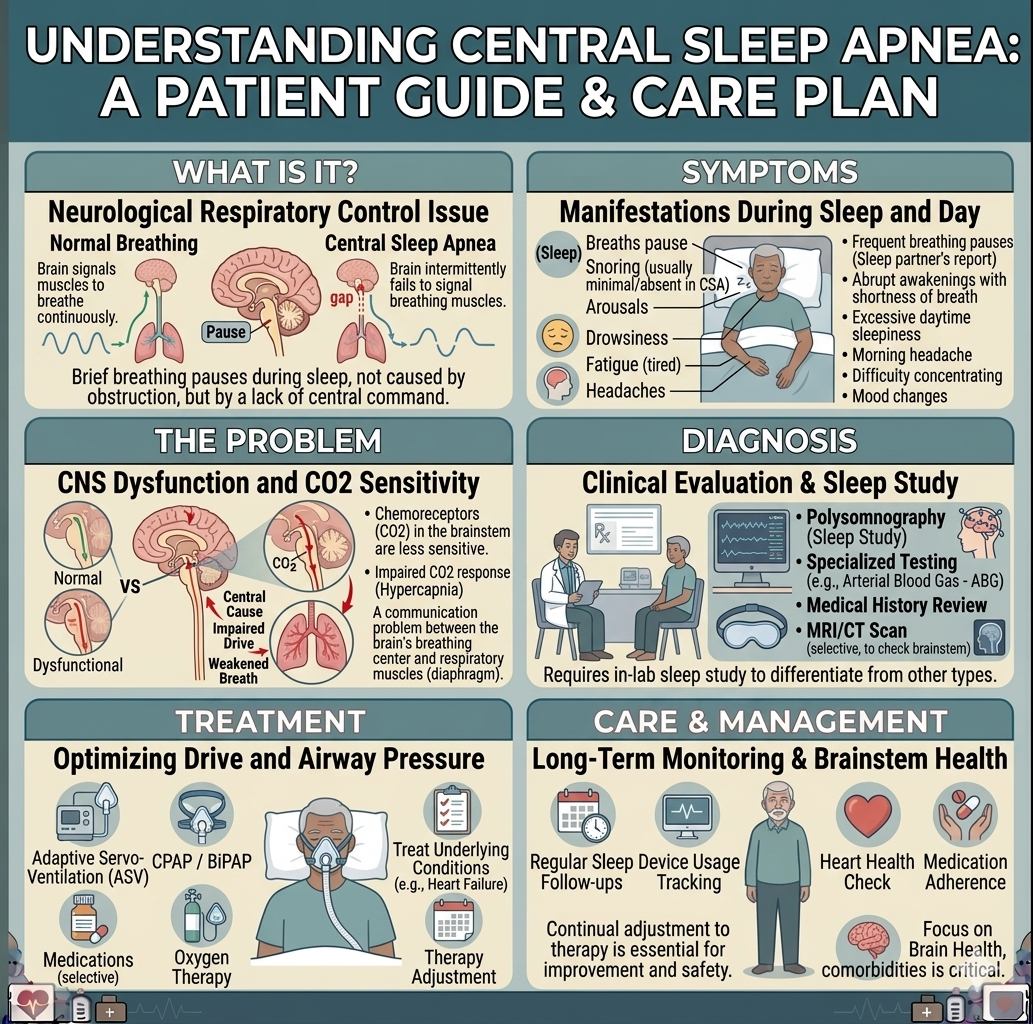
Central Sleep Apnea (CSA) is a medical condition where your breathing repeatedly stops and starts while you are asleep. Unlike Obstructive Sleep Apnea, where a blocked airway causes breathing pauses, CSA occurs because your brain temporarily fails to send the correct signals to the muscles that control breathing. This condition is less common but can be linked to other health issues like heart failure, stroke, or even sleeping at high altitudes. Managing underlying medical conditions, using specialized breathing devices, or receiving supplemental oxygen are common approaches to treatment.
Understanding the Condition
Central Sleep Apnea: Understanding Breathing Pauses During Sleep
Understanding the Condition
Common Symptoms
Pauses in Breathing During Sleep (Apneas): Periods where breathing completely stops for brief moments. Often noticed by a sleep partner.
Sudden Awakenings with Shortness of Breath: Waking up abruptly feeling like you cannot catch your breath.
Insomnia (Difficulty Staying Asleep): Trouble maintaining sleep throughout the night, leading to fragmented rest.
Excessive Daytime Sleepiness (Hypersomnia): Feeling unusually tired or falling asleep during the day, even after what seems like enough sleep.
Trouble Focusing: Difficulty concentrating or staying mentally sharp during daily activities.
Mood Changes: Experiencing irritability, anxiety, or feelings of depression.
Morning Headaches: Waking up with a headache that often resolves shortly after getting out of bed.
Snoring: While less common and typically less pronounced than in obstructive sleep apnea, some individuals with central sleep apnea may still snore.
Consultation Guide
Which Specialist to Meet
If you or your partner notice symptoms of central sleep apnea, it is important to consult your primary care physician. They may then refer you to a sleep specialist, neurologist, or cardiologist, depending on the suspected underlying cause. A pulmonologist might also be involved if lung health is a factor.
Preparations Before Your Visit
Before your appointment, prepare by keeping a sleep diary for a week or two, noting your sleep patterns, any awakenings, and daytime symptoms. List all medications you are currently taking, including over-the-counter drugs and supplements. Gather your complete medical history and write down any questions you have for the doctor to ensure all your concerns are addressed.
Book a doctor visit near me
Managing Existing Health Conditions: Addressing and effectively managing conditions such as heart failure, stroke, or end-stage kidney disease can often significantly improve or resolve symptoms of central sleep apnea. (Duration: Ongoing, as part of your overall health management.)
Avoiding High Altitudes: If your central sleep apnea is triggered by sleeping at high altitudes, avoiding such environments or gradually acclimatizing can help prevent episodes. (Duration: As needed, when traveling to or residing in high-altitude areas.)
Regular Medical Follow-ups: Schedule consistent appointments with your sleep specialist or primary care doctor to monitor your symptoms, treatment effectiveness, and overall health.
Symptom Awareness: Pay attention to any changes in your daytime sleepiness, mood, or sleep quality and promptly report them to your doctor for evaluation.
Healthy Lifestyle Choices: Maintain a healthy body weight, engage in regular physical activity as advised by your doctor, and limit alcohol and sedatives, which can worsen sleep apnea symptoms.
Consultation Guide
Central Sleep Apnea (CSA) is a medical condition where your breathing repeatedly stops and starts while you are asleep. Unlike Obstructive Sleep Apnea, where a blocked airway causes breathing pauses, CSA occurs because your brain temporarily fails to send the correct signals to the muscles that control breathing. This condition is less common but can be linked to other health issues like heart failure, stroke, or even sleeping at high altitudes. Managing underlying medical conditions, using specialized breathing devices, or receiving supplemental oxygen are common approaches to treatment.
Oxygen Therapy: Delivering additional oxygen through a mask or nasal tubes during sleep can help maintain sufficient blood oxygen levels, particularly if they drop significantly during apnea episodes. (Duration: Nightly, as prescribed by your doctor, for varying durations depending on the severity and underlying cause.)
Manage Heart Conditions: Work closely with your cardiologist to ensure conditions like heart failure or irregular heart rhythms are effectively managed, as these are significant risk factors for central sleep apnea.
Address Neurological Issues: If you have a history of stroke or other brain conditions, follow your neurologist's recommendations to manage these, which can affect the brain's ability to regulate breathing.
Diagnostic Procedures
Polysomnography (Sleep Study)
Polysomnography is the most comprehensive test used to diagnose central sleep apnea and other sleep disorders. This study records various body functions during sleep, providing detailed information about your sleep patterns and any disruptions. It monitors your brain waves, the oxygen level in your blood, heart rate, breathing patterns, and eye and leg movements.
What to Expect
A polysomnography is usually conducted overnight at a specialized sleep center or hospital. You will arrive in the evening, and a sleep technologist will attach sensors to different parts of your body, including your scalp, face, chest, and limbs. A clip will also be placed on your finger to measure oxygen levels. These sensors are designed to be as non-intrusive as possible while accurately recording data throughout the night. You will sleep in a private room, and the technologist will monitor the readings from another room. The goal is to observe a typical night's sleep to identify when and why your sleep patterns are disrupted. If you are a shift worker, the test may be arranged during your usual sleep hours in the daytime.
Treatment Options
Reviewing Medications: If certain medications, particularly opioids, are contributing to your breathing irregularities, your doctor may adjust your prescription or suggest alternatives. (Duration: As prescribed by your healthcare provider, potentially long-term.)
Continuous Positive Airway Pressure (CPAP) Therapy: A mask worn during sleep delivers a continuous stream of pressurized air to help keep your airways open and support regular breathing. (Duration: Long-term, used nightly during sleep.)
Bilevel Positive Airway Pressure (BPAP) Therapy: Similar to CPAP, but this device delivers two different pressures: a higher pressure when you breathe in and a lower pressure when you breathe out, making breathing feel more natural for some individuals. (Duration: Long-term, used nightly during sleep.)
Adaptive Servo-Ventilation (ASV) Therapy: An advanced device that monitors your breathing pattern throughout the night. It 'learns' your normal breathing and then provides varying levels of air pressure to normalize your breathing and airflow, especially helpful for complex central sleep apnea. (Duration: Long-term, used nightly during sleep.)
Discuss All Medications: Regularly review all your medications, especially pain relievers like opioids, with your doctor to understand their potential impact on your breathing during sleep and explore alternatives if necessary.
Gradual Altitude Acclimatization: If you plan to travel to or reside in high-altitude areas, ascend gradually to allow your body time to adjust, which can help prevent high-altitude sleep apnea.
Long-Term Monitoring and Support
Consistent Treatment Adherence: Strictly follow your prescribed treatment plan, including nightly use of breathing devices or oxygen therapy, to ensure optimal management of your condition.
Periodic Sleep Studies: Your doctor may recommend occasional follow-up sleep studies to reassess the severity of your condition and make any necessary adjustments to your treatment settings.
Prevention & Long-Term Wellbeing
Managing Underlying Conditions and Lifestyle
Prevention
Tags & Topics
Notice an error or need an update?
Help us keep medical information accurate. Report incorrect info or suggest an edit.


