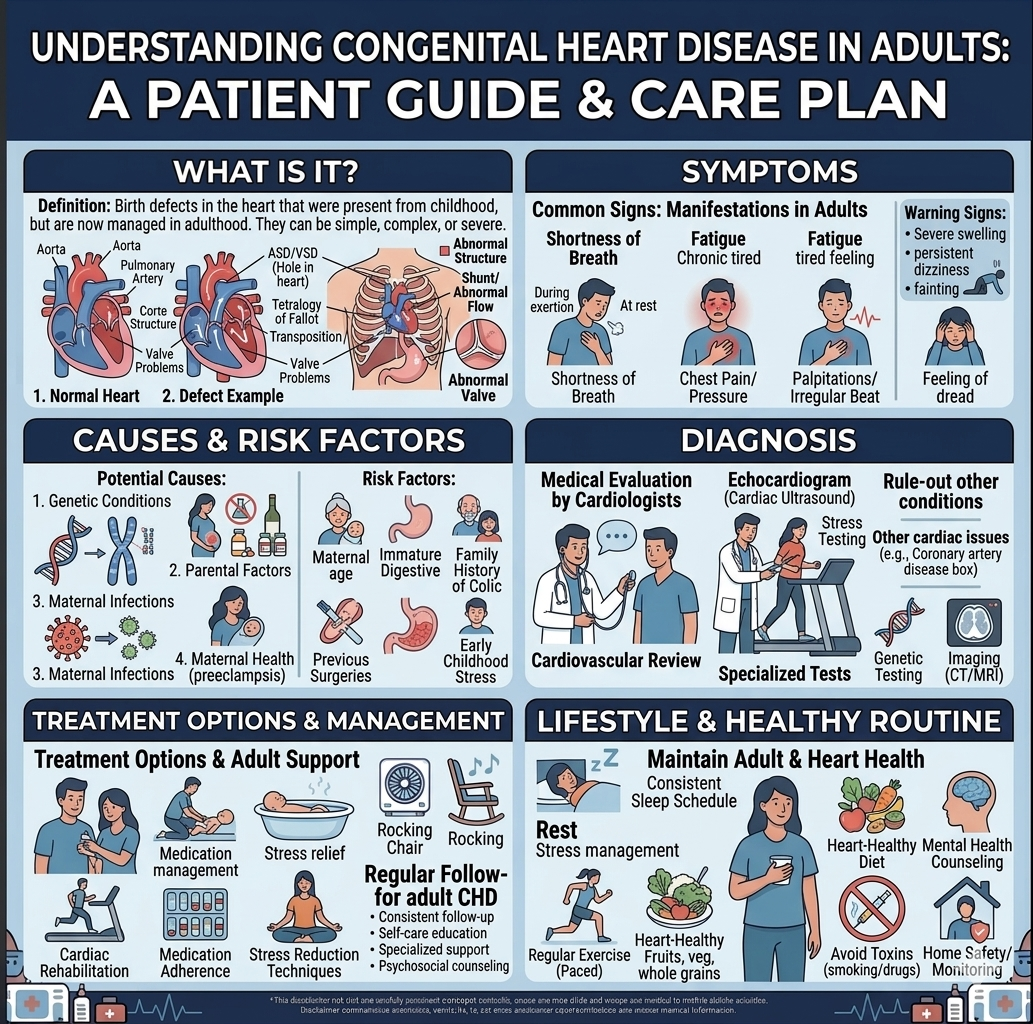
Adult congenital heart disease refers to one or more structural problems with the heart that were present at birth. These conditions can alter how blood flows through the heart and to the body. While some heart defects are mild, others can lead to serious, life-threatening complications. Thanks to advancements in diagnosis and treatment, most people born with heart defects now survive into adulthood. Treatment often involves regular medical checkups, medications, and sometimes procedures or surgery, tailored to the specific condition.
Understanding the Condition
Adult Congenital Heart Disease
Understanding the Condition
Common Symptoms
Irregular Heartbeats (Arrhythmias): The heart may beat too fast, too slow, or with an uneven rhythm.
Chest Pain or Unexplained Shortness of Breath: Seek emergency medical help immediately if you experience these symptoms.
Consultation Guide
Which Specialist to Meet
You should consult with a cardiologist, especially one specializing in adult congenital heart disease (ACHD). If you are pregnant or planning to become pregnant, you will also need to see an obstetrician specializing in high-risk pregnancies, in coordination with your cardiologist.
Preparations Before Your Visit
Before your visit, gather your full medical history, including any treatments for heart conditions you received as a child. Make a list of all your current symptoms, any medications you are taking, and any questions you have for your doctor. If you were treated for a congenital heart defect as a child, it is important to schedule ongoing checkups as an adult.
Book a doctor visit near me
Electrodes will be placed on your chest to monitor your ECG. You will start exercising at a slow pace, with the intensity gradually increasing. Your breathing, blood pressure, and heart rhythm will be continuously monitored. The test continues until you reach a target heart rate or develop symptoms. It typically lasts 15-30 minutes for the exercise portion, plus preparation time.
Cardiac Catheterization
Symptom Awareness and Prompt Medical Attention: Be vigilant for new or worsening symptoms like unexplained chest pain, severe shortness of breath, or prolonged irregular heartbeats, and seek medical help immediately if they occur.
Consultation Guide
Bluish or Grayish Skin (Cyanosis): Low oxygen levels in the blood can cause a blue or gray tint to the skin, lips, or fingernails. This may be more or less noticeable depending on natural skin tone.
Shortness of Breath: Difficulty breathing, especially during activity or at rest.
Quick Fatigue with Activity: Feeling unusually tired or exhausted very quickly after minimal physical effort.
Swelling (Edema): Fluid buildup in body tissues, often seen in the legs, ankles, or abdomen.
Diagnostic Procedures
Adult congenital heart disease refers to one or more structural problems with the heart that were present at birth. These conditions can alter how blood flows through the heart and to the body. While some heart defects are mild, others can lead to serious, life-threatening complications. Thanks to advancements in diagnosis and treatment, most people born with heart defects now survive into adulthood. Treatment often involves regular medical checkups, medications, and sometimes procedures or surgery, tailored to the specific condition.
A chest X-ray uses a small amount of radiation to create images of your heart, lungs, blood vessels, and bones. It can help detect problems like an enlarged heart or fluid accumulation.
What to Expect
You will stand or sit in front of an X-ray plate, often asked to hold your breath for a few seconds. The procedure is quick, painless, and usually takes only a few minutes.
Electrocardiogram (ECG or EKG)
An ECG records the electrical signals of your heart to check its rhythm and rate. It can help diagnose irregular heartbeats or signs of heart strain.
What to Expect
Sticky patches (electrodes) will be placed on your chest, arms, and legs. These patches are connected by wires to a machine that records your heart's electrical activity. You will lie still during the test, which typically takes about 5-10 minutes and is painless.
An echocardiogram uses sound waves to create moving pictures of your heart, showing its structure, how well it's pumping, and how blood flows through its chambers and valves. This helps identify heart defects and assess their severity.
What to Expect
You will lie on an exam table while a technician applies a special gel to your chest. A handheld device (transducer) is then moved across your chest, sending sound waves to your heart. You may feel slight pressure. The images are displayed on a screen. The test usually lasts 30-60 minutes.
A stress test evaluates how your heart works during physical activity. It monitors your heart rate, blood pressure, and ECG while you exercise on a treadmill or stationary bike. If you cannot exercise, medication can be given to mimic the effects of exercise on the heart.
What to Expect
What to Expect
You will be given a local anesthetic at the insertion site, and often a mild sedative to help you relax. The catheter is then carefully threaded through the blood vessels to the heart. You might feel pressure but generally no pain. The procedure can take from 30 minutes to several hours, depending on its purpose. You will need to lie still during this time.
Genetic Counseling: If there is a family history of congenital heart disease, genetic counseling can help assess risks for future pregnancies and guide potential genetic testing or screening.
Pre-pregnancy Health Optimization: Ensuring immunity to rubella (German measles) through vaccination and diligently managing pre-existing conditions like type 1 or type 2 diabetes before and throughout pregnancy can reduce risks.
Treatment Options
This procedure involves guiding a thin, flexible tube (catheter) through a blood vessel, typically in the groin or wrist, to your heart. It allows doctors to measure pressures, take samples, inject dye for X-ray imaging (angiogram), or perform certain treatments.
Medications
Heart Rhythm Control Medications: Used to regulate irregular heartbeats (arrhythmias), preventing them from being too fast, too slow, or erratic. (Duration: Ongoing, as prescribed by your doctor.)
Fluid Reduction Medications: Help reduce excess fluid buildup in the body, such as swelling in the legs or lungs. (Duration: Ongoing, as prescribed by your doctor.)
Blood Pressure Lowering Medications: Manage high blood pressure, especially in the lung arteries (pulmonary hypertension), which can occur with some heart defects. (Duration: Ongoing, as prescribed by your doctor.)
Heart Valve Repair or Replacement: Open-heart or minimally invasive surgery to fix a damaged heart valve (e.g., if it doesn't open fully or leaks) or replace it with an artificial or biological valve, improving blood flow. (Duration: A one-time surgery, followed by a recovery period of several weeks to months. The lifespan of repaired or replacement valves varies.)
Corrective Heart Surgery: Surgery to repair structural heart defects, such as closing holes between heart chambers (septal defects) or reconnecting improperly formed blood vessels, to restore normal heart function. (Duration: A one-time major surgery, followed by a recovery period of several weeks to months.)
Heart Transplant: A major operation in which a severely failing heart is replaced with a healthier donor heart. This is typically a last resort when other treatments are no longer effective. (Duration: A one-time major surgery, followed by lifelong immunosuppressant medication and monitoring.)
Avoid Harmful Substances During Pregnancy: Abstaining from alcohol and smoking during pregnancy is crucial. Always discuss all medications, including over-the-counter drugs and supplements, with your healthcare provider to ensure they are safe during pregnancy.
Long-Term Monitoring and Management
Regular Specialized Checkups: Lifelong follow-up with a cardiologist specializing in adult congenital heart disease (ACHD) is essential for ongoing monitoring, early detection of complications, and personalized care.
Prevention & Long-Term Wellbeing
Infection Prevention Antibiotics: May be prescribed for a short period before certain dental procedures for individuals at risk of developing heart lining infections (endocarditis). (Duration: Short-term, prior to specific medical or dental procedures.)
Pacemaker Implantation: A small battery-powered device surgically placed under the skin near the collarbone. It sends electrical impulses to stimulate the heart and maintain a regular, adequate heartbeat if it is too slow. (Duration: The device typically lasts 5-15 years, followed by a procedure to replace the battery/device.)
Implantable Cardioverter-Defibrillator (ICD) Implantation: A small device placed in the chest that constantly monitors heart rhythm. If it detects dangerously fast or irregular heartbeats, it delivers electrical shocks to restore a normal rhythm. (Duration: The device typically lasts 5-10 years, followed by a procedure to replace the battery/device.)
Catheter-Based Interventions: Performed during cardiac catheterization, these procedures use catheters to repair certain heart defects. Examples include using balloons to widen narrowed valves or arteries (angioplasty) or deploying devices to close holes in the heart (e.g., atrial septal defects). (Duration: Typically a one-time procedure, with potential for follow-up interventions if needed.)
Prevention (for future pregnancies)
Oral Hygiene and Infection Prevention: Maintaining excellent dental hygiene through regular brushing, flossing, and dental checkups is vital to reduce the risk of heart lining infections (endocarditis), as bacteria from the mouth can enter the bloodstream and affect a vulnerable heart.
Heart-Healthy Lifestyle: Adopt a lifestyle that supports heart health, including a balanced diet rich in fruits, vegetables, and lean proteins, regular physical activity as advised by your doctor, maintaining a healthy weight, and avoiding smoking.
Pregnancy Planning and Consultation: If you have complex congenital heart disease and are considering pregnancy, it is crucial to consult with your ACHD cardiologist and a high-risk obstetrician beforehand. They can discuss potential risks, guide you on the safety of pregnancy, and plan for specialized care if needed.
Tags & Topics
Notice an error or need an update?
Help us keep medical information accurate. Report incorrect info or suggest an edit.

