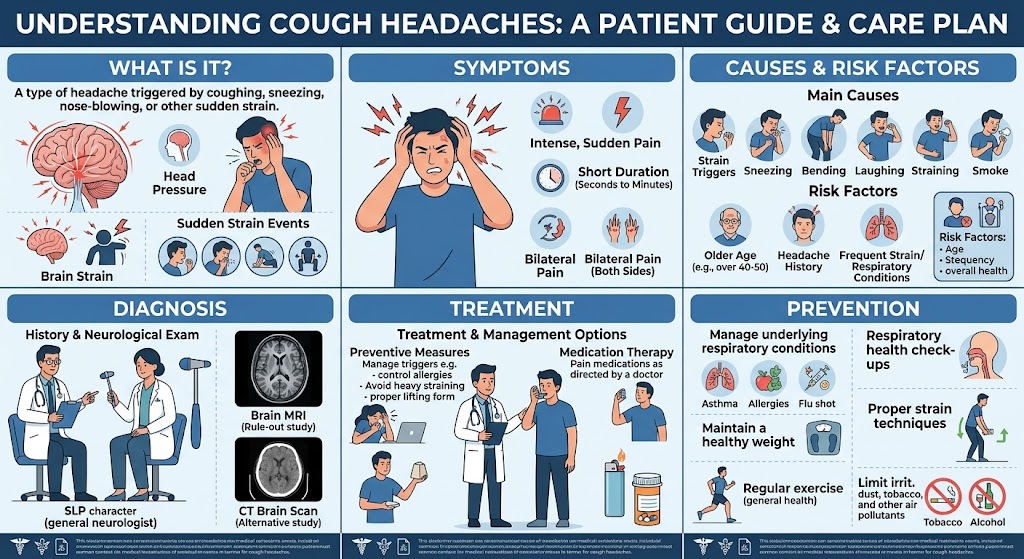
Cough headaches are head pains triggered specifically by coughing or other straining activities like sneezing, laughing, or bending over. They are uncommon and fall into two types. Primary cough headaches are usually harmless, caused only by coughing, and resolve quickly without treatment. Secondary cough headaches, however, are more serious. Though also triggered by a cough, they stem from underlying problems within or near the brain or spinal cord, such as structural issues or tumors, and may require significant medical intervention. Anyone experiencing a new cough headache should promptly consult a healthcare provider to determine its cause.
Understanding the Condition
Cough Headaches: Understanding Pain Triggered by Coughing
Understanding the Condition
Common Symptoms
Sudden Head Pain: Headaches begin immediately after coughing, sneezing, or straining activities. It's crucial to distinguish them from existing headaches (e.g., migraine) that simply worsen with coughing.
Pain Duration: Typically lasts for a few seconds to several minutes, rarely longer.
Pain Location: Often affects both sides of the head.
Pain Intensity: Can be mild to severe, often described as a sharp, splitting, or stabbing pain.
Imbalance or Dizziness: Feeling unsteady on your feet (may accompany secondary cough headaches).
Fainting: Temporary loss of consciousness (may accompany secondary cough headaches).
Blurred or Double Vision: Difficulty seeing clearly or seeing two images of one object (may accompany secondary cough headaches).
Weakness or Numbness: Reduced strength or loss of sensation in parts of the body (may accompany secondary cough headaches).
Consultation Guide
Which Specialist to Meet
Start with a General Practitioner, who can refer you to a Neurologist, a brain and nervous system specialist.
Preparations Before Your Visit
Before your visit, detail your headache episodes: timing, duration, intensity, triggers, and any accompanying symptoms. Bring a list of medications, medical history, and questions. Be prepared to describe your symptoms accurately.
Book a doctor visit near me
Observation and Symptomatic Relief
Pain Management: For primary cough headaches, which are often harmless and brief, treatment focuses on managing pain with over-the-counter pain relievers as needed. (Duration: Short-term, as symptoms occur.)
Report New Symptoms: Immediately report any new, worsening, or unusual symptoms—especially changes in headache patterns, vision, balance, or neurological function—to your doctor.
Consultation Guide
Cough headaches are head pains triggered specifically by coughing or other straining activities like sneezing, laughing, or bending over. They are uncommon and fall into two types. Primary cough headaches are usually harmless, caused only by coughing, and resolve quickly without treatment. Secondary cough headaches, however, are more serious. Though also triggered by a cough, they stem from underlying problems within or near the brain or spinal cord, such as structural issues or tumors, and may require significant medical intervention. Anyone experiencing a new cough headache should promptly consult a healthcare provider to determine its cause.
You'll lie on a movable table that slides into a large, doughnut-shaped machine. The scanner rotates around your head, taking X-ray images. You must lie still for a few minutes. Sometimes, a special contrast dye injected into a vein highlights blood vessels or tissues, which might cause a brief warm sensation or metallic taste. The procedure is generally painless.
Brain MRI (Magnetic Resonance Imaging)
A brain MRI uses powerful magnets, radio waves, and a computer to produce highly detailed images of the brain, neck, and spine. It doesn't use radiation and offers intricate views of soft tissues and subtle brain changes.
Pressure-Reducing Medications: If high pressure around the brain is the cause, specific medications may be prescribed to reduce fluid buildup or inflammation. (Duration: Varies by cause, potentially long-term.)
Anti-inflammatory Agents: Corticosteroids may be used to reduce swelling or inflammation impacting brain structures. (Duration: Short-term courses, physician-determined.)
Management of Underlying Cough Causes: Treating conditions that cause persistent coughing (e.g., allergies, respiratory infections) can help prevent headache triggers. (Duration: Ongoing, as needed for the specific condition.)
Manage Coughing Causes: Address and treat conditions causing chronic coughing (e.g., allergies, asthma, infections) with your doctor's guidance.
Avoid Straining: Minimize intense straining activities like heavy lifting or forceful bowel movements. Consider fiber or stool softeners if constipation is an issue.
Regular Medical Follow-ups: Maintain appointments with your provider, especially for secondary cough headaches or underlying conditions, for continuous monitoring and management.
Diagnostic Procedures
Brain CT Scan (Computed Tomography)
A brain CT scan uses X-rays and computer technology to create detailed cross-sectional images of the brain, skull, blood vessels, and soft tissues, offering more detail than standard X-rays. It quickly visualizes the brain from various angles.
What to Expect
What to Expect
You'll lie on a movable table entering a long, tube-shaped machine. It's open at both ends, but can feel enclosed. The machine makes loud knocking noises, so earplugs or headphones are offered. You must remain very still for 30-60 minutes or longer. A contrast agent might be injected. The procedure is painless but noisy and requires prolonged stillness.
Lumbar Puncture (Spinal Tap)
A lumbar puncture (spinal tap) is a procedure in the lower back to collect cerebrospinal fluid (CSF), the protective fluid around your brain and spinal cord. CSF is tested for infections, bleeding, central nervous system diseases, or abnormal pressure.
What to Expect
You'll typically lie on your side with knees to chest or sit leaning forward. The doctor cleans and numbs your lower back with a local anesthetic. A thin needle is carefully inserted between two lower back bones to collect CSF. You might feel pressure or a brief sharp sensation. After, you usually lie flat to reduce the risk of headache, a common side effect.
Treatment Options
Medications
Decompression Surgery: For structural issues like Chiari malformation, surgery creates more space for brain structures by removing a small bone piece from the skull or upper spine. (Duration: Single procedure, followed by recovery.)
Prevention & Long-Term Wellbeing
Brain Lesion Removal: Surgical removal of brain tumors, aneurysms, or abnormal blood vessel tangles (vascular malformations) to relieve pressure or treat bleeding. (Duration: Single procedure, followed by recovery.)
CSF Leak Repair: Surgical repair of a cerebrospinal fluid leak to restore normal fluid pressure around the brain and spine. (Duration: Single procedure, followed by recovery.)
Prevention
Healthy Lifestyle: Adopt a balanced diet, regular exercise, and adequate sleep to support overall brain health and potentially reduce headache frequency.
Tags & Topics
Notice an error or need an update?
Help us keep medical information accurate. Report incorrect info or suggest an edit.


