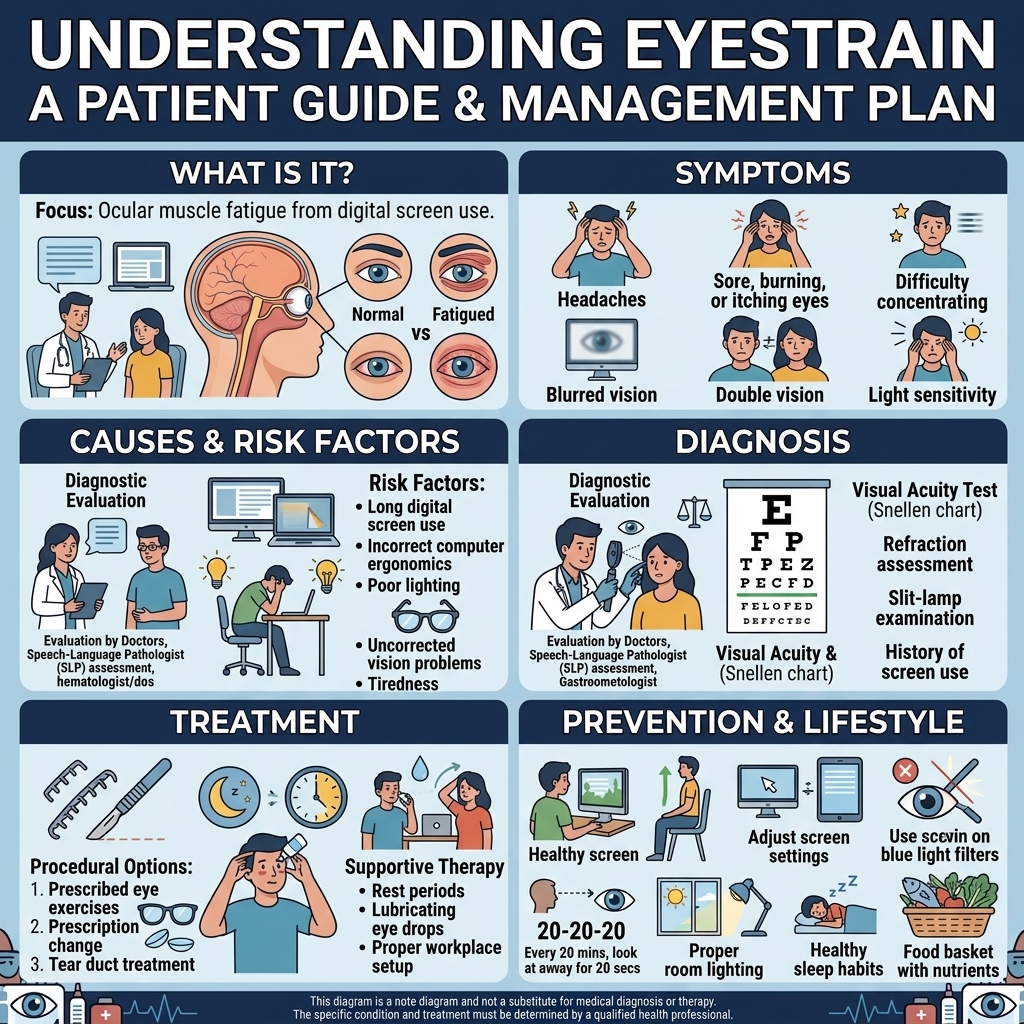
Eyestrain is a common, temporary condition where your eyes feel tired and uncomfortable from intense or prolonged visual tasks. This often happens after activities like driving long distances, reading for extended periods, or using digital screens for many hours. While generally not serious and easily relieved with rest, persistent eyestrain can sometimes point to an unaddressed eye problem that needs professional care.
Understanding the Condition
Understanding Eyestrain
Understanding the Condition
Eyestrain is a common, temporary condition where your eyes feel tired and uncomfortable from intense or prolonged visual tasks. This often happens after activities like driving long distances, reading for extended periods, or using digital screens for many hours. While generally not serious and easily relieved with rest, persistent eyestrain can sometimes point to an unaddressed eye problem that needs professional care.
Common Symptoms
Sore, tired, burning or itching eyes: A feeling of discomfort, irritation, or fatigue in and around the eyes.
Watery or dry eyes: Eyes may feel excessively wet or uncomfortably dry, gritty, or scratchy.
Blurred or double vision: Difficulty seeing clearly, with images appearing fuzzy or doubled.
Sore neck, shoulders or back: Pain or stiffness in the upper body, often from poor posture adopted during intense focus.
Increased sensitivity to light (photophobia): Discomfort or pain when exposed to bright lights, causing a natural inclination to squint.
Difficulty concentrating: Finding it hard to focus attention on tasks, often due to eye discomfort or fatigue.
Feeling that you cannot keep your eyes open: An overwhelming sensation of drowsiness or the inability to keep eyelids lifted due to extreme eye fatigue.
Consultation Guide
Which Specialist to Meet
Before your visit, make a list of your symptoms, including when they started and what makes them better or worse. Note down your daily screen time, work environment, and any other activities requiring intense visual focus. Bring details of your current glasses or contact lens prescription, if any, and a list of any medications you are taking. Also, be prepared to discuss your overall health and medical history.
Book a doctor visit near me
Warm Compresses: Applying a warm, damp cloth over closed eyelids can soothe tired eyes and help with dry eye symptoms. (Duration: 5-10 minutes, 1-2 times daily)
Consultation Guide
Eye drops will be administered, which will cause your pupils to enlarge. Your vision will likely be blurry, and your eyes will be sensitive to light for several hours after, so you'll need someone to drive you home and should bring sunglasses.
Diagnostic Procedures
You should consult an ophthalmologist or an optometrist. An ophthalmologist is a medical doctor who specializes in eye and vision care and can perform eye exams, diagnose and treat disease, prescribe medications, and perform surgery. An optometrist provides primary vision care, including eye exams, vision testing, prescribing and dispensing corrective lenses, detecting certain eye abnormalities, and prescribing some medications.
Preparations Before Your Visit
This test measures how clearly you see by asking you to read letters from a chart placed a specific distance away. It helps identify if your vision is blurry or impaired.
What to Expect
You will stand or sit a set distance from an eye chart (often called a Snellen chart) and cover one eye at a time while reading the smallest line of letters you can see. This is a quick and painless procedure.
This test determines the exact lens prescription needed to correct any refractive errors (like nearsightedness, farsightedness, or astigmatism) that might be contributing to eyestrain.
What to Expect
You will look through a device called a phoropter, which contains different lenses. The doctor will switch between various lenses and ask you which one makes the letters on the eye chart appear clearer. You simply need to tell the doctor what looks best.
Slit Lamp Examination
The slit lamp is a microscope with a bright light that allows the doctor to examine the front structures of your eye in detail, including the eyelids, cornea, conjunctiva, iris, and lens. This helps detect conditions like dry eyes or inflammation.
What to Expect
You will rest your chin and forehead on a support while the doctor shines a narrow beam of light into your eye and looks through the microscope. It's a non-invasive procedure, though the bright light can be intense for a moment.
Pupil Dilation (if necessary)
Eye drops are used to temporarily widen your pupils, allowing the doctor a better view of the back of your eye, including the retina and optic nerve, to rule out other underlying conditions.
What to Expect
Treatment Options
20-20-20 Rule: Every 20 minutes, look away from your screen at an object 20 feet away for at least 20 seconds. This helps your eye muscles relax and prevents fatigue. (Duration: Ongoing practice during screen use)
Adjusting Screen Settings: Optimize your computer or device screen's brightness, contrast, and text size to a comfortable level. Reduce blue light emission if possible. (Duration: One-time setup, with minor adjustments as needed)
Optimizing Lighting: Ensure your workspace has appropriate, non-glare lighting. Avoid direct light sources shining into your eyes or onto your screen. (Duration: One-time setup, with occasional adjustments)
Using Lubricating Eye Drops: Over-the-counter artificial tears can moisten dry eyes and relieve irritation. (Duration: As needed, typically a few times a day)
Medications
Prescription Eye Drops: If dry eyes are severe or persistent, your doctor may prescribe specific eye drops to reduce inflammation or stimulate tear production. (Duration: As prescribed, usually several weeks to months)
Prescription Lenses: If uncorrected vision problems are contributing to eyestrain, your doctor may prescribe new or updated glasses or contact lenses. (Duration: Ongoing use)
Specialty Lenses: Some individuals benefit from lenses designed for computer use, which provide optimal focus at arm's length. (Duration: Ongoing use)
Prevention & Long-Term Wellbeing
Prevention
Maintain Regular Breaks: Consistently follow the 20-20-20 rule during prolonged visual tasks to give your eyes a chance to rest and refocus.
Optimize Your Workstation: Position your computer screen about an arm's length away, with the top of the screen slightly below eye level. Use an ergonomic chair to maintain good posture.
Control Lighting and Glare: Avoid glare from windows or bright lights. Use indirect or softer lighting, and consider an anti-glare screen filter for digital devices.
Keep Eyes Moist: Consciously blink more often, especially during screen use, to spread tears across your eyes. Use a humidifier in dry environments to add moisture to the air.
Stay Hydrated: Drinking enough water throughout the day can support overall bodily functions, including tear production.
Long-Term Eye Health
Schedule Regular Eye Exams: Undergo comprehensive eye examinations as recommended by your eye care professional to detect and address any underlying vision problems or eye conditions early.
Manage Underlying Health Conditions: Conditions like dry eye, uncorrected refractive errors, or certain systemic diseases can contribute to eyestrain; manage these effectively with your doctor.
Limit Screen Time When Possible: While often unavoidable, try to reduce recreational screen time to give your eyes a break.
Tags & Topics
Notice an error or need an update?
Help us keep medical information accurate. Report incorrect info or suggest an edit.


