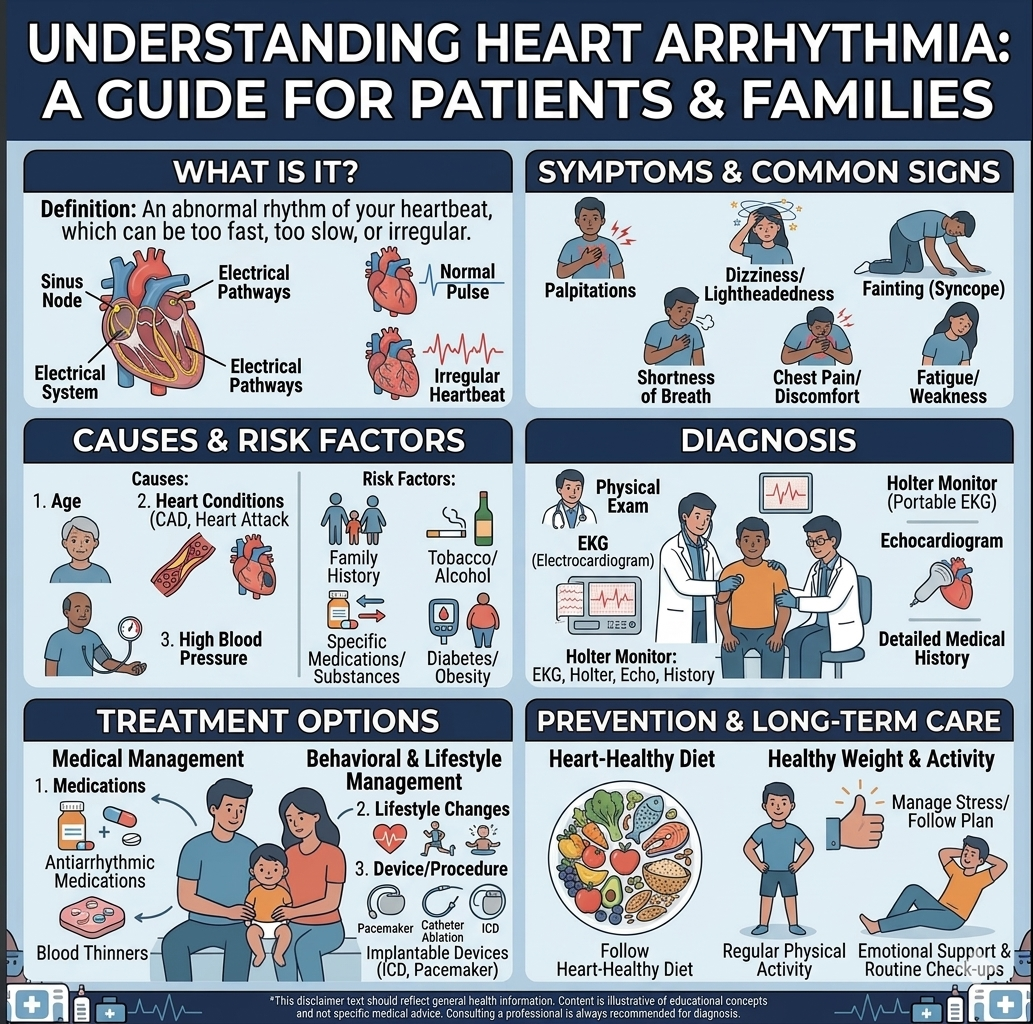
A heart arrhythmia (uh-RITH-me-uh) is an irregular heartbeat, meaning your heart may beat too fast, too slow, or with an inconsistent pattern. This happens when the electrical signals that control your heart's rhythm don't work properly. While some arrhythmias are harmless, others can lead to serious health problems or even be life-threatening. Your heart rate naturally changes with activity (faster during exercise, slower during sleep), but an arrhythmia refers to an abnormal rhythm at inappropriate times. Treatments aim to regulate the heartbeat, often involving lifestyle changes, medications, devices, or procedures. Arrhythmias are generally grouped by heart rate: Tachycardia (tak-ih-KAHR-dee-uh) is a fast heart rate (over 100 beats per minute), and Bradycardia (brad-e-KAHR-dee-uh) is a slow heart rate (under 60 beats per minute).
Understanding the Condition
Heart Arrhythmia: Understanding and Managing Irregular Heartbeats
Understanding the Condition
Common Symptoms
Fluttering, Pounding, or Racing Heart: Often described as 'palpitations' or a sensation of your heart skipping beats.
Fast Heartbeat: Feeling like your heart is racing unusually fast.
Slow Heartbeat: Feeling like your heart is beating unusually slowly.
Chest Pain: Discomfort, pressure, or tightness in the chest.
Shortness of Breath: Difficulty catching your breath or feeling winded easily.
Extreme Tiredness: Unusual fatigue or a significant lack of energy.
Lightheadedness or Dizziness: Feeling unsteady, woozy, or faint.
Fainting: A temporary loss of consciousness.
Consultation Guide
Which Specialist to Meet
You should consult a cardiologist, a doctor specializing in heart conditions. For more complex rhythm disorders, an electrophysiologist, a cardiologist with advanced training in the heart's electrical system, may be recommended.
Preparations Before Your Visit
Before your visit, make a detailed list of all your symptoms, including when they occur, how long they last, and what triggers them. Be ready to discuss your full medical history, any current medications or supplements you take, and any questions you have. Keeping a log of your heart rate or any unusual sensations can also be helpful.
Book a doctor visit near me
Electrodes are attached to your chest and connected to a small recorder worn on a belt or strap. You wear the device during most daily activities, typically avoiding bathing or swimming. You might be asked to keep a diary of your activities and any symptoms.
Implantable Loop Recorder
A tiny device inserted just under the skin of the chest that continuously monitors and records heart activity for up to three years, specifically to capture rare or brief arrhythmias.
A minor surgical procedure, usually under local anesthesia, is performed to implant the small device under the skin. It records silently, and data can be wirelessly transmitted to your doctor periodically or when you activate it after experiencing symptoms.
Uses sound waves to create moving pictures of your heart, showing its structure, how blood flows through its chambers and valves, and how well it's pumping.
You'll lie flat on a special table with straps to keep you secure. Your heart rate and blood pressure will be monitored. After a period, the table will slowly tilt you upright, simulating standing. This position is maintained for a period while monitoring continues, and medication may be given to provoke symptoms.
Coronary Artery Bypass Surgery (CABG): If blockages in heart arteries are causing or worsening arrhythmias, this surgery creates new paths for blood to flow around blocked areas using healthy blood vessels from other parts of the body. Improved blood flow can reduce arrhythmia symptoms. (Duration: A one-time surgical intervention, with long-term benefits for blood flow.)
Consultation Guide
Assesses how your heart rate and blood pressure react to changes in body position, often used to determine the cause of unexplained fainting or dizziness.
Diagnostic Procedures
Electrocardiogram (ECG or EKG)
A quick, painless test that records the heart's electrical activity to check its rate and rhythm.
What to Expect
Small sticky patches (electrodes) are placed on your chest, arms, and legs, connected to a machine. You lie still for a few minutes while your heart's electrical signals are recorded. The test is usually very brief.
A wearable device that continuously records your heart's rhythm for 1-2 days (or longer) to detect infrequent irregularities that a standard ECG might miss.
What to Expect
What to Expect
What to Expect
You'll lie on a table while a technician applies gel to your chest and moves a handheld device (transducer) over the area. The transducer sends sound waves that bounce off your heart, creating images on a screen. The test is generally painless and takes about 30-60 minutes.
Evaluates how your heart works under physical exertion. It helps detect blood flow problems to the heart or arrhythmias that only appear during exercise.
What to Expect
An invasive test that creates a detailed map of the heart's electrical system to precisely identify the source of irregular heartbeats.
What to Expect
What to Expect
Treatment Options
A heart arrhythmia (uh-RITH-me-uh) is an irregular heartbeat, meaning your heart may beat too fast, too slow, or with an inconsistent pattern. This happens when the electrical signals that control your heart's rhythm don't work properly. While some arrhythmias are harmless, others can lead to serious health problems or even be life-threatening. Your heart rate naturally changes with activity (faster during exercise, slower during sleep), but an arrhythmia refers to an abnormal rhythm at inappropriate times. Treatments aim to regulate the heartbeat, often involving lifestyle changes, medications, devices, or procedures. Arrhythmias are generally grouped by heart rate: Tachycardia (tak-ih-KAHR-dee-uh) is a fast heart rate (over 100 beats per minute), and Bradycardia (brad-e-KAHR-dee-uh) is a slow heart rate (under 60 beats per minute).
Electrodes are placed on your chest to monitor your heart rate and rhythm, and a blood pressure cuff is placed on your arm. You'll walk on a treadmill or ride a stationary bike, gradually increasing the intensity. If you can't exercise, you may receive medication that mimics exercise effects on the heart.
Electrophysiology (EP) Study
Thin, flexible wires (catheters) are guided through a blood vessel (usually in the groin) to your heart. These catheters record electrical signals and can safely trigger arrhythmias to pinpoint their origin. You'll receive medication to help you relax or sleep during the procedure, which can take several hours.
Medications
Rhythm and Rate Control Medications: Prescribed drugs to control heart rate (making it slower or faster), regulate heart rhythm, or prevent blood clots (e.g., for conditions like atrial fibrillation). The specific medication depends on the arrhythmia and individual health needs. (Duration: Often long-term, possibly lifelong, depending on the condition.)
Procedures and Therapies
Cardioversion: A medical procedure that uses quick, low-energy electrical shocks delivered through paddles on the chest to reset an irregular heartbeat to a normal rhythm. It can also be done using certain medications. (Duration: Usually a one-time procedure, but may be repeated if the arrhythmia recurs.)
Cardiac Ablation: Uses thin, flexible tubes (catheters) guided to the heart to deliver heat (radiofrequency) or extreme cold (cryoablation) energy. This creates tiny scars that block faulty electrical signals causing irregular heartbeats. (Duration: A one-time procedure, but some individuals may require repeat ablations.)
Pacemaker: A small, battery-powered device surgically implanted under the skin near the collarbone. It helps the heart maintain a steady beat by sending electrical signals if the heart beats too slowly. (Duration: Implanted for long-term use (many years), with battery replacement needed periodically.)
Implantable Cardioverter-Defibrillator (ICD): A small device implanted in the chest that continuously monitors for dangerously fast or irregular heartbeats (like ventricular tachycardia or fibrillation). If detected, it delivers a brief electrical shock to restore a normal rhythm. (Duration: Implanted for long-term use (many years), with battery replacement needed periodically.)
Automated External Defibrillator (AED): A portable device found in public places or available for home use. It delivers an electrical shock to restart a heart that has suddenly stopped (sudden cardiac arrest). It provides voice instructions for use by trained or untrained individuals. (Duration: Used only during emergencies.)
Surgical Procedures
Discuss Blood Thinners: If you have certain types of arrhythmias, particularly atrial fibrillation, talk with your doctor about whether blood-thinning medication is appropriate to reduce your risk of stroke.
Adhere to Treatment Plan: Take all prescribed medications as directed and follow all recommendations for device care or post-procedure recovery for ongoing heart health.
Prevention & Long-Term Wellbeing
Prevention and Long-Term Wellbeing
Don't Smoke: Smoking significantly harms the heart and blood vessels, increasing arrhythmia risk.
Eat a Heart-Healthy Diet: Focus on fruits, vegetables, whole grains, lean proteins, and healthy fats. Limit salt, saturated and trans fats, and added sugars.
Exercise Regularly: Aim for at least 30 minutes of moderate-intensity activity most days of the week to strengthen your heart.
Maintain a Healthy Weight: Excess weight can strain the heart and increase the risk of various heart conditions, including arrhythmias.
Manage Stress: Practice relaxation techniques like meditation, yoga, or deep breathing, as stress and anxiety can sometimes trigger irregular heartbeats.
Control Underlying Conditions: Effectively manage high blood pressure, high cholesterol, and diabetes with your doctor's guidance, as these can contribute to arrhythmias.
Get Enough Sleep: Adults should aim for 7-9 hours of quality sleep nightly to support overall heart health and rhythm regulation.
Limit Caffeine and Alcohol: Excessive consumption of these substances can sometimes trigger or worsen irregular heart rhythms.
Tags & Topics
Notice an error or need an update?
Help us keep medical information accurate. Report incorrect info or suggest an edit.

