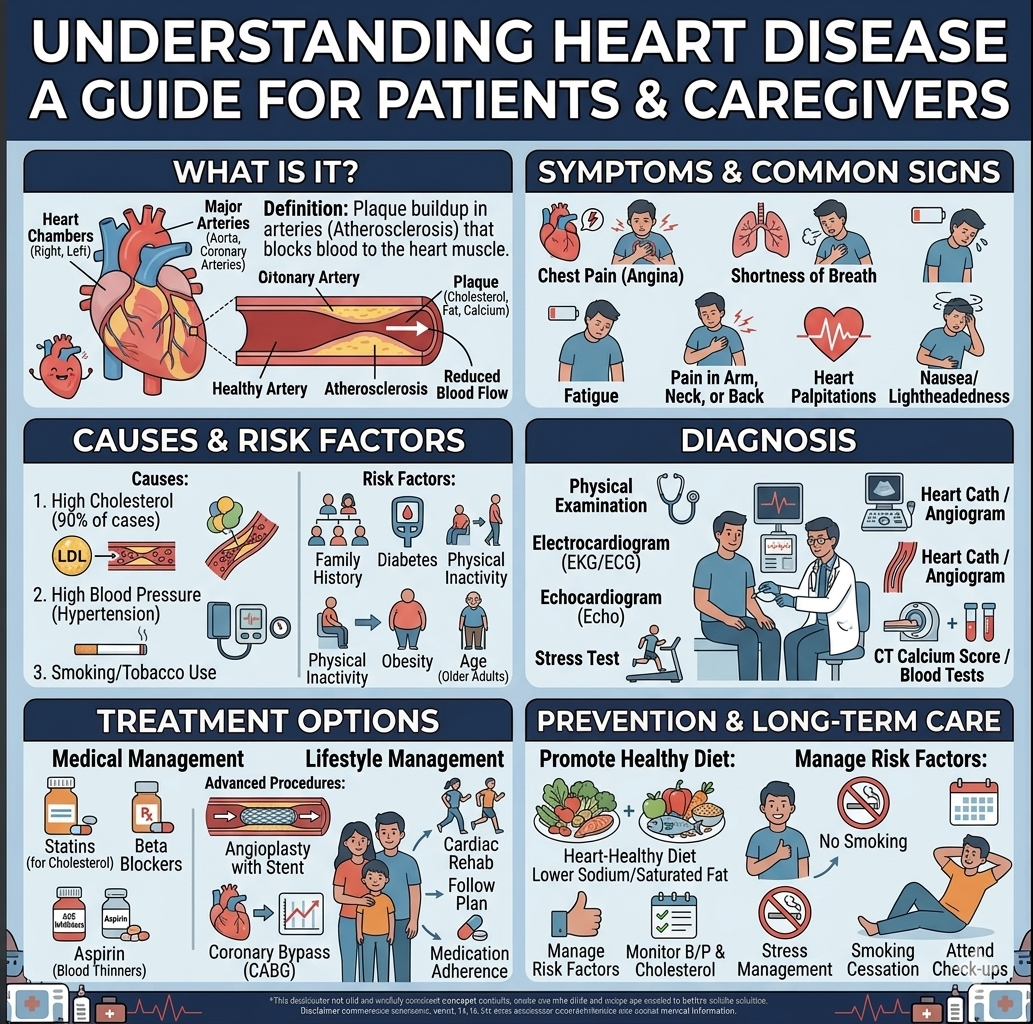
Heart disease is a broad term for various conditions affecting the heart. These conditions can impact how your heart beats, its blood vessels, muscles, or valves. Key types include blocked arteries (coronary artery disease), irregular heartbeats (arrhythmias), heart problems present at birth (congenital defects), heart muscle disease, and heart valve issues. Many forms of heart disease can be prevented or managed through healthy lifestyle choices and medical care.
Understanding the Condition
Heart Disease: Understanding Your Heart's Health
Understanding the Condition
Common Symptoms
General Heart Disease Symptoms: Symptoms depend on the specific type of heart condition. It's crucial to pay attention to any unusual changes and discuss them with a healthcare professional.
Symptoms of Blocked Arteries (Coronary Artery Disease): This common condition involves a buildup of fatty deposits (plaque) in the arteries supplying the heart, reducing blood flow. Symptoms can include chest pain, tightness, pressure, or discomfort (often called angina); shortness of breath; and pain in the neck, jaw, throat, upper belly, or back. If blood vessels in the legs or arms are narrowed, you might experience pain, numbness, weakness, or coldness in those limbs. Sometimes, this condition is only diagnosed after a heart attack, stroke, or heart failure occurs.
Symptoms of Irregular Heartbeats (Arrhythmias): When the heart beats too quickly, too slowly, or in an uneven pattern, you might feel fluttering in your chest, a racing or slow heartbeat, chest pain or discomfort, lightheadedness, shortness of breath, or even fainting or feeling like you might faint.
Consultation Guide
Which Specialist to Meet
You should first consult your primary care doctor for any heart-related concerns. If heart disease is suspected, they will likely refer you to a cardiologist, a specialist in heart conditions. For advanced cases or specific procedures, you might see electrophysiologists (for rhythm disorders) or cardiovascular surgeons.
Preparations Before Your Visit
Before your visit, make a list of all your symptoms, including when they started and how often they occur. Gather your complete medical history, including any existing conditions, past surgeries, and all current medications (prescription and over-the-counter). Note any family history of heart disease. Prepare a list of questions for your doctor.
Book a doctor visit near me
Consultation Guide
Weight Management: Maintaining a healthy weight eases strain on the heart and improves other risk factors. (Duration: Ongoing)
Stress Reduction: Emotional stress can negatively impact heart health. Practice relaxation techniques like meditation or yoga. (Duration: Ongoing)
Adequate Sleep: Adults should aim for 7 to 9 hours of quality sleep each night for overall health, including heart health. (Duration: Ongoing)
Good Dental Health: Regular brushing, flossing, and dental checkups prevent germs from entering the bloodstream and potentially causing heart infections. (Duration: Ongoing)
Yearly Flu Vaccination: For individuals with heart disease, a flu shot can reduce the risk of severe complications from influenza. (Duration: Annually)
Cardiac Ablation: Uses heat or cold energy delivered through catheters to create tiny scars in the heart, blocking faulty electrical signals that cause irregular heartbeats. (Duration: One-time procedure, may require repeat)
Cardiac Catheterization (Interventional): Used to open narrowed or blocked arteries (e.g., during an angiogram) or to perform other interventions like repairing heart defects. (Duration: One-time procedure, as needed)
Cardioversion: Delivers quick, low-energy electrical shocks to the chest to restore a normal heart rhythm for certain types of irregular heartbeats. (Duration: One-time procedure, may require repeat)
Coronary Angioplasty and Stents: A balloon-tipped catheter is used to widen a blocked heart artery, then a small mesh tube (stent) is typically inserted to keep the artery open and prevent re-narrowing. (Duration: One-time procedure (stent remains))
Pacemaker Implantation: A small, battery-powered device surgically placed under the skin near the collarbone to send electrical impulses to regulate a slow heartbeat. (Duration: Device lasts 5-15 years, then replaced)
Implantable Cardioverter-Defibrillator (ICD) Implantation: A small device placed in the chest to continuously monitor heart rhythm and deliver electric shocks to correct dangerously fast heartbeats. (Duration: Device lasts 5-10 years, then replaced)
Manage Chronic Conditions: Work with your healthcare team to effectively control high blood pressure, high cholesterol, and diabetes, as these are major risk factors for heart disease.
Stress Management: Chronic stress can harm the arteries and worsen other risk factors. Incorporate stress-reducing activities into your daily routine.
Good Oral Hygiene: Poor dental health can allow germs to enter the bloodstream and potentially lead to heart infections. Regular brushing, flossing, and dental checkups are important.
Long-Term Monitoring and Support
Regular Health Checkups: Routine medical visits can help detect heart disease early and monitor existing conditions, allowing for timely intervention and management.
Diagnostic Procedures
An imaging test that uses small amounts of radiation to create pictures of your heart, lungs, blood vessels, airways, and chest bones. It helps detect problems like an enlarged heart or fluid around the lungs.
What to Expect
You will stand against a plate, and an X-ray machine will take images while you briefly hold your breath. The process is quick and generally painless.
Complete Blood Count (CBC)
A routine blood test that measures various components of your blood, including red blood cells, white blood cells, and platelets. It can indicate anemia, infection, or other conditions affecting your overall health.
What to Expect
A healthcare professional will draw a sample of blood, usually from a vein in your arm, using a needle. You might feel a brief pinch or sting.
This X-ray imaging test visualizes the heart's blood vessels (coronary arteries) to check for narrowing or blockages, often used to diagnose coronary artery disease.
What to Expect
A thin, flexible tube (catheter) is inserted through a blood vessel (e.g., in the groin or arm) and guided to the heart. A special dye is injected, and X-ray images are taken as the dye flows through the arteries.
CT Scan (Computerized Tomography)
A CT scan uses X-rays from multiple angles to create detailed cross-sectional images (slices) of bones, blood vessels, and soft tissues, offering more detail than standard X-rays.
What to Expect
You will lie on a motorized table that slides into a large, donut-shaped machine. The scanner rotates around you. You might receive a contrast dye intravenously to enhance image clarity.
This test uses sound waves (ultrasound) to produce moving pictures of your heart, showing its structure, how it's pumping, and blood flow through its chambers and valves.
What to Expect
You will lie on a table. A gel is applied to your chest, and a handheld device (transducer) is moved across your skin. You will hear whooshing sounds as the images are captured.
Electrocardiogram (ECG or EKG)
A quick and painless test that records the electrical signals of your heart. It helps detect irregular heartbeats, heart attacks, or other heart problems.
What to Expect
Sticky patches (electrodes) are placed on your chest, arms, and legs. These patches are connected by wires to a machine that records your heart's electrical activity. You lie still for a few minutes.
A small, portable device that continuously records your heart's electrical activity for 24-48 hours or longer. It's used to detect irregular heartbeats that might not show up during a regular ECG.
What to Expect
Electrodes are attached to your chest and connected to a small recording device that you wear. You carry on with your normal daily activities, but typically avoid showering.
An imaging test that shows how blood flows to your heart muscle at rest and during physical activity. It uses a small amount of radioactive material (tracer) to highlight blood flow issues.
What to Expect
This test monitors how your heart responds to physical exertion. It helps identify coronary artery disease or irregular heart rhythms that become apparent during activity.
What to Expect
Treatment Options
A radioactive tracer is injected. Images are taken at rest. Then, you'll walk on a treadmill or bike (or receive medication to simulate exercise). More images are taken after exertion to compare blood flow.
You'll walk on a treadmill or ride a stationary bike while your heart rate, blood pressure, and ECG are continuously monitored. If you cannot exercise, medication can be given to mimic the effects of exercise.
Medications
Blood Pressure Control Medications: Various medications are prescribed to lower high blood pressure, reducing strain on the heart and arteries. (Duration: Ongoing)
Cholesterol-Lowering Medications: These help reduce 'bad' cholesterol levels, preventing plaque buildup in arteries. (Duration: Ongoing)
Blood Sugar Management Medications: For individuals with diabetes, these medications help control blood sugar levels, reducing heart disease risk. (Duration: Ongoing)
Anti-Arrhythmic Medications: Used to regulate abnormal heart rhythms, helping the heart beat more regularly. (Duration: Ongoing)
Blood Thinners (e.g., daily low-dose aspirin): May be recommended for some individuals at high risk to prevent blood clots. Discuss this with your doctor due to bleeding risks. (Duration: Ongoing, if prescribed)
Procedures and Devices
Coronary Artery Bypass Surgery (CABG): Creates a new path for blood flow around a blocked or partially blocked artery in the heart using a healthy blood vessel taken from another part of the body. (Duration: One-time major surgery)
Heart Transplant: A failing heart is replaced with a healthier donor heart, typically reserved for severe heart failure when other treatments are no longer effective. (Duration: One-time major surgery, lifelong monitoring and medication)
Adhere to Treatment Plans: Follow your doctor's recommendations for medications and lifestyle changes to manage your condition effectively and prevent complications.
Know Your Family History: Understanding your family's history of heart disease can help your doctor assess your personal risk and guide screening decisions.
Prevention & Long-Term Wellbeing
Heart disease is a broad term for various conditions affecting the heart. These conditions can impact how your heart beats, its blood vessels, muscles, or valves. Key types include blocked arteries (coronary artery disease), irregular heartbeats (arrhythmias), heart problems present at birth (congenital defects), heart muscle disease, and heart valve issues. Many forms of heart disease can be prevented or managed through healthy lifestyle choices and medical care.
Lifestyle and Home Remedies
Heart-Healthy Diet: Focus on fruits, vegetables, whole grains, lean proteins, and healthy fats (like those found in fish, nuts, and plant oils). Limit saturated and trans fats, excessive salt, and added sugars. (Duration: Ongoing)
Regular Physical Activity: Aim for at least 30 minutes of moderate-intensity exercise most days of the week. This helps control weight, blood pressure, cholesterol, and blood sugar. (Duration: Ongoing)
Smoking Cessation: Quitting smoking and avoiding secondhand smoke significantly reduces damage to arteries and lowers heart attack risk. (Duration: Ongoing)
Prevention and Risk Reduction
Maintain a Healthy Lifestyle: This includes eating a balanced diet rich in fruits, vegetables, and whole grains, exercising regularly, maintaining a healthy weight, and getting enough sleep (7-9 hours per night).
Avoid Tobacco Use: Smoking and exposure to secondhand smoke severely damage the heart and blood vessels. Quitting is one of the most impactful steps for heart health.
Tags & Topics
Notice an error or need an update?
Help us keep medical information accurate. Report incorrect info or suggest an edit.

