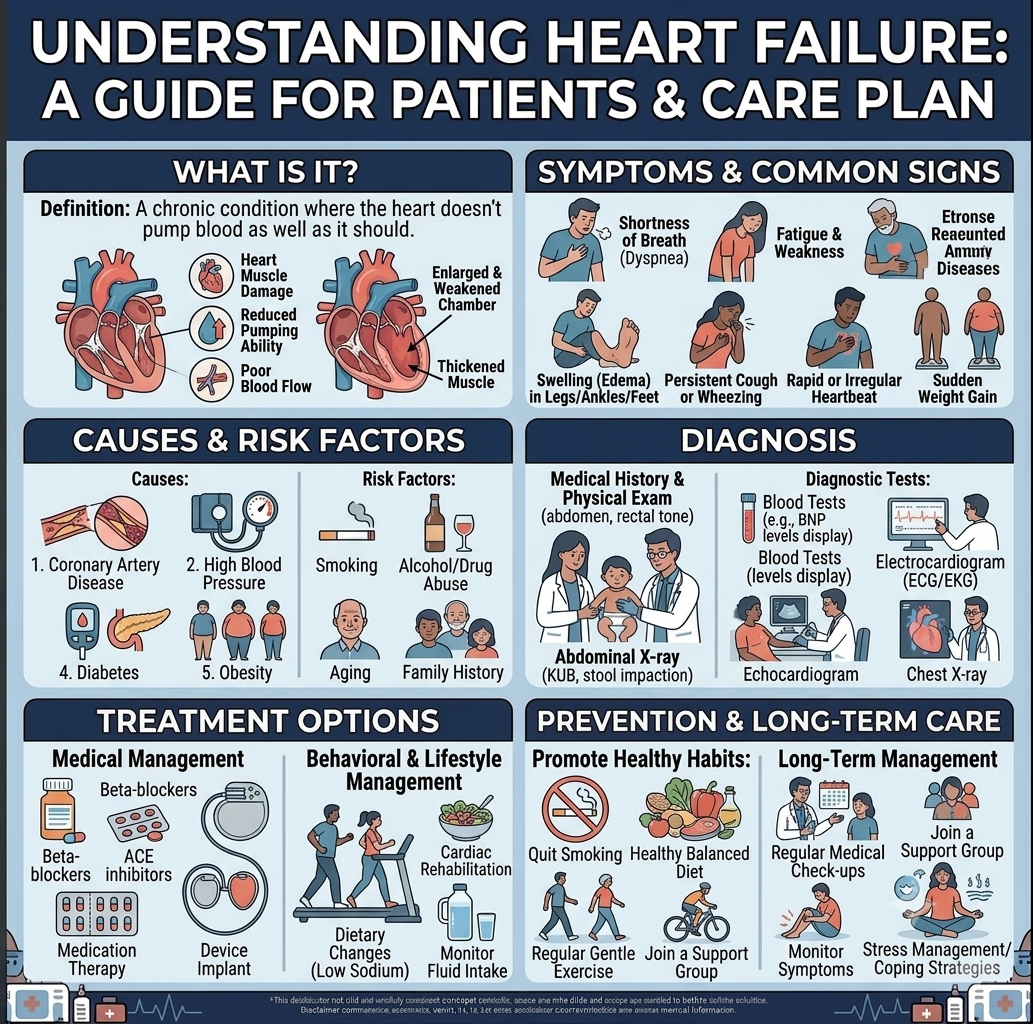
Heart failure, sometimes called congestive heart failure, is a serious condition where your heart muscle doesn't pump blood effectively enough to meet your body's needs. This can lead to blood backing up and fluid collecting in your lungs, causing breathlessness, and swelling in other body parts like your legs. Over time, conditions like narrowed heart arteries or high blood pressure can weaken or stiffen the heart, making it less efficient. While it can be life-threatening, proper treatment, lifestyle changes, and careful management can improve symptoms and quality of life.
Understanding the Condition
Understanding Heart Failure: A Guide for Non-Medical Persons
Understanding the Condition
Heart failure, sometimes called congestive heart failure, is a serious condition where your heart muscle doesn't pump blood effectively enough to meet your body's needs. This can lead to blood backing up and fluid collecting in your lungs, causing breathlessness, and swelling in other body parts like your legs. Over time, conditions like narrowed heart arteries or high blood pressure can weaken or stiffen the heart, making it less efficient. While it can be life-threatening, proper treatment, lifestyle changes, and careful management can improve symptoms and quality of life.
Common Symptoms
Breathlessness: Shortness of breath during activity or when lying down, often due to fluid buildup in the lungs. In severe cases, this can lead to wheezing, sometimes called 'cardiac asthma'.
You should consult with a general practitioner initially, who will likely refer you to a cardiologist (a heart specialist). In some cases, you may also work with a palliative care team to manage symptoms and improve quality of life.
Preparations Before Your Visit
Before your visit, make a list of all your symptoms, including when they started and how often they occur. Bring a complete list of all medications you are currently taking, including dosages and any supplements. Be prepared to discuss your medical history, family history of heart conditions, and lifestyle habits.
Book a doctor visit near me
Prescribed Medications: Various medications are used to manage symptoms, reduce the heart's workload, remove excess fluid, improve pumping function, or regulate heart rhythm. These help slow the progression of heart failure and improve quality of life. (Duration: Typically taken daily for the rest of your life, with dosages adjusted as needed.)
Palliative Care: Specialized medical care focused on providing relief from pain and other symptoms of a serious illness, improving quality of life for the patient and family. This care is provided alongside other treatments. (Duration: Ongoing, as needed throughout the course of the illness.)
Heart Failure Action Plan: Work with your healthcare team to create a personalized plan to quickly identify and respond to worsening symptoms, helping you know when to call your doctor or seek emergency care.
Regular Monitoring: Consistent follow-up appointments and tests are crucial, even if symptoms improve, to check for complications like kidney or liver damage and changes in heart function.
Consultation Guide
Fatigue and Weakness: Feeling very tired and weak, even after minimal activity, because the heart can't deliver enough oxygen-rich blood to your muscles.
Swelling (Edema): Swelling in your legs, ankles, and feet, and sometimes your belly, caused by fluid retention in the body.
Rapid or Irregular Heartbeat: A fluttering or pounding sensation in your chest, indicating your heart is working harder or has an abnormal rhythm.
Reduced Exercise Ability: Finding it harder to do physical activities you once managed easily.
Persistent Cough: A cough that doesn't go away, sometimes bringing up white, pink, or blood-tinged mucus, especially at night.
Rapid Weight Gain: Sudden increase in weight over a short period, often due to fluid accumulation.
Nausea and Poor Appetite: Feeling sick to your stomach or having a reduced desire to eat.
Difficulty Concentrating: Trouble focusing or a general decrease in mental alertness due to reduced blood flow to the brain.
Chest Pain: Pain in the chest, particularly if heart failure is a result of a heart attack.
Consultation Guide
Which Specialist to Meet
Diagnostic Procedures
Electrocardiogram (ECG or EKG)
A quick, non-invasive test that records the electrical signals of your heart to check its rhythm and activity.
What to Expect
Small, sticky patches called electrodes will be placed on your chest, and sometimes your arms or legs. Wires connect these to a machine that records your heart's electrical activity. The test takes only a few minutes, is painless, and you just need to lie still.
An imaging test that uses X-rays to create pictures of your heart, lungs, and blood vessels to check for fluid buildup or an enlarged heart.
What to Expect
You will stand or sit in front of an X-ray machine. You'll be asked to take a deep breath and hold it for a few seconds while the images are taken. It's a quick, painless procedure, and you will wear a protective lead apron.
This test uses sound waves to produce moving pictures of your heart, showing its structure, how well it pumps blood, and how your heart valves are working.
What to Expect
You'll lie on an exam table while a technician applies a gel to your chest. A device called a transducer, which sends out sound waves, will be moved across your chest. You might feel some pressure, but the test is generally painless and takes about 30-60 minutes.
A test that shows how your heart works during physical activity, usually on a treadmill or stationary bike, or using medication if you cannot exercise.
What to Expect
What to Expect
You will lie on a narrow table that slides into a large, donut-shaped machine. You'll need to lie still, and you may hear whirring noises. Sometimes, a dye is injected into a vein to make blood vessels clearer. The scan is painless and takes about 10-30 minutes.
Cardiac Catheterization
An invasive procedure where a thin, flexible tube (catheter) is guided through a blood vessel to your heart to measure pressures or take tissue samples.
What to Expect
What to Expect
Treatment Options
Electrodes will be placed on your chest to monitor your heart rate, and a blood pressure cuff will be on your arm. You'll start exercising slowly, with the intensity gradually increasing. Your heart rate, blood pressure, and breathing will be continuously monitored. If medication is used, you'll lie still while it's administered.
CT Scan (Computed Tomography Scan)
An advanced imaging technique using X-rays to create detailed cross-sectional images of your heart, lungs, and blood vessels.
You'll receive a local anesthetic to numb an area, usually in your groin or arm, where a small incision is made. The catheter is inserted and guided to your heart. You might feel pressure but generally no pain. You'll be awake but given medication to help you relax. The procedure can last 30 minutes to several hours, followed by a period of rest.
A specific type of cardiac catheterization that uses X-rays and a special dye to visualize blockages or narrowing in the heart's arteries.
This procedure is similar to cardiac catheterization. After the catheter is in place, a dye is injected through it into your arteries. X-ray images are then taken, allowing doctors to see how blood flows through your heart's vessels. You may feel a brief warm sensation from the dye. If blockages are found, treatments like opening the artery might be done immediately.
Medications
Ventricular Assist Device (VAD) Implantation: A mechanical pump surgically implanted in the chest to help a weakened heart pump blood to the rest of the body. Often used as a bridge to transplant or as a long-term solution. (Duration: Major open-heart surgery, typically several hours. The device can be used for months to many years.)
Surgical Procedures
Coronary Artery Bypass Graft (CABG) Surgery: A surgery that creates new pathways for blood to flow around blocked or narrowed heart arteries, improving blood supply to the heart muscle. (Duration: Major open-heart surgery, typically 3-6 hours. Recovery takes several weeks to months.)
Heart Transplant: A major operation to replace a severely failing heart with a healthier donor heart, usually reserved for advanced heart failure when other treatments haven't worked. (Duration: Major surgery, typically several hours. Requires lifelong medication to prevent organ rejection.)
Therapies
Follow Medical Advice: Take all prescribed medications as directed and attend regular check-ups to monitor your heart health.
Address Mental Health: Seek support for feelings of sadness, anxiety, or depression, as these can impact your ability to follow your treatment plan and overall quality of life.
Maintain Quality of Life: Discuss any concerns about daily activities, including sexual health, with your doctor. Cardiac rehabilitation and counseling can help maintain intimacy and activity levels safely.
Prevention & Long-Term Wellbeing
Home Remedies and Lifestyle Changes
Dietary Adjustments: Following a heart-healthy diet low in salt, saturated fats, and cholesterol, and limiting fluid intake as advised by your doctor. (Duration: Ongoing, as a permanent lifestyle change.)
Regular Exercise: Engaging in safe, consistent physical activity as recommended by your doctor, often as part of a cardiac rehabilitation program. (Duration: Ongoing, usually several times a week.)
Weight Management: Maintaining a healthy body weight to reduce the strain on your heart. (Duration: Ongoing.)
Stress Management: Finding healthy ways to cope with stress, which can impact heart health. (Duration: Ongoing.)
Pacemaker Implantation: A small device surgically placed under the skin near the collarbone to regulate a slow heartbeat by sending electrical pulses. (Duration: Surgical procedure is typically a few hours; the device lasts 5-15 years before battery replacement is needed.)
Implantable Cardioverter-Defibrillator (ICD) Implantation: A device placed in the chest to monitor heart rhythm and deliver electrical shocks to correct dangerously fast or irregular heartbeats. (Duration: Surgical procedure is typically a few hours; the device lasts 5-10 years before battery replacement is needed.)
Cardiac Rehabilitation: A supervised program including exercise training, education about heart-healthy living, and counseling to help improve heart health and strength. (Duration: Typically 6-12 weeks, with ongoing recommended lifestyle changes.)
Prevention
Manage Underlying Conditions: Effectively treat and control conditions that can lead to heart failure, such as high blood pressure, diabetes, and coronary artery disease.
Adopt a Heart-Healthy Lifestyle: Maintain a healthy weight, eat a balanced diet, exercise regularly, avoid smoking, and manage stress to protect your heart.
Tags & Topics
Notice an error or need an update?
Help us keep medical information accurate. Report incorrect info or suggest an edit.

