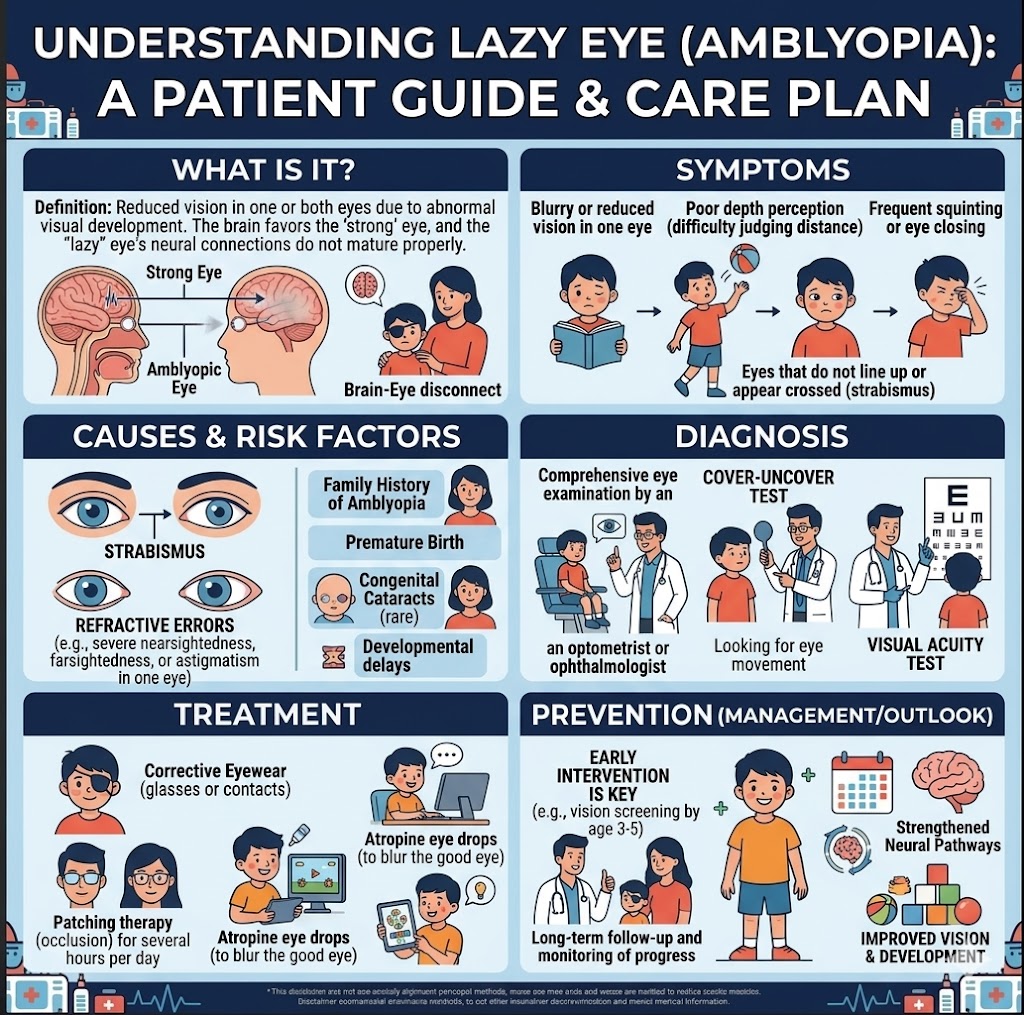
Lazy eye, medically known as amblyopia, is a condition where vision in one eye is reduced because the eye and brain are not working together effectively. This typically develops early in life, from birth up to about age seven, making it the most common cause of vision impairment in children. The weaker eye may sometimes appear to wander inward or outward. While it usually affects one eye, it can rarely impact both. Amblyopia occurs when abnormal visual experiences in early childhood disrupt the nerve pathways between the back of the eye (retina) and the brain. The brain starts to favor the stronger eye and eventually ignores or suppresses the signals from the weaker eye, leading to decreased vision that glasses alone cannot fully correct. Early detection and treatment are crucial to prevent permanent vision problems.Common causes include a significant difference in vision prescription between the eyes (like one eye being much more farsighted than the other), eyes that are misaligned (crossed eyes or eyes that turn out), or anything that blocks clear vision in one eye, such as a cataract (a clouding of the eye's natural lens).
Understanding the Condition
Understanding Lazy Eye (Amblyopia) in Children
Understanding the Condition
Common Symptoms
Eye that wanders: One eye may visibly turn inward (crossed eye) or outward, not appearing to look in the same direction as the other eye.
Eyes not working together: The child's eyes may seem to move independently rather than coordinating their gaze.
Poor depth perception: Difficulty judging distances or seeing in three dimensions.
Squinting or shutting an eye: The child may frequently squint or close one eye, especially when trying to focus.
Head tilting: Tilting the head to one side to try and see more clearly.
Abnormal vision screening results: A routine vision check may reveal that one eye has significantly poorer vision than the other.
Lack of obvious signs: Sometimes, there are no noticeable external signs, and amblyopia is only discovered during a comprehensive eye exam.
Consultation Guide
Which Specialist to Meet
If you notice any signs of a wandering eye in your child after the first few weeks of life, or if you have concerns about their vision, it is important to consult your pediatrician. They can then refer you to an eye care specialist, such as a pediatric ophthalmologist or optometrist, who specializes in children's eye health and conditions like amblyopia.
Preparations Before Your Visit
Before your visit, make a list of any symptoms you've observed in your child, including when they started and how often they occur. Be prepared to share your family's medical history, especially if there's a history of crossed eyes, childhood cataracts, or other eye conditions. You might also want to write down any questions you have for the doctor.
Book a doctor visit near me
Routine Childhood Eye Exams: Ensure your child receives regular comprehensive eye exams as recommended by your pediatrician and eye specialist. This is vital for detecting amblyopia or risk factors early, even if no symptoms are apparent. A complete eye exam is generally recommended between ages 3 and 5 for all children.
Consultation Guide
Lazy eye, medically known as amblyopia, is a condition where vision in one eye is reduced because the eye and brain are not working together effectively. This typically develops early in life, from birth up to about age seven, making it the most common cause of vision impairment in children. The weaker eye may sometimes appear to wander inward or outward. While it usually affects one eye, it can rarely impact both. Amblyopia occurs when abnormal visual experiences in early childhood disrupt the nerve pathways between the back of the eye (retina) and the brain. The brain starts to favor the stronger eye and eventually ignores or suppresses the signals from the weaker eye, leading to decreased vision that glasses alone cannot fully correct. Early detection and treatment are crucial to prevent permanent vision problems.Common causes include a significant difference in vision prescription between the eyes (like one eye being much more farsighted than the other), eyes that are misaligned (crossed eyes or eyes that turn out), or anything that blocks clear vision in one eye, such as a cataract (a clouding of the eye's natural lens).
A thorough eye examination is essential to diagnose amblyopia and identify its underlying cause. This typically includes assessing visual acuity, checking eye alignment and movement, and examining the internal structures of the eye.
The eye specialist will likely use various child-friendly tests to check your child's vision, even if they can't read an eye chart. This might involve looking at pictures, following lights, or matching shapes. They will also check how well the eyes work together and if there are any issues with eye muscles. Eye drops may be used to temporarily widen the pupils, allowing the doctor to get a clear view of the retina and optic nerve at the back of the eye and accurately determine if your child needs glasses. This part of the exam may cause temporary blurry vision and light sensitivity for a few hours.
For all children, a routine vision screening is recommended between ages 3 and 5, often as part of a regular check-up or at school, to catch potential vision problems like amblyopia early.
Cataract Removal Surgery: If amblyopia is caused by a cataract (clouding of the eye's natural lens), surgery is performed to remove the cloudy lens, allowing light to enter the eye clearly. This is often followed by corrective lenses or other treatments. (Duration: A single surgical procedure, with recovery typically taking a few weeks. Follow-up treatment for amblyopia is almost always needed.)
Eye Muscle Surgery (Strabismus Surgery): For amblyopia caused by misaligned eyes (strabismus), surgery can be performed to adjust the eye muscles, helping to align the eyes. While it improves eye alignment, vision therapy or other amblyopia treatments are usually still necessary to improve vision itself. (Duration: A single surgical procedure, with recovery typically taking a few weeks. Ongoing amblyopia treatment may continue for months to years.)
Targeted Eye Exercises: Specific exercises and activities, often supervised by an eye care professional, are designed to improve the coordination between the eyes, enhance focusing skills, and strengthen the weaker eye. This may include computer-based programs or prism glasses. (Duration: Sessions typically occur weekly over several months, with daily exercises performed at home. Total duration varies based on individual progress.)
Diagnostic Procedures
Comprehensive Eye Exam
What to Expect
What to Expect
A healthcare provider or trained screener will use charts with letters, numbers, or shapes that your child can identify from a distance. For very young children, they may use a special device that can detect differences in how light reflects off each eye, indicating a need for further evaluation by an eye specialist. This screening is usually quick and non-invasive.
Treatment Options
Corrective Lenses and Occlusion Therapy
Corrective Eyewear: Glasses or contact lenses are prescribed to correct significant refractive errors (like farsightedness, nearsightedness, or astigmatism) in one or both eyes. This ensures both eyes are sending clear images to the brain. (Duration: Ongoing, often for several years during childhood, with regular adjustments as vision changes.)
Eye Patching (Occlusion Therapy): The child wears a patch over the stronger, unaffected eye for several hours a day. This forces the weaker, lazy eye to work harder, stimulating the brain-eye connection and improving vision in the amblyopic eye. (Duration: Typically for a few hours daily, ranging from several weeks to months or even years, depending on the severity and response to treatment. Close monitoring by an eye specialist is required.)
Blurring Eye Drops (Penalization Therapy): Eye drops, often containing a medication that temporarily blurs the vision in the stronger eye, are used as an alternative to patching. This encourages the weaker eye to take over and strengthen. (Duration: Daily or several times a week, over several months to years, with dosage and frequency adjusted by an eye specialist.)
Surgical Procedures
Prompt Treatment of Underlying Conditions: Address any conditions that can lead to amblyopia, such as cataracts, significant refractive errors, or strabismus, as soon as they are identified. Early intervention is key to successful outcomes.
Long-Term Management and Monitoring
Consistent Adherence to Treatment Plan: Follow the prescribed treatment plan diligently, whether it involves wearing glasses, patching, using eye drops, or performing exercises. Consistency is crucial for the success of amblyopia therapy.
Regular Follow-Up Appointments: Attend all scheduled follow-up appointments with the eye specialist to monitor progress, make necessary adjustments to treatment, and ensure the amblyopia does not recur, particularly during the critical period of visual development.
Support and Encouragement: Provide a supportive environment for your child, encouraging them to comply with treatment. Explain the importance of the treatment in simple terms, and celebrate small victories to maintain motivation.
Prevention & Long-Term Wellbeing
Prevention and Early Detection
Tags & Topics
Notice an error or need an update?
Help us keep medical information accurate. Report incorrect info or suggest an edit.


