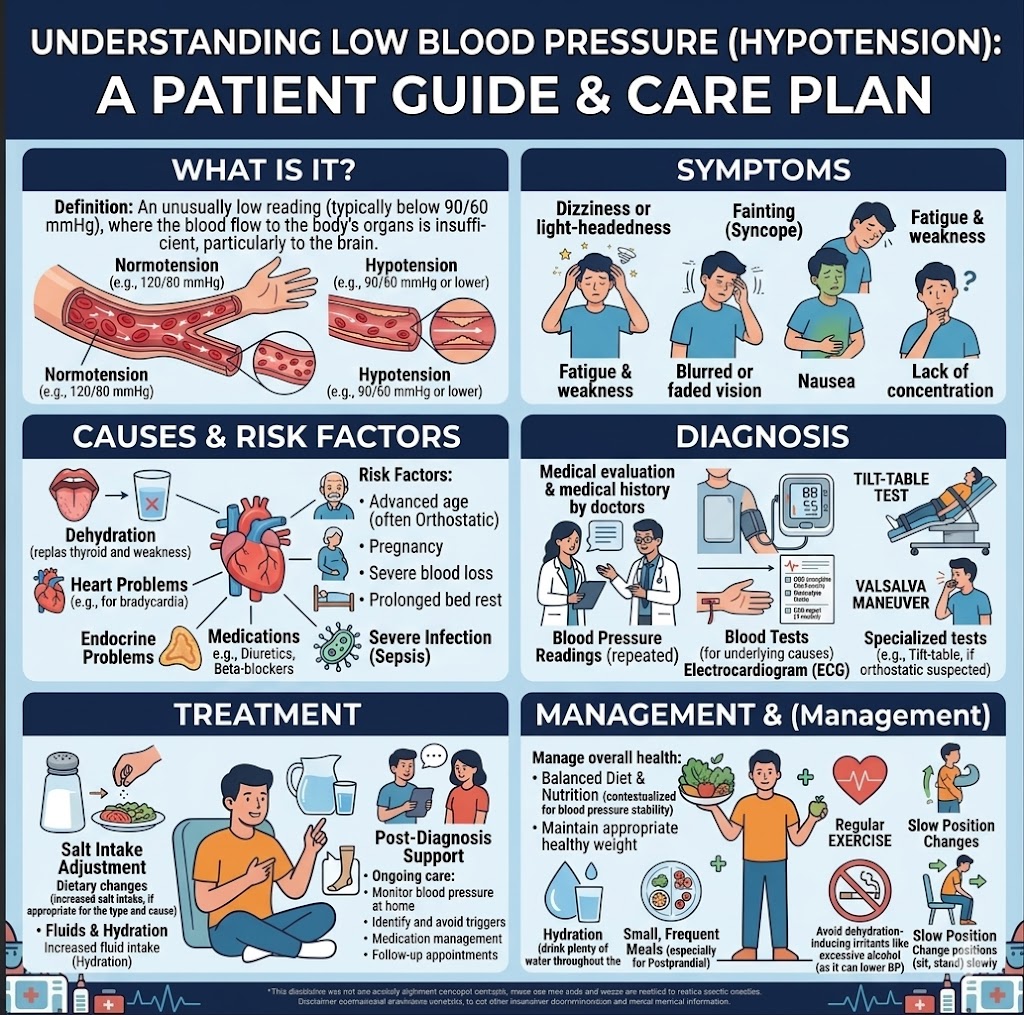
Low blood pressure, or hypotension, occurs when the force of blood pushing against your artery walls is lower than normal—typically defined as a reading below 90/60 mm Hg. While some people live naturally with low blood pressure and experience no symptoms, for others, it can cause dizziness, fainting, or indicate serious underlying health issues. Key types include orthostatic (sudden drop when standing), postprandial (drop after eating), neurally mediated (drop after standing too long), and multiple system atrophy with orthostatic hypotension (a rare nervous system disorder).
Understanding the Condition
Understanding Low Blood Pressure (Hypotension)
Understanding the Condition
Low blood pressure, or hypotension, occurs when the force of blood pushing against your artery walls is lower than normal—typically defined as a reading below 90/60 mm Hg. While some people live naturally with low blood pressure and experience no symptoms, for others, it can cause dizziness, fainting, or indicate serious underlying health issues. Key types include orthostatic (sudden drop when standing), postprandial (drop after eating), neurally mediated (drop after standing too long), and multiple system atrophy with orthostatic hypotension (a rare nervous system disorder).
Common Symptoms
Dizziness and Lightheadedness: A feeling of spinning, instability, or faintness, often triggered by standing up too quickly.
Blurred or Fading Vision: Temporary loss of visual clarity or a feeling that your surroundings are fading or dimming.
Trouble Concentrating: Difficulty focusing on tasks, processing thoughts, or maintaining mental clarity.
Nausea: An unsettled, upset stomach that sometimes accompanies sudden drops in pressure.
Shock: A life-threatening condition caused by extremely low blood pressure. Symptoms include confusion, cold or clammy skin, pale skin color (pallor), rapid and shallow breathing, and a weak, rapid pulse.
Consultation Guide
Which Specialist to Meet
Keep a daily log of your blood pressure readings, symptoms, and the times they occur. Note any specific triggers, such as eating a heavy meal or standing for long periods. Bring a complete list of all medications, over-the-counter drugs, and supplements you take.
Book a doctor visit near me
You will lie flat on a motorized table and be secured with safety straps. After a period of rest, the table is tilted upright to simulate a standing position. Your heart rate and blood pressure are continuously monitored for up to 45 minutes to see if the position change triggers symptoms.
Blood Vessel Constrictors: Prescription medications designed to prevent blood vessels from widening too much, which helps maintain higher blood pressure. (Duration: Long-term daily use, often adjusted based on symptom severity.)
Consultation Guide
You should start by consulting your Primary Care Physician (PCP). Depending on the suspected cause, you may be referred to a Cardiologist (heart specialist) or a Neurologist (nervous system specialist).
Preparations Before Your Visit
Diagnostic Procedures
A quick, routine test that measures the pressure in your arteries while your heart beats and rests.
What to Expect
An inflatable cuff is wrapped around your upper arm. The cuff will inflate, squeezing your arm tightly for a few seconds, and then slowly deflate. It is painless, though the brief squeezing sensation can feel slightly uncomfortable.
Electrocardiogram (ECG or EKG)
A noninvasive test that records the electrical signals of your heart to detect rhythm abnormalities or structural issues.
What to Expect
You will lie flat on a table. A technician will place several sticky patches (electrodes) on your chest, arms, and legs. Wires connect these patches to a machine that records your heart rhythm. The test takes about 5 to 10 minutes and is entirely painless.
An ultrasound of the heart that uses sound waves to produce live images of your heart chambers, valves, and blood flow.
What to Expect
You will lie on your side while a technician applies a cool gel to your chest. They will press and move a hand-held device (transducer) across your chest to capture images. You may hear whooshing sounds during the test, which takes 30 to 60 minutes.
An evaluation of how well your heart functions when it is working hard during physical activity.
What to Expect
A diagnostic procedure used to evaluate how your nervous system and heart react when you change body positions.
What to Expect
Treatment Options
You will walk on a treadmill or ride a stationary bike while connected to an ECG machine and blood pressure monitor. The exercise intensity will gradually increase. If you are unable to exercise, you will receive an intravenous medication that mimics the heart-rate increase of exercise.
Pharmacological Treatments
Blood Volume Expanders: Prescription medications that help your kidneys retain sodium and fluid, thereby increasing overall blood volume. (Duration: Typically continuous/long-term daily use.)
Prevention & Long-Term Wellbeing
Lifestyle and Dietary Adjustments
Increased Salt and Water Intake: Consuming more sodium (under medical supervision) and fluids to expand blood volume and raise blood pressure. (Duration: Ongoing/Long-term management.)
Small, Low-Carbohydrate Meals: Eating smaller meals more frequently throughout the day to prevent post-meal blood pressure drops. (Duration: Lifelong dietary habit.)
Physical Therapies and Devices
Compression Stockings: Wearing elastic stockings that apply gentle pressure to the legs and abdomen, preventing blood from pooling in the lower body. (Duration: Daily use during waking hours, indefinitely.)
Prevention and Daily Living
Change Positions Slowly: Transition gradually when moving from lying down to sitting, and from sitting to standing, to give your body time to adjust.
Stay Well Hydrated: Drink plenty of water consistently throughout the day, especially in hot weather or when exercising, to prevent dehydration.
Limit or Avoid Alcohol: Avoid alcoholic beverages, as they can dehydrate the body and widen blood vessels, lowering blood pressure further.
Long-Term Monitoring
At-Home Blood Pressure Tracking: Use an automatic, electronic home blood pressure monitor to track your readings and share the log with your doctor during visits.
Tags & Topics
Notice an error or need an update?
Help us keep medical information accurate. Report incorrect info or suggest an edit.

