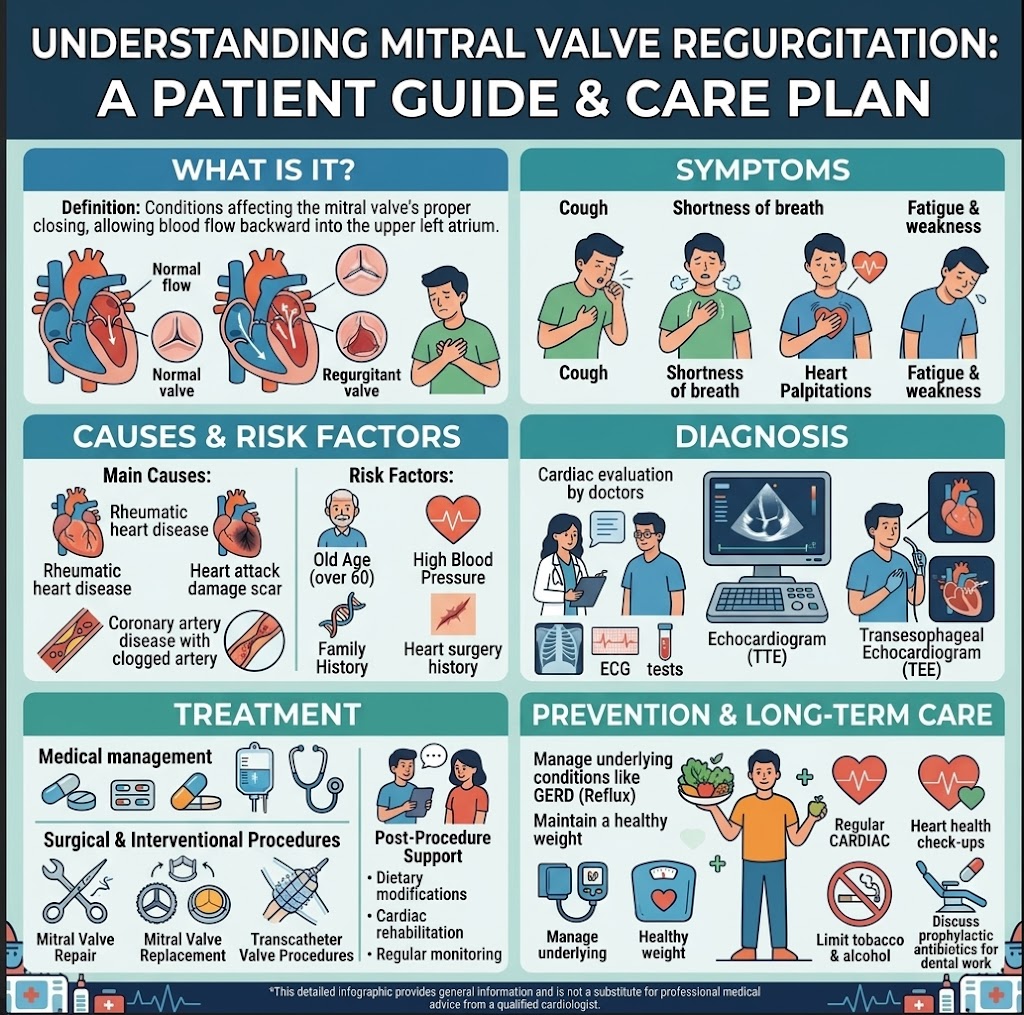
Mitral valve regurgitation is the most common type of heart valve disease. In a healthy heart, the mitral valve acts as a one-way gate, keeping blood flowing forward. In this condition, the valve's flaps fail to close tightly, allowing blood to leak backward. This leakage forces the heart to work much harder to pump blood to the rest of your body, which can eventually lead to fatigue, shortness of breath, or heart failure if left untreated.
Understanding the Condition
Mitral Valve Regurgitation: Understanding Your Leaky Heart Valve
Understanding the Condition
Mitral valve regurgitation is the most common type of heart valve disease. In a healthy heart, the mitral valve acts as a one-way gate, keeping blood flowing forward. In this condition, the valve's flaps fail to close tightly, allowing blood to leak backward. This leakage forces the heart to work much harder to pump blood to the rest of your body, which can eventually lead to fatigue, shortness of breath, or heart failure if left untreated.
Common Symptoms
Before your appointment, write down any symptoms you are experiencing, even if they seem unrelated. Create a list of all your medications, vitamins, and supplements. Gather your medical history, including any family history of heart disease, and prepare a list of questions to ask your doctor.
Book a doctor visit near me
A technician will attach sticky electrodes to your chest and connect them to a small recording device that you can clip to your belt or wear on a strap. You will keep a log of your daily activities and any symptoms you feel.
A test that monitors how your heart and blood vessels respond to physical exertion, showing if your symptoms get worse when your heart pumps harder.
Watchful Waiting: For mild or moderate valve leakage without symptoms, your cardiologist will perform regular checkups and echocardiograms to monitor the condition. (Duration: Ongoing; indefinitely as long as the condition remains stable.)
Fluid-Reducing Medications (Diuretics): These medications help your kidneys flush excess salt and water out of your body, reducing swelling in your legs and relieving pressure in your lungs. (Duration: Typically lifelong or as directed by your doctor to manage symptoms.)
Monitor Blood Pressure and Symptoms: Check your blood pressure and body weight daily. A sudden increase in weight can indicate that your body is retaining fluid, which is a warning sign of worsening heart function.
Consultation Guide
Unusual Fatigue: Feeling constantly exhausted or worn out, even after getting plenty of rest, because your body is not receiving enough oxygen-rich blood.
Shortness of Breath: Difficulty breathing or feeling winded, especially during physical activity or when lying flat in bed.
Heart Palpitations: A sensation that your heart is racing, pounding, fluttering, or skipping beats.
Swollen Feet or Ankles: Fluid buildup (edema) in your lower legs and feet caused by the heart's reduced ability to circulate blood efficiently.
Irregular Heart Rhythm: An uneven or chaotic heartbeat, also known as an arrhythmia, which can make you feel dizzy or lightheaded.
Consultation Guide
Which Specialist to Meet
Diagnostic Procedures
You should meet with a cardiologist, a medical doctor who specializes in diagnosing and treating heart conditions. If your valve requires repair or replacement, you will also consult with a cardiothoracic surgeon, a specialist in heart surgeries.
Preparations Before Your Visit
Echocardiogram (Heart Ultrasound)
An imaging test that uses high-frequency sound waves to create live pictures of your heart in motion, showing how well blood flows through your valves.
What to Expect
A technician will apply gel to your chest and press a small hand-held wand called a transducer against your skin. The test is completely painless and takes about 30 to 60 minutes.
Electrocardiogram (ECG or EKG)
A quick, non-invasive test that measures and records the electrical activity of your heart to detect irregular heartbeats or signs of heart strain.
What to Expect
You will lie flat while a technician places several sticky, small patches (electrodes) on your chest, arms, and legs. You must lie still for a few minutes while the machine records your heart's signals.
An imaging test that uses a small amount of radiation to take a picture of your heart, lungs, and blood vessels to check for heart enlargement or fluid in the lungs.
What to Expect
You will stand or sit in front of an X-ray machine and will be asked to hold your breath for a few seconds while the image is taken. It is fast and painless.
Cardiac Catheterization
An invasive diagnostic procedure used to measure pressures in your heart chambers and evaluate blood flow through the valves.
What to Expect
You will receive a local anesthetic and mild sedation. A doctor will insert a thin, flexible tube (catheter) into a blood vessel in your groin or wrist and gently guide it to your heart. You may feel a warm flush as contrast dye is injected to capture detailed images.
A portable ECG device that continuously records your heart's electrical activity over a 24- to 48-hour period while you go about your normal routine.
What to Expect
What to Expect
Treatment Options
You will walk on a treadmill or ride a stationary bike while connected to ECG monitors and a blood pressure cuff. The exercise will slowly get more challenging. If you cannot exercise, you will receive a medication through an IV that safely mimics the effects of exercise on your heart.
Medications & Active Surveillance
Blood Pressure and Rhythm Regulators: Medicines used to lower blood pressure, which reduces the strain on your heart, and drugs that prevent blood clots or control irregular heart rhythms. (Duration: Usually a lifelong daily treatment plan.)
Surgical and Minimally Invasive Procedures
Mitral Valve Repair: The preferred surgical option where the surgeon preserves and fixes your own heart valve by patching tears, reshaping the leaflets, or placing a supportive ring around the valve base. (Duration: One-time surgery; hospital stay is typically 4 to 7 days, with a recovery period of 4 to 8 weeks.)
Mitral Valve Replacement: If your valve cannot be repaired, the surgeon removes it and replaces it with either a mechanical valve (made of metal/carbon) or a biological tissue valve (made from animal tissue). (Duration: One-time surgery; mechanical valves last a lifetime but require lifelong blood thinners; tissue valves last 10 to 15 years and may eventually need to be replaced.)
Transcatheter Valve Repair (Mitral Clip): A minimally invasive alternative for patients too weak for open-heart surgery. A clip is guided through a leg vein to the heart to clip the leaky valve flaps together, reducing backward blood flow. (Duration: One-time procedure; hospital stay is typically 1 to 2 days, with a rapid recovery of about 1 week.)
Prevention & Long-Term Wellbeing
Prevention & Lifestyle Adjustments
Adopt a Heart-Healthy Diet: Eat a diet rich in fruits, vegetables, whole grains, and lean proteins while drastically reducing your salt intake to prevent fluid retention and high blood pressure.
Engage in Doctor-Approved Exercise: Participate in regular, low-to-moderate physical activity like walking or swimming to strengthen your cardiovascular system, ensuring you discuss safe limits with your cardiologist.
Quit Smoking and Limit Alcohol: Avoid all tobacco products and limit alcohol consumption to protect your heart muscle from extra damage and reduce the risk of irregular heart rhythms.
Long-Term Monitoring & Infection Control
Maintain Excellent Dental Hygiene: Brush and floss daily and visit your dentist regularly. Bacteria from dental infections can enter your bloodstream and infect damaged heart valves, a condition called endocarditis.
Tags & Topics
Notice an error or need an update?
Help us keep medical information accurate. Report incorrect info or suggest an edit.

