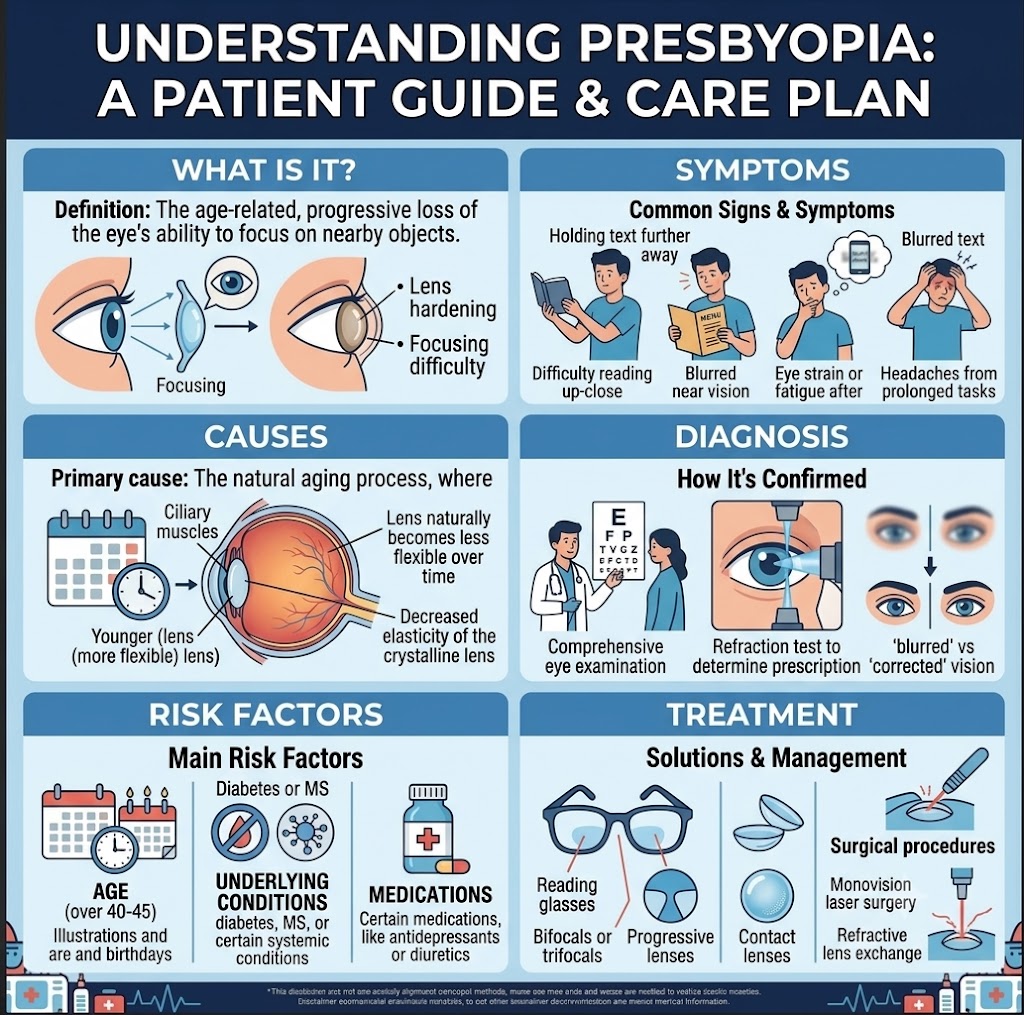
Presbyopia is a common eye condition where your eyes gradually lose the ability to focus on close-up objects. It's a natural part of aging, typically becoming noticeable in your early to mid-40s and progressing until around age 65. You might first notice it when you need to hold reading material farther away to see clearly. A routine eye exam can identify presbyopia, and it can be effectively managed with corrective lenses or, in some cases, surgery.
Understanding the Condition
Presbyopia: Understanding Age-Related Farsightedness
Understanding the Condition
Common Symptoms
Blurred Close-Up Vision: Difficulty seeing objects clearly at normal reading distance, such as text on a book or phone.
Holding Reading Material Farther Away: A tendency to extend your arms to make letters or objects clearer.
Eyestrain and Headaches: Discomfort or pain in and around the eyes, or headaches, particularly after reading or doing detailed close-up work. These symptoms can worsen when you are tired or in dim lighting.
When to Seek Immediate Medical Care: Consult an eye doctor if blurry close-up vision interferes with your daily activities. Seek immediate medical care if you experience any of the following, as they could indicate a more serious condition: a sudden loss of vision in one eye (with or without pain), sudden hazy or blurred vision, seeing flashes of light, new black spots (floaters), or halos around lights, or experiencing double vision.
Consultation Guide
Which Specialist to Meet
Before your appointment, gather your current glasses or contact lenses, a list of all medications you are taking (including over-the-counter drugs and supplements), any questions you have about your vision, and details about your family's medical history, especially any eye conditions. It is also helpful to note down when you first noticed your symptoms and how they impact your daily life.
Book a doctor visit near me
Diagnostic Procedures
Comprehensive Eye Exam
A comprehensive eye exam is used to diagnose presbyopia and assess overall eye health. This exam helps your eye doctor determine the extent of your vision changes and rule out other conditions.
What to Expect
During the exam, you'll typically undergo several tests. You'll read letters from an eye chart at various distances to test your visual acuity. A refraction test will measure how light bends as it passes through your eye; the doctor will use a device called a phoropter to quickly switch lenses in front of your eyes, asking which one makes your vision clearer. You may also have a dilated eye exam, where drops are used to widen your pupils, allowing the doctor a better view of the back of your eye (retina and optic nerve) to check for any other eye conditions. This can make your vision blurry and sensitive to light for several hours after.
Treatment Options
Presbyopia is a common eye condition where your eyes gradually lose the ability to focus on close-up objects. It's a natural part of aging, typically becoming noticeable in your early to mid-40s and progressing until around age 65. You might first notice it when you need to hold reading material farther away to see clearly. A routine eye exam can identify presbyopia, and it can be effectively managed with corrective lenses or, in some cases, surgery.
To address presbyopia and other eye health concerns, you should consult an eye care professional. This includes an Optometrist, who provides primary vision care, or an Ophthalmologist, a medical doctor specializing in eye and vision care who can also perform surgery.
Preparations Before Your Visit
Reading Glasses: Available without prescription for mild presbyopia, or customized with a prescription for more precise correction. These are typically worn only for close-up tasks. (Duration: Used as needed, ongoing.)
Bifocals, Trifocals, and Progressive Lenses: These prescription lenses offer multiple viewing zones within one lens. Bifocals have two distinct power segments (for distance and near vision), trifocals add an intermediate-distance segment, and progressive lenses transition smoothly between distance, intermediate, and near vision without visible lines. (Duration: Used continuously or as needed, ongoing.)
Multifocal and Monovision Contact Lenses: Multifocal contact lenses allow you to see clearly at multiple distances, similar to progressive eyeglasses. Monovision involves wearing a contact lens in one eye for distance vision and a different lens in the other eye for close-up vision, allowing your brain to adapt. (Duration: Worn daily or extended wear, ongoing.)
Surgical Procedures
Refractive Surgery: This type of surgery aims to reshape the cornea (the clear front surface of the eye) to improve its focusing power. While general refractive surgeries primarily correct distance vision, specific techniques can create a monovision effect or incorporate multifocal patterns to address presbyopia. (Duration: Generally a one-time procedure; results may vary over time.)
Prevention & Long-Term Wellbeing
Prevention and Long-Term Eye Health
Regular Eye Exams: Schedule routine comprehensive eye exams, especially after age 40, to monitor vision changes and detect any eye conditions early.
Manage Chronic Health Conditions: If you have conditions like diabetes, high blood pressure, or cardiovascular disease, work closely with your doctor to manage them, as they can impact eye health and potentially worsen presbyopia.
Protect Your Eyes from the Sun: Wear sunglasses that block 99% or 100% of UVA and UVB radiation when outdoors, as prolonged sun exposure can contribute to eye damage.
Use Good Lighting: Ensure adequate and bright lighting when reading or doing close-up work to reduce eye strain and improve clarity.
Take Vision Breaks: Follow the '20-20-20 rule': every 20 minutes, look away from your close-up work at an object 20 feet away for at least 20 seconds. This helps reduce eye fatigue.
Use Corrective Lenses as Prescribed: Always wear your prescribed eyeglasses or contact lenses for the activities they are intended, even if your vision seems only slightly blurred without them.
Tags & Topics
Notice an error or need an update?
Help us keep medical information accurate. Report incorrect info or suggest an edit.


