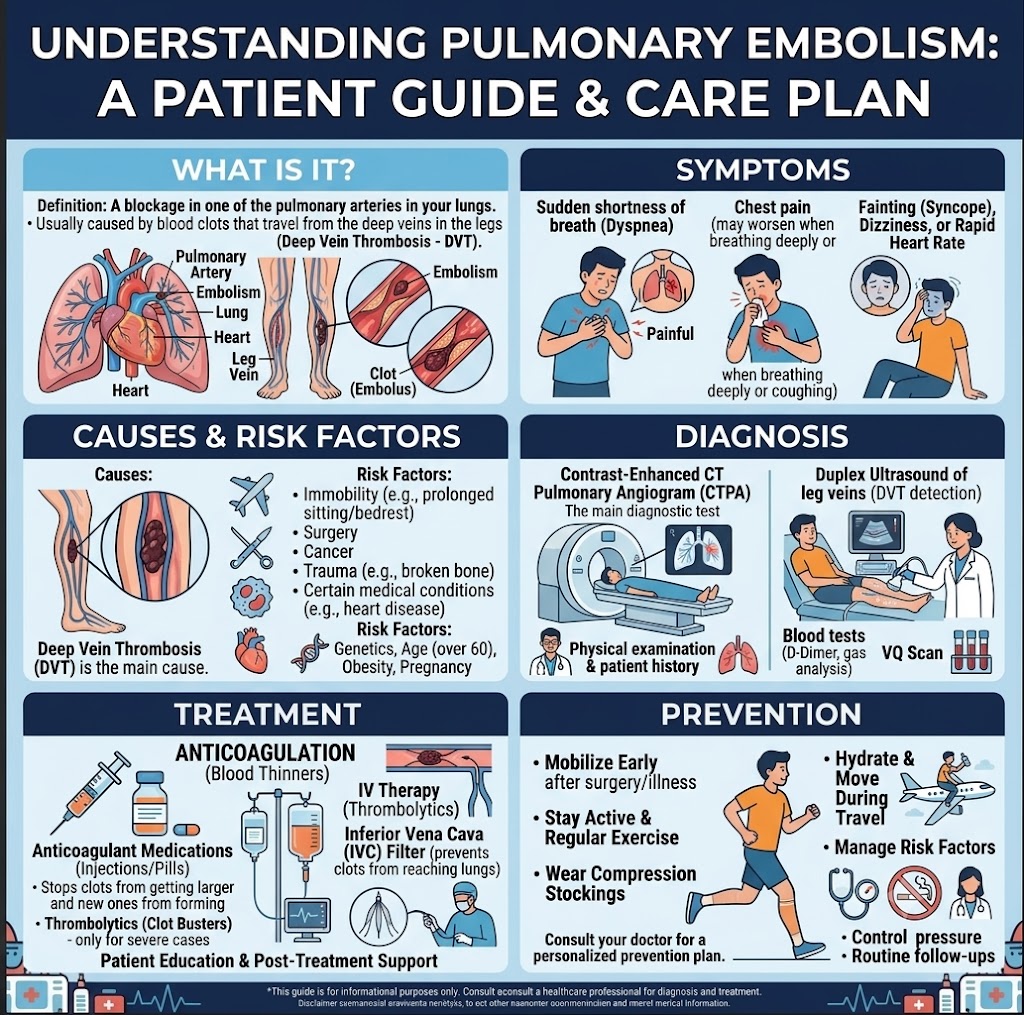
A pulmonary embolism (PE) is a serious medical condition where a blood clot blocks an artery in the lungs, stopping blood flow to that part of the lung. Most commonly, these clots originate in deep veins of the legs and travel to the lungs. Because it can quickly restrict oxygen supply, PE can be life-threatening. However, receiving quick diagnosis and treatment significantly improves the chance of recovery. Preventive measures, especially against blood clots in the legs, are crucial.
Understanding the Condition
Pulmonary Embolism: Understanding Blood Clots in the Lungs
Understanding the Condition
Common Symptoms
Shortness of Breath: Often appears suddenly, with trouble catching your breath even at rest, worsening with physical activity.
Chest Pain: Sharp chest pain, often mistaken for a heart attack, worsening with deep breaths, coughing, bending, or leaning. It can make deep breathing difficult.
If you experience symptoms suggestive of a pulmonary embolism, seek immediate medical attention from an emergency physician. For ongoing care or less urgent concerns related to clot prevention, you might consult a general practitioner, a lung specialist (pulmonologist), or a heart specialist (cardiologist). A blood disorder specialist (hematologist) may also be involved for clotting disorders.
Preparations Before Your Visit
When preparing for your visit, provide details on symptoms, recent medical history (including surgeries or long periods of inactivity), current medications (including supplements), and any family history of blood clots.
Book a doctor visit near me
A chest X-ray uses a small amount of radiation to create pictures of your heart, lungs, blood vessels, airways, and bones. It helps identify issues like fluid around the lungs or lung collapse, and can rule out other conditions with similar symptoms, though it doesn't directly diagnose PE.
Ultrasound uses high-frequency sound waves to create live internal images. It's crucial for detecting deep vein thrombosis (DVT), blood clots in leg veins that can travel to the lungs. While not directly imaging lung clots, finding a DVT strongly supports a PE diagnosis when symptoms are present.
Clot-Dissolving Medications (Thrombolytics): Given intravenously, these powerful medications rapidly dissolve large, life-threatening blood clots that are causing severe symptoms. (Duration: Administered as a single infusion or over several hours in an emergency setting.)
Recognize Warning Signs: Be aware of symptoms for recurrent pulmonary embolism or deep vein thrombosis and seek immediate medical attention if they reappear.
Consultation Guide
A pulmonary embolism (PE) is a serious medical condition where a blood clot blocks an artery in the lungs, stopping blood flow to that part of the lung. Most commonly, these clots originate in deep veins of the legs and travel to the lungs. Because it can quickly restrict oxygen supply, PE can be life-threatening. However, receiving quick diagnosis and treatment significantly improves the chance of recovery. Preventive measures, especially against blood clots in the legs, are crucial.
Fainting: A sudden drop in heart rate or blood pressure can cause a temporary loss of consciousness (syncope).
Cough: May produce mucus that is bloody or streaked with blood.
Rapid or Irregular Heartbeat: Your heart might beat unusually fast or unevenly.
Lightheadedness or Dizziness: Feeling unsteady or faint.
Excessive Sweating: Unusual or profuse perspiration.
Leg Pain or Swelling: Typically in the back of the lower leg, often indicating a deep vein clot where the embolism originated.
Clammy or Discolored Skin: The skin may appear cool, damp, and bluish or grayish, especially around the lips or fingertips (cyanosis).
Consultation Guide
Which Specialist to Meet
You will lie on a motorized table that slides into a large, donut-shaped machine. An IV line will be inserted for a contrast dye, which might cause a warm sensation or metallic taste. You will be asked to remain still and may hold your breath briefly. The scan typically takes 15-30 minutes.
Blood Thinners (Anticoagulants): These medications reduce the blood's ability to form new clots and help prevent existing ones from growing, allowing your body time to naturally dissolve them. (Duration: Typically taken for at least three to six months, and sometimes longer or indefinitely, depending on the cause and risk of recurrence.)
Diagnostic Procedures
What to Expect
You will typically stand or sit in front of an X-ray machine. You might be asked to take a deep breath and hold it for a few seconds. The process is quick, usually taking only a few minutes, and is painless. You may need to remove jewelry and wear a gown.
CT scan (Computerized Tomography Scan)
A CT scan uses X-rays and computer processing to create detailed cross-sectional images of body structures, including blood vessels. For PE diagnosis, a CT pulmonary angiogram (CTPA) is often used, involving a contrast dye injection to highlight lung arteries and detect blockages.
What to Expect
What to Expect
You will lie on an examination table. A gel will be applied to the skin over the area being examined (e.g., your leg). A healthcare professional will press a small, handheld device (transducer) against your skin and move it around. The procedure is generally painless, though you might feel some pressure.
Treatment Options
Medications
Catheter-Directed Procedures: A catheter guided through blood vessels to the lung clot delivers clot-dissolving medication directly or uses devices to break up/remove the clot. (Duration: A single procedure, typically lasting a few hours, followed by hospital recovery.)
Clot Removal (Pulmonary Embolectomy): Surgical removal of very large, life-threatening clots from lung arteries when medications are ineffective or contraindicated. (Duration: A single surgical procedure requiring a hospital stay and recovery period of several days to weeks.)
Vena Cava Filter: A filter placed in a large vein (inferior vena cava) to catch clots before they reach the lungs, used when blood thinners are unsuitable or ineffective. (Duration: Placement is a quick procedure. The filter may remain permanently or be removed after the risk of clotting decreases, typically within weeks to months.)
Medications: If at high risk (e.g., after surgery), your doctor may prescribe blood-thinning medications to prevent clots.
Compression Stockings: These specialized stockings apply steady pressure to your legs, helping blood flow more efficiently and preventing pooling.
Leg Elevation: Elevate legs above heart when possible (e.g., at night, during long sitting) to improve circulation.
Early Physical Activity: Move and walk as soon as medically advised post-surgery or illness; simple leg/foot exercises boost blood flow.
Pneumatic Compression Devices: Cuffs around legs inflate/deflate, gently massaging veins to enhance blood flow.
Preventing Clots During Travel
Stay Hydrated: Drink plenty of water. Avoid alcohol, which can lead to dehydration and increased clotting risk.
Take Movement Breaks: On long trips, get up and walk around for a few minutes every hour or two.
Exercise in Your Seat: Perform simple exercises like bending and circling your ankles, and raising your toes and heels every 15-30 minutes.
Wear Support Stockings: Your doctor might recommend wearing compression or support stockings during travel to aid circulation.
Long-Term Monitoring and Management
Adhere to Medical Advice: Strictly follow your doctor's instructions regarding medications and lifestyle changes.
Regular Follow-ups: Attend all scheduled appointments to monitor your condition, adjust medication, and screen for complications.
Prevention & Long-Term Wellbeing
Extracorporeal Membrane Oxygenation (ECMO): A life support technique for critical lung failure due to extensive clots, ECMO acts as an artificial lung and heart, providing oxygen and removing carbon dioxide while the patient's own organs rest. (Duration: Days to weeks, depending on the severity of the condition and the patient's recovery.)
Prevention of Blood Clots in Legs
Lifestyle Adjustments: Maintain a healthy weight, quit smoking, and manage underlying conditions to reduce future risk.
Tags & Topics
Notice an error or need an update?
Help us keep medical information accurate. Report incorrect info or suggest an edit.


