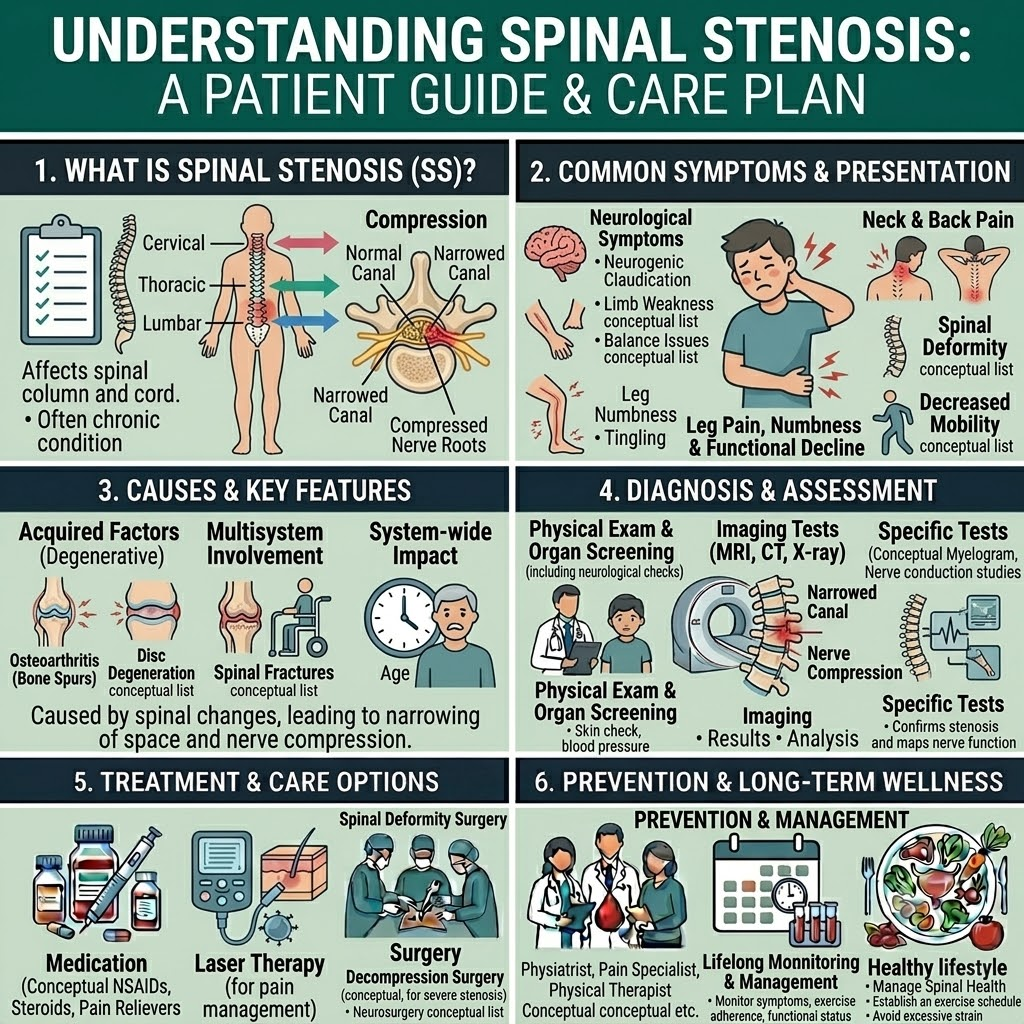
Spinal stenosis is a condition where the spaces within your backbone become too narrow. This narrowing can put pressure on your spinal cord and the nerves that branch out from it. It most commonly affects the lower back and the neck. While some individuals may not experience any symptoms, others might have pain, tingling, numbness, or muscle weakness that can worsen over time. The primary cause is often the natural wear-and-tear of the spine, usually due to arthritis.
Understanding the Condition
Spinal Stenosis: Understanding a Narrowing Spine
Understanding the Condition
Spinal stenosis is a condition where the spaces within your backbone become too narrow. This narrowing can put pressure on your spinal cord and the nerves that branch out from it. It most commonly affects the lower back and the neck. While some individuals may not experience any symptoms, others might have pain, tingling, numbness, or muscle weakness that can worsen over time. The primary cause is often the natural wear-and-tear of the spine, usually due to arthritis.
Common Symptoms
General Symptoms: Spinal stenosis often begins with no symptoms, but when they appear, they tend to start slowly and gradually worsen. The specific symptoms depend on which part of the spine is affected.
Symptoms in the Lower Back (Lumbar Stenosis): This can cause pain or cramping in one or both legs. These symptoms typically flare up when you stand for prolonged periods or walk, and they often improve when you lean forward or sit down. Some people may also experience persistent back pain.
Symptoms in the Neck (Cervical Stenosis): Neck involvement can lead to tingling or weakness in a hand, leg, foot, or arm. It may also result in problems with walking, balance issues, and, in more severe cases, difficulties with bowel or bladder control.
Consultation Guide
Which Specialist to Meet
Before your visit, prepare a list of your symptoms, including when they started, what makes them better or worse, and how they affect your daily life. Gather information about your full medical history, including any past injuries, surgeries, and all medications, supplements, or vitamins you currently take. It's also helpful to write down any questions you have for the doctor.
Book a doctor visit near me
Adhere to Physical Therapy: Even after initial treatment, continuing with a personalized exercise program from your physical therapist is key to maintaining strength, flexibility, and preventing symptom recurrence or worsening.
Regular Medical Check-ups: Ongoing monitoring with your healthcare provider is important to track symptoms, evaluate the effectiveness of treatments, and adjust your care plan as needed.
Pain Management Strategies: Learn and apply various pain management techniques, which might include heat/cold therapy, mindfulness, or specific exercises, to cope with any persistent discomfort effectively.
Ergonomic Adjustments: Make ergonomic adjustments at home and work, such as using supportive chairs, standing desks, or proper lifting techniques, to minimize strain on your spine during daily activities.
Consultation Guide
A CT scan uses specialized X-ray equipment and computer processing to create detailed cross-sectional images, or 'slices,' of bones, blood vessels, and soft tissues inside the body. It provides more detailed information than a standard X-ray, helping to identify the exact location and cause of spinal narrowing.
During a CT scan, you will lie on a motorized table that slides into a large, doughnut-shaped machine. You'll need to remain very still as the table moves through the scanner. You might hear whirring or clicking noises. In some cases, a contrast dye may be injected into a vein to highlight specific areas, which might cause a temporary warm sensation.
Diagnostic Procedures
An X-ray is a quick, painless imaging test that creates pictures of the structures inside your body, particularly your bones. It can reveal changes in the spine, such as bone spurs or alignment issues, which might indicate narrowing.
What to Expect
You will typically lie on an X-ray table or stand against a plate, and a technician will position the body part to be X-rayed. You'll need to remain still for a few moments while the X-ray machine captures images. The procedure is generally very quick and painless.
CT Scan (Computerized Tomography Scan)
What to Expect
Treatment Options
Initially, you might consult your primary care doctor, who can then refer you to specialists such as a neurosurgeon, an orthopedic spine surgeon, a pain management specialist, or a neurologist. A physical therapist may also be involved in non-surgical treatment plans.
Preparations Before Your Visit
Conservative Treatments
Medications: Over-the-counter pain relievers can help manage mild to moderate pain. Your doctor may prescribe stronger medications for pain and inflammation, or muscle relaxers to ease muscle spasms. These are typically used for short to medium-term relief as part of a broader treatment plan. (Duration: Short-term to ongoing, as needed)
Physical Therapy: A physical therapist can teach you exercises to build strength and endurance in your back and abdominal muscles, which support the spine. They can also help improve your flexibility, balance, and posture, reducing pressure on spinal nerves. This is often a foundational treatment. (Duration: Several weeks to months, with ongoing home exercises)
Cortisone Shots: These are injections of corticosteroid medicine, often combined with a local anesthetic, directly into the affected area of the spine. Cortisone shots can reduce inflammation and pain, providing temporary relief. Due to potential side effects, the number of injections allowed in a year is usually limited. (Duration: Pain relief can last for weeks to several months; limited to a few shots per year)
Surgical Procedures
Laminectomy: This surgery involves removing the back part of a spinal bone, called the lamina, to create more space within the spinal canal. By enlarging the canal, it relieves pressure on the spinal cord and nerves. While effective for radiating pain, it does not cure the underlying arthritis. (Duration: One-time procedure; recovery typically takes several weeks to months)
Laminotomy: A laminotomy is a less extensive surgery than a laminectomy, where only a portion of the lamina is removed. This procedure creates a smaller opening, just enough to relieve pressure in a very specific spot, minimizing disruption to surrounding tissues. It can be performed in the neck or lower back. (Duration: One-time procedure; recovery typically takes several weeks)
Prevention & Long-Term Wellbeing
Laminoplasty: Performed specifically on the spinal bones in the neck, laminoplasty aims to increase space in the spinal canal by creating a 'hinge' on the lamina. Metal plates or screws are then used to hold the opened section wider, maintaining the enlarged space. This preserves more of the natural spinal structure than a laminectomy. (Duration: One-time procedure; recovery typically takes several weeks to months)
Spinal Fusion: Spinal fusion is a surgical procedure to permanently connect two or more spinal bones, preventing movement between them. This is done by placing bone or a bone-like material between the vertebrae, often held together with metal plates, screws, or rods. It's used to stabilize the spine, correct problems, or reduce pain, sometimes performed alongside a laminectomy. (Duration: One-time procedure; fusion can take several months to a year to fully heal)
Prevention
Maintain a Healthy Weight: Excess body weight puts additional stress on your spine, potentially accelerating wear and tear. Maintaining a healthy weight reduces this strain and can help prevent spinal conditions from worsening.
Engage in Regular, Low-Impact Exercise: Activities like swimming, cycling, and walking can strengthen back and core muscles, improve flexibility, and support spinal health without putting excessive stress on the joints. Consult your doctor or a physical therapist for suitable exercises.
Practice Good Posture: Awareness of your posture, whether sitting, standing, or lifting, can help align your spine correctly and reduce unnecessary stress. Proper body mechanics are crucial in protecting your back.
Manage Underlying Conditions: If you have arthritis or other spinal problems, actively managing these conditions with your doctor's guidance can help slow down the progression of spinal stenosis.
Long-Term Wellbeing
Tags & Topics
Notice an error or need an update?
Help us keep medical information accurate. Report incorrect info or suggest an edit.

