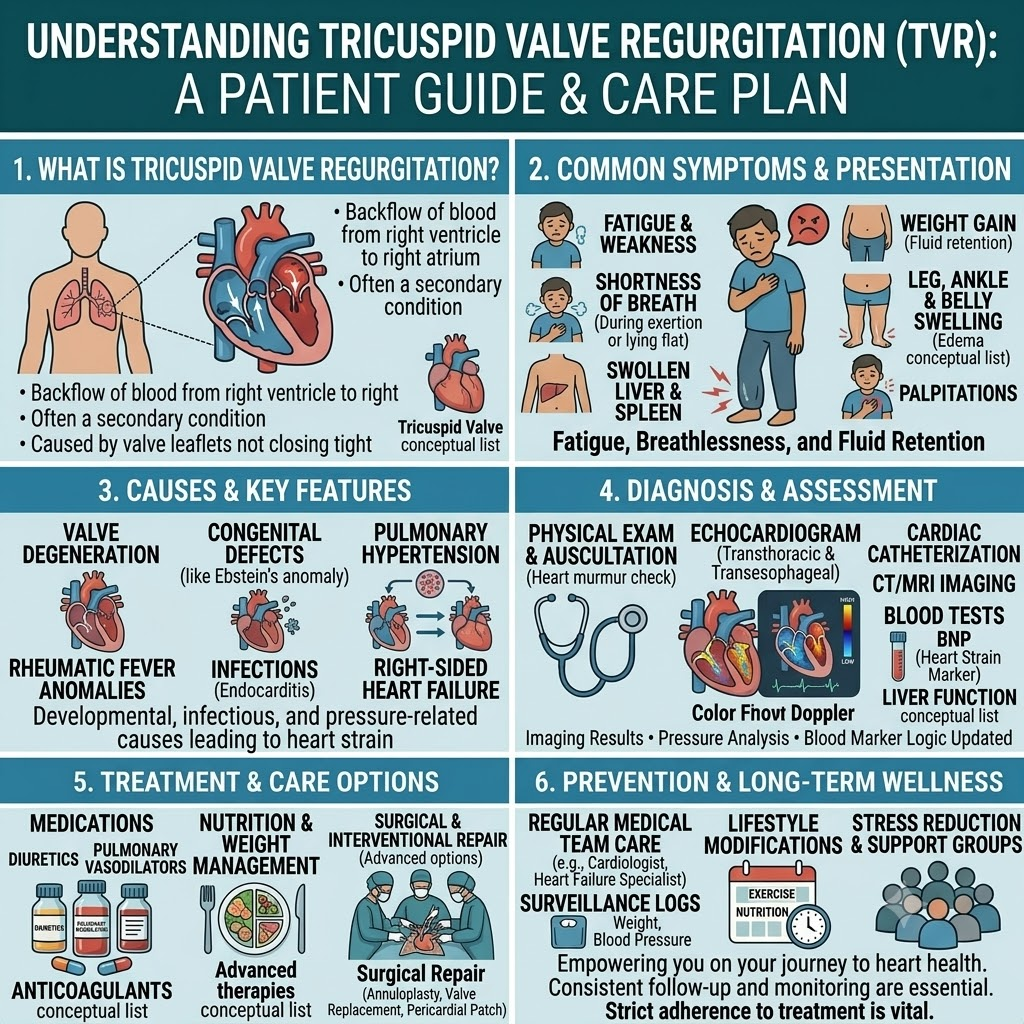
Tricuspid valve regurgitation is a type of heart valve disease where the valve between the two right chambers of your heart doesn't close completely. This causes blood to flow backward into the upper right chamber, instead of moving forward to the lungs. As a result, the heart has to work harder, and less blood reaches the lungs. This condition is also known as tricuspid regurgitation or tricuspid insufficiency.Some individuals are born with a heart valve issue that leads to this condition, known as congenital heart valve disease. However, tricuspid valve regurgitation can also develop later in life due to infections or other health problems. Mild cases might not cause noticeable symptoms or require treatment. More severe cases, especially if they cause symptoms, may need medication or surgery.Factors that increase the risk of developing tricuspid valve regurgitation include an irregular heartbeat (atrial fibrillation), congenital heart defects, damage to the heart muscle (such as from a heart attack), heart failure, high blood pressure in the lungs (pulmonary hypertension), heart infections, previous radiation therapy to the chest, and the use of certain medications (including some for weight loss, migraines, or mental health disorders).
Understanding the Condition
Tricuspid Valve Regurgitation: Understanding a Leaky Heart Valve
Understanding the Condition
Tricuspid valve regurgitation is a type of heart valve disease where the valve between the two right chambers of your heart doesn't close completely. This causes blood to flow backward into the upper right chamber, instead of moving forward to the lungs. As a result, the heart has to work harder, and less blood reaches the lungs. This condition is also known as tricuspid regurgitation or tricuspid insufficiency.Some individuals are born with a heart valve issue that leads to this condition, known as congenital heart valve disease. However, tricuspid valve regurgitation can also develop later in life due to infections or other health problems. Mild cases might not cause noticeable symptoms or require treatment. More severe cases, especially if they cause symptoms, may need medication or surgery.Factors that increase the risk of developing tricuspid valve regurgitation include an irregular heartbeat (atrial fibrillation), congenital heart defects, damage to the heart muscle (such as from a heart attack), heart failure, high blood pressure in the lungs (pulmonary hypertension), heart infections, previous radiation therapy to the chest, and the use of certain medications (including some for weight loss, migraines, or mental health disorders).
Common Symptoms
Extreme Tiredness: Feeling unusually fatigued or lacking energy, even after rest.
Shortness of Breath with Activity: Difficulty breathing or feeling winded during physical exertion.
Rapid or Pounding Heartbeat: Sensation of your heart beating very fast, fluttering, or pounding.
Pounding or Pulsing Feeling in the Neck: A noticeable throbbing or pulsing sensation in the neck area.
Swelling: Fluid buildup causing puffiness in the belly (abdomen), legs, or visible distension of neck veins.
Consultation Guide
Which Specialist to Meet
If you experience unusual tiredness or shortness of breath with activity, it's important to see a general doctor. They may refer you to a cardiologist, a doctor specializing in heart conditions.
Preparations Before Your Visit
Before your visit, make sure to write down all your symptoms, including when they started and how severe they are. Prepare a list of all your medications, vitamins, and supplements. Also, gather your complete medical history and write down any questions you have for the doctor.
Book a doctor visit near me
Symptom Management Medications: Used to manage symptoms like fluid retention (diuretics) or irregular heart rhythms. They help reduce the heart's workload and improve overall comfort. (Duration: Long-term, as prescribed by a doctor.)
Minimally Invasive Catheter-Based Procedures
Adhere to Medications: Take all prescribed medications exactly as directed by your healthcare provider, especially those for managing symptoms or related heart conditions.
Monitor for New or Worsening Symptoms: Be vigilant for any changes in your health, such as increased fatigue, shortness of breath, or swelling, and report them promptly to your doctor.
Consultation Guide
A detailed test mapping your heart's electrical system to find the cause of irregular heart rhythms and assess risks. Catheters with electrodes are placed inside the heart.
Cardiac Ablation: Catheters deliver heat or cold to create small scars in the heart, blocking faulty electrical signals that cause irregular heartbeats (like atrial fibrillation, a common complication). (Duration: Procedure takes a few hours; may require follow-up.)
Diagnostic Procedures
A quick imaging test using radiation to create pictures of your heart, lungs, blood vessels, and chest bones, helping detect issues like fluid, masses, or heart enlargement.
What to Expect
You stand or sit briefly in front of an X-ray machine. It's painless, very quick, and typically takes only a few minutes.
Echocardiogram (Echo)
Uses sound waves to produce live images of your heart's structure, how it pumps blood, and how well your valves are working. Essential for diagnosing valve problems.
What to Expect
Gel is applied to your chest, and a wand (transducer) is moved across it. You might be asked to change positions. The test is painless, taking 30-60 minutes.
Electrocardiogram (ECG or EKG)
Records your heart's electrical signals to show its rate and rhythm. This quick test helps identify irregular heartbeats or signs of heart damage.
What to Expect
Small sticky patches (electrodes) are placed on your chest and limbs. Wires connect to a machine that records activity. It's painless and quick.
Stress Test (Exercise Stress Test)
What to Expect
Electrodes are placed on your chest and a cuff on your arm. You'll gradually increase exercise intensity as a doctor supervises and monitors your heart.
An advanced test using a small amount of radioactive material to create images showing blood flow to your heart at rest and during exercise. It pinpoints areas of poor flow or damage.
What to Expect
Tracer is injected, and special scans are taken before and after exercise, similar to a standard stress test. The overall process takes a few hours.
Cardiac Catheterization
A thin, flexible tube (catheter) is guided through a blood vessel to your heart. It can diagnose conditions by measuring pressures, taking samples, or visualizing blood flow. It can also treat issues.
What to Expect
You'll receive local anesthetic and possibly sedation. The catheter is inserted; you may feel pressure but not pain. Duration varies by purpose.
Electrophysiology (EP) Study
What to Expect
Similar to cardiac catheterization, you'll receive sedation and local anesthetic. Catheters record and stimulate heart signals. It takes several hours.
Treatment Options
Shows how your heart works under physical strain. You'll exercise on a treadmill or bike, or receive medication to simulate exercise, while monitoring heart activity.
Medications
Tricuspid Valve Repair (Catheter-based): For certain cases, a catheter delivers devices or sutures through a blood vessel to help the tricuspid valve close better, avoiding open-heart surgery. (Duration: Procedure takes a few hours; recovery is generally quicker than surgery.)
Procedures for Related Conditions
Tricuspid Valve Repair: A surgeon repairs the damaged tricuspid valve, often by tightening the ring around the valve or patching holes in the flaps. This helps the valve close properly. Can be open-heart or minimally invasive. (Duration: Surgery takes several hours. Hospital stay typically 5-7 days for open-heart; full recovery takes weeks to months.)
Tricuspid Valve Replacement: If the valve cannot be repaired, it is removed and replaced with an artificial (mechanical or biological) valve. This can be done via open-heart surgery or minimally invasive techniques. (Duration: Surgery takes several hours. Hospital stay typically 5-7 days for open-heart; full recovery takes weeks to months.)
Regular Medical Check-ups: Consistent visits to your doctor, especially a heart specialist, are vital to monitor your condition, adjust treatments, and detect any changes early.
Prevention & Long-Term Wellbeing
Prevention and Long-Term Wellbeing
Healthy Lifestyle Choices: Maintain a heart-healthy diet (low in salt, saturated fat, and cholesterol), engage in regular, moderate exercise as advised by your doctor, and maintain a healthy weight.
Manage Underlying Conditions: Effectively manage conditions like high blood pressure, high cholesterol, diabetes, and other heart diseases that can worsen tricuspid valve regurgitation or contribute to its development.
Avoid Tobacco and Limit Alcohol: Quitting smoking and avoiding other tobacco products, along with limiting alcohol intake, significantly improves overall heart health.
Tags & Topics
Notice an error or need an update?
Help us keep medical information accurate. Report incorrect info or suggest an edit.

