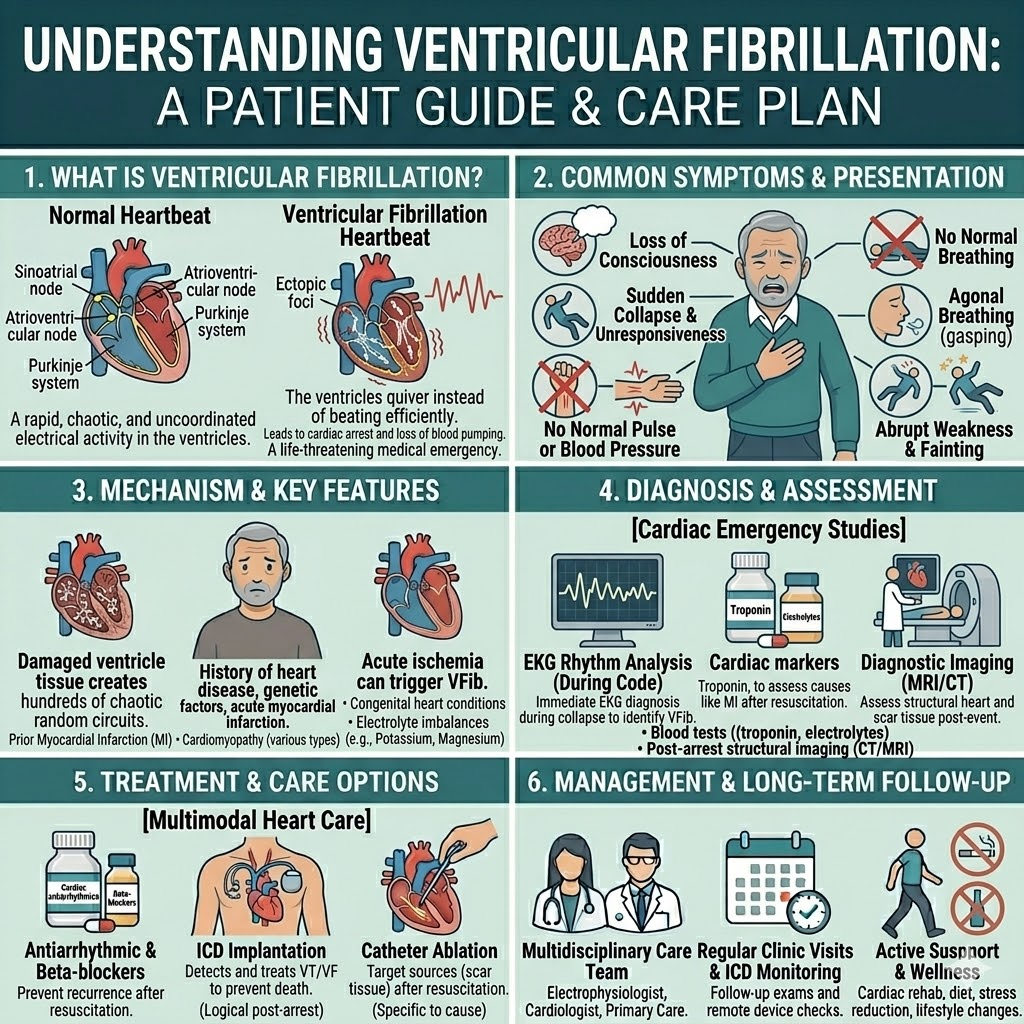
Ventricular fibrillation (VFib) is a life-threatening type of irregular heart rhythm where the heart's lower chambers (ventricles) quiver chaotically instead of pumping blood effectively. This stops blood flow to the body and brain, making it a medical emergency that is the most common cause of sudden cardiac death. Immediate treatment, including CPR and an electrical shock (defibrillation), is crucial to restore a normal heart rhythm and save a life. VFib can also be called V-fib or VF.
Understanding the Condition
Ventricular Fibrillation: A Critical Heart Emergency
Understanding the Condition
Common Symptoms
Main Symptoms During an Episode: The most common and immediate signs of ventricular fibrillation are collapse and loss of consciousness, as the heart stops pumping blood.
Warning Symptoms Before an Episode: Before an episode, some individuals may experience signs of an irregularly fast or erratic heartbeat (arrhythmia), such as a racing or pounding heart, dizziness, lightheadedness, chest pain, shortness of breath, or nausea.
Consultation Guide
Which Specialist to Meet
If you experience unexplained fast or pounding heartbeats, or any symptoms suggestive of an irregular heart rhythm, you should see a heart doctor (cardiologist) or a heart rhythm specialist (electrophysiologist). In an emergency, call for immediate medical help.
Preparations Before Your Visit
If you or someone you know experiences unexplained heart symptoms, it is helpful to note down details like when symptoms occur, how long they last, and what you were doing at the time. Be prepared to discuss your full medical history, family history of heart conditions, and all medications you are taking. If you witness someone collapse, immediately call emergency services (e.g., 911). If trained, begin cardiopulmonary resuscitation (CPR) and use an automated external defibrillator (AED) if one is available nearby.
Book a doctor visit near me
Recognize and Report Symptoms: Be aware of any recurring symptoms of irregular heartbeats or other concerning signs, and report them promptly to your healthcare team. This ensures timely intervention if needed.
Consultation Guide
Ventricular fibrillation (VFib) is a life-threatening type of irregular heart rhythm where the heart's lower chambers (ventricles) quiver chaotically instead of pumping blood effectively. This stops blood flow to the body and brain, making it a medical emergency that is the most common cause of sudden cardiac death. Immediate treatment, including CPR and an electrical shock (defibrillation), is crucial to restore a normal heart rhythm and save a life. VFib can also be called V-fib or VF.
You will lie on a motorized table that slides into a large, doughnut-shaped machine. The machine will rotate around you as images are taken. For some scans, a contrast dye may be injected into a vein, which can cause a warm sensation. You will need to remain very still during the scan.
CT Coronary Angiogram
This is a specialized CT scan that focuses on the arteries supplying blood to your heart (coronary arteries). It uses a powerful X-ray machine and contrast dye to create detailed images, checking for narrowing or blockages.
Adopt a Heart-Healthy Lifestyle: Maintain a balanced diet rich in fruits, vegetables, and whole grains, engage in regular physical activity, manage a healthy weight, quit smoking, and limit alcohol to reduce risk factors for heart disease.
Manage Underlying Health Conditions: Work closely with your healthcare provider to effectively control conditions like high blood pressure, high cholesterol, and diabetes, which can contribute to heart disease and VFib risk.
Regular Medical Check-ups: Schedule routine visits with your doctor to monitor your heart health, especially if you have a history of heart issues, risk factors, or a family history of heart disease.
Long-Term Monitoring and Support
Diagnostic Procedures
Electrocardiogram (ECG or EKG)
An ECG is a quick, non-invasive test that records the electrical signals of your heart. It helps assess heart rate, rhythm, and detect signs of heart damage or problems.
What to Expect
Small, sticky patches called electrodes will be placed on your chest, and sometimes on your arms or legs. These patches are connected by wires to an ECG machine, which records your heart's electrical activity. You'll lie still for a few minutes. The test is painless and takes only a short time.
A Holter monitor is a portable device that continuously records your heart's electrical activity, typically for 24 to 48 hours, during your normal daily routine. It's used to capture irregular heart rhythms that might be missed during a brief ECG.
What to Expect
Electrodes will be taped to your chest and connected to a small, portable recording device worn on a belt or strap. You'll be instructed to go about your usual activities, avoiding baths or showers that could get the device wet. After the recording period, you'll return the device for analysis.
An echocardiogram uses sound waves to create moving pictures of your heart. This test helps visualize the heart's structure, chambers, valves, and how blood flows through them, aiding in the diagnosis of heart conditions.
What to Expect
You will lie on an exam table, and a gel will be applied to your chest. A handheld wand (transducer) will be moved across your chest. This wand emits sound waves that bounce off your heart, creating images on a screen. You may hear swooshing sounds during the test. It is generally painless.
A chest X-ray uses a small amount of radiation to create images of your heart, lungs, blood vessels, and bones of the chest and spine. It helps detect problems like fluid in the lungs, lung masses, or general heart size.
What to Expect
You will stand or sit in front of an X-ray plate, and you may be asked to hold your breath briefly while the image is taken. The procedure is quick, painless, and does not require any special preparation.
CT Scan (Computerized Tomography Scan)
A CT scan uses specialized X-ray equipment and computer processing to create detailed cross-sectional images (slices) of bones, blood vessels, and soft tissues inside the body. It provides more detailed views than standard X-rays.
What to Expect
What to Expect
What to Expect
You will receive a local anesthetic at the insertion site, and possibly a mild sedative to help you relax. The catheter is then inserted. You may feel pressure but typically no pain during the catheter's movement. X-ray images are taken as the dye flows through your heart arteries. After the procedure, you will need to lie flat for several hours to prevent bleeding at the insertion site.
Treatment Options
Similar to a regular CT scan, you will lie on a table that moves through the scanner. A contrast dye will be injected into a vein, which helps highlight the blood vessels. You may be asked to hold your breath at times, and your heart rate might be temporarily slowed with medication to get clearer images. It is a non-invasive procedure.
Coronary Angiogram (Cardiac Catheterization)
This is an invasive procedure to visualize the coronary arteries. A thin, flexible tube (catheter) is inserted into a blood vessel (usually in the groin or wrist) and guided to the heart. Contrast dye is injected through the catheter, and X-rays are taken to show blockages or narrowing.
Cardiopulmonary Resuscitation (CPR): A manual technique involving chest compressions and rescue breaths to circulate blood and oxygen to the brain and other vital organs when the heart has stopped. (Duration: Performed immediately until emergency medical personnel arrive or heart function is restored.)
Automated External Defibrillator (AED) Shock: A portable device that delivers a controlled electrical shock to the chest to interrupt the chaotic electrical activity of VFib and allow the heart to restart with a normal rhythm. (Duration: Administered immediately by trained individuals or emergency responders; one or more shocks may be given as needed.)
Medications
Anti-arrhythmic Medications: Drugs designed to stabilize the heart's electrical activity, helping to prevent future episodes of irregular heart rhythms like VFib. (Duration: Often prescribed for long-term use.)
Other Heart Medications: Medications such as beta-blockers or calcium channel blockers may be used to manage underlying conditions like high blood pressure or to slow the heart rate, reducing the risk of VFib. Blood thinners may be used if clots are a concern. (Duration: Typically long-term, depending on the underlying condition.)
Implantable Cardioverter-Defibrillator (ICD): A small, battery-powered device surgically placed under the skin in the chest or abdomen. It constantly monitors the heart's rhythm and automatically delivers an electrical shock if it detects a dangerously fast or irregular heartbeat, correcting it. (Duration: Permanent implant; battery usually lasts 5-10 years and requires replacement.)
Coronary Angioplasty and Stent Placement: A procedure to open narrowed or blocked coronary arteries. A balloon-tipped catheter is used to widen the artery, and a small mesh tube (stent) is typically inserted to keep the artery open and maintain blood flow. (Duration: A single procedure; stents are permanent implants.)
Surgical Procedures
Coronary Artery Bypass Graft (CABG) Surgery: A surgical procedure where a healthy blood vessel from another part of the body (e.g., leg or chest) is used to create a new pathway, or bypass, around a blocked or narrowed coronary artery, restoring blood flow to the heart muscle. (Duration: A single surgical procedure; benefits can last for many years.)
Adhere to Treatment Plans: Consistently follow all prescribed medication regimens and instructions for any implanted devices like ICDs. Regular follow-up with your cardiologist is essential for optimal management.
Prevention & Long-Term Wellbeing
Prevention of Recurrence
Consider Cardiac Rehabilitation: Participate in structured exercise and education programs designed to help you recover, improve your heart health, and make sustainable lifestyle changes after a cardiac event or procedure.
Tags & Topics
Notice an error or need an update?
Help us keep medical information accurate. Report incorrect info or suggest an edit.

