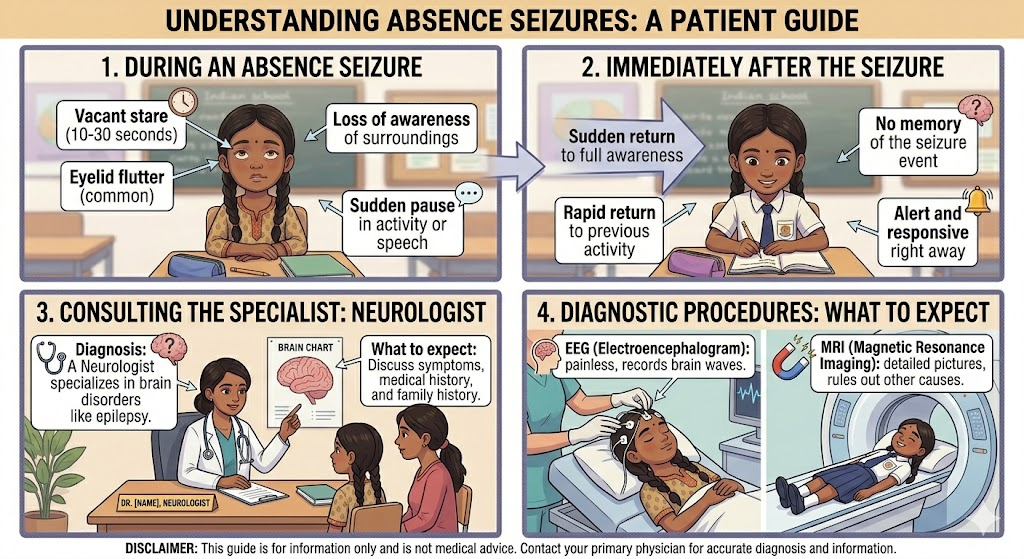
Absence seizures, sometimes called petit mal seizures, are brief, sudden moments where a person loses consciousness. They are much more common in children than in adults. During a seizure, a person might simply stare into space for a few seconds before quickly becoming alert again. This type of seizure usually does not cause physical injury. However, injuries could occur if a seizure happens while a person is doing an activity like driving a car or riding a bike. Absence seizures are often managed with anti-seizure medication. Many children eventually stop having absence seizures during their teenage years. Some children who have them may later develop other types of seizures.
Understanding the Condition
Absence Seizure (Petit Mal Seizure)
A simple absence seizure often looks like a vacant stare and can be mistaken for not paying attention. The seizure typically lasts about 10 seconds but can be as long as 30 seconds. Afterwards, the person is not confused, dizzy, or drowsy.
Common symptoms during an absence seizure include:
Suddenly stopping an activity without falling.
Small movements involving both hands.
Write down any other symptoms or changes in health.
Consultation Guide
Absence seizures, sometimes called petit mal seizures, are brief, sudden moments where a person loses consciousness. They are much more common in children than in adults. During a seizure, a person might simply stare into space for a few seconds before quickly becoming alert again. This type of seizure usually does not cause physical injury. However, injuries could occur if a seizure happens while a person is doing an activity like driving a car or riding a bike. Absence seizures are often managed with anti-seizure medication. Many children eventually stop having absence seizures during their teenage years. Some children who have them may later develop other types of seizures.
A person usually has no memory of the event afterwards. However, if the seizure is longer, they may be aware of the missed time. Some people experience multiple episodes every day, which can disrupt their school or daily life. Because the seizures are so brief, a child may have them for some time before an adult notices. Often, the first sign of this seizure disorder is a child's declining ability to learn, with teachers noting the child has trouble paying attention or is often daydreaming.
Absence seizures often have a genetic cause. Seizures occur when there is an unusual burst of electrical activity from nerve cells (neurons) in the brain. During an absence seizure, these electrical signals repeat in a specific three-second pattern. Changes in the levels of chemical messengers, called neurotransmitters, that help nerve cells communicate, may also play a role.
Risk factors for absence seizures include:
Risk factors for absence seizures include:
Age: They are most common in children between 4 and 14 years old.
Sex: They are more common in females.
Family History: About one quarter of children with absence seizures have a close relative who also has seizures.
Potential Complications
While most children eventually outgrow absence seizures, some may experience:
You will lie down on a long, tube-shaped machine. The machine will scan your head while a computer takes pictures. The test itself does not cause pain and is considered very safe because it does not use radiation. The machine does make a loud noise, and some people may find being in the enclosed space uncomfortable. The strength of the magnet (measured in tesla, or T) determines the detail of the images.
Electroencephalogram (EEG)
Educational and Behavioral Support: Because absence seizures can be mistaken for inattention and disrupt learning, collaboration with teachers and the use of behavioral therapies can help address potential trouble with learning or behavior and minimize social isolation.
Ongoing Monitoring: Regular follow-up with a healthcare professional is necessary for continued seizure control and to monitor for the potential development of other types of seizures, such as generalised tonic-clonic seizures, which may occur in some children as they grow older.
Diagnostic Procedures
To help your doctor make a diagnosis, here are some things you can prepare before your appointment:
Keep a detailed diary of the seizures, including when they happen, what the person is doing right before, during, and immediately after the event, and how long they last.
Brain Magnetic Resonance Imaging (MRI)
A Brain MRI is a test that uses a powerful magnet and radio waves to create detailed pictures, or "slices," of the brain. It may also take images of the neck and spine. This test can help a healthcare professional see areas where changes have occurred or where the brain is not functioning as it should, and can be used to diagnose conditions like stroke, tumors, or multiple sclerosis.
What to Expect
An EEG is a main test used to help diagnose epilepsy and other seizure conditions. It measures and records the electrical activity of the brain. Brain cells communicate using electrical impulses, and this activity is recorded as wavy lines. An EEG helps diagnose conditions like seizures, as well as find changes in brain activity. It can also be used to confirm brain death.
What to Expect
Small metal discs called electrodes will be placed on your scalp. These electrodes record the electrical impulses from your brain. Brain cells are active all the time, even during sleep. The test results show changes in brain activity, which may help diagnose the condition.
This article is for informational purposes only and is not a substitute for professional medical advice, diagnosis, or treatment. Always consult your treating physician or another qualified healthcare provider with any questions you may have regarding a medical condition.
Report an error in the article to errorreport@example.com.
Treatment Options
Needing to take anti-seizure medication for life.
Developing full convulsions, such as generalised tonic-clonic seizures.
Trouble with learning or behaviour.
Injury during a seizure.
If you or your child may be having absence seizures, you should meet with a specialist, such as a Neurologist. Book a doctor visit near me.
Preparation for Your Visit
List all medications, vitamins, and supplements being taken.
Be ready to discuss the family medical history regarding seizures.
Treatment for absence seizures aims to control the seizures and minimize side effects.
Medication: The primary treatment involves taking daily anti-seizure medicines to reduce the frequency of seizures. The medication is started at a low dose and adjusted as needed. Duration: Months to years, often until the person outgrows the seizures.
Procedures/Therapies: In some cases, behavioral therapies may be used alongside medication to address learning or behavioral difficulties that can result from the seizures. Duration: Varies, often short-term or ongoing as needed.
Surgical Procedures: Surgery is typically not a treatment for absence seizures. It is reserved for specific, severe forms of epilepsy that do not respond to medication, which is rarely the case with absence seizures. Duration: Not applicable for absence seizures.
Medication Adherence: Consistent and correct use of anti-seizure medication, as prescribed by a neurologist, is the most critical step in preventing frequent seizures.
Prevention & Long-Term Wellbeing
Home Remedies/Lifestyle Adjustments: Maintaining a regular sleep schedule, reducing stress, and avoiding known seizure triggers (if any) can help manage the condition. Duration: Ongoing.
Prevention and Long-Term Wellbeing
Preventing absence seizures and ensuring long-term well-being involves a combination of medical adherence and lifestyle strategies.
Lifestyle Management: Maintain a regular sleep schedule and reduce stress, as these factors can influence seizure frequency. It is also important to identify and avoid any personal seizure triggers.
Safety Measures: Although absence seizures are usually brief, care must be taken during activities where brief loss of awareness could be dangerous, such as swimming alone, driving (if applicable), or operating machinery.
Tags & Topics
Notice an error or need an update?
Help us keep medical information accurate. Report incorrect info or suggest an edit.


