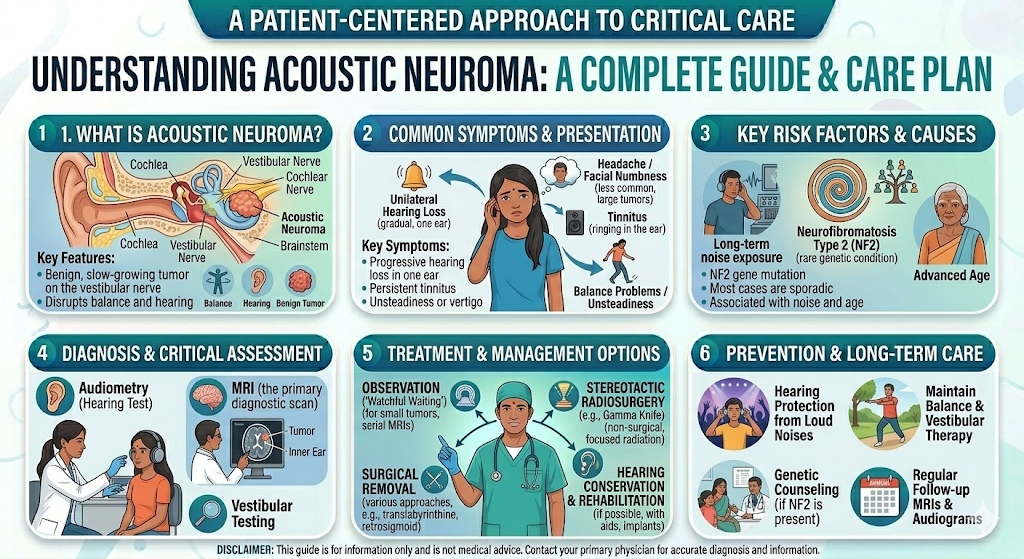
A vestibular schwannoma, which used to be called an acoustic neuroma, is a slow-growing, non-cancerous tumour that develops on the main nerve connecting the inner ear to the brain. This critical nerve, known as the vestibulocochlear nerve, manages both your hearing and your sense of balance.
Understanding the Condition
Vestibular Schwannoma (Acoustic Neuroma)
A vestibular schwannoma, which used to be called an acoustic neuroma, is a slow-growing, non-cancerous tumour that develops on the main nerve connecting the inner ear to the brain. This critical nerve, known as the vestibulocochlear nerve, manages both your hearing and your sense of balance.
As the tumour expands, it presses on this nerve, which can lead to hearing loss, ringing in the ear, and problems with balance. While the tumour grows close to the brainstem inside the skull, it is a type of nerve tumour, not a brain tumour. This condition is rare and usually affects only one ear, with the risk increasing as people age.
Symptoms and Complications
Symptoms typically develop gradually over months or years, as these tumours usually grow slowly.
Hearing loss that worsens slowly, often affecting just one ear or being much worse on one side. Rarely, it can occur suddenly.
Ringing in the affected ear, known as tinnitus.
A feeling of unsteadiness or loss of balance.
Less Common Signs: Numbness, weakness, or very rarely, loss of muscle movement on the affected side of the face.
Preparation Before Your Visit: Write down when your symptoms—especially hearing loss, ringing in the ear, or balance issues—began. Be ready to discuss your medical history and any concerns you have about your facial feeling or movement.
Book a doctor visit near me
Description: For small tumors that are slow-growing or not causing severe symptoms, doctors often recommend a "wait-and-see" approach. This involves regularly scheduled MRI scans and hearing checks to monitor the tumor's size. Physical therapy (vestibular rehabilitation) may also be used to help manage chronic balance difficulties.
Duration: Ongoing, often for many years, unless growth is observed or symptoms progress.
Description: Medications are generally not used to treat the tumor itself, but may be prescribed to manage related symptoms such as dizziness or pain associated with the condition.
Duration: Varies depending on the symptom being managed; may be short-term or long-term.
Radiation Therapy (Procedure)
Managing a vestibular schwannoma, whether through observation, radiation, or surgery, is often a long-term journey that focuses on managing symptoms and quality of life.
Ongoing Monitoring: Continue with scheduled MRI scans and hearing tests as advised by your specialist to monitor for any changes in the tumour or your symptoms.
Consultation Guide
If the tumour becomes large or is left untreated, it can cause severe complications:
Permanent hearing loss and chronic balance issues.
Pressure on nearby brain structures can lead to headaches or difficulty with coordination and walking (ataxia).
A buildup of fluid in the brain (hydrocephalus) in rare, severe cases, which can cause vomiting, sleepiness, or vision changes.
The precise cause of vestibular schwannoma is usually unknown. In some people, the condition is linked to a change in a gene on chromosome 22 that is responsible for controlling the protective Schwann cells around the nerves. When this gene malfunctions, cells can grow out of control, forming a tumour.
The only confirmed risk factor is having a parent with NF2-related schwannomatosis (NF2), a rare genetic disorder where tumors grow on the hearing and balance nerves on both sides of the head. Although a small factor, long-term exposure to loud noise may also slightly increase the risk.
Specialist to Meet: An Otolaryngologist (Ear, Nose, and Throat or ENT specialist) or a Neuro-otologist (a specialist focusing on ear and neurological conditions).
Hearing Protection: Since long-term exposure to loud noise is a small possible risk factor, using hearing protection in noisy environments may be advisable.
Long-term Well-being and Management
Diagnostic Procedures
Diagnostics: Detailed Description of Procedures
Diagnosis often involves tests to assess hearing and to capture images of the tumor's location and size.
Hearing Tests (Audiometry)
This assessment measures your ability to hear sounds at various volumes and frequencies. A specific pattern of hearing loss in one ear, known as sensorineural hearing loss, is often seen with this condition.
What to Expect
Brain Magnetic Resonance Imaging (MRI)
The MRI is the most common and detailed test used to detect a vestibular schwannoma. It uses a powerful magnetic field and radio waves, along with a computer, to produce detailed cross-sectional pictures of the brain and surrounding structures.
What to Expect
Computerised Tomography (CT) Scan
What to Expect
Mental Health Support: The diagnosis and management of chronic conditions can be stressful. Seeking support from counselors or patient groups can aid in coping with the emotional impact and long-term changes.
Disclaimer: This article provides general health information and is not intended to be a substitute for professional medical advice, diagnosis, or treatment. Always consult your treating physician or another qualified healthcare provider with any questions you may have regarding a medical condition.
To report an error in the article, please send an email to errors@medicalwriter.com.
Treatment Options
A CT scan uses X-ray technology and computer processing to create cross-sectional images of the body. While an MRI is usually better for soft tissue tumors, a CT scan provides detailed images of bone structures and can be used to help plan treatment.
Management of vestibular schwannoma falls into three main categories: observation, radiation therapy, and surgical removal.
Observation/Monitoring (Home Remedies/Therapies)
Description: Techniques like Stereotactic Radiosurgery (SRS) deliver highly focused, precise beams of high-energy radiation directly to the tumor. This treatment works by damaging the tumor cells' ability to grow and multiply. It is often performed without an incision and is considered a non-surgical option.
Duration: The radiation is usually delivered in a single session or occasionally a few sessions. The effects of the treatment, such as stabilization or shrinkage of the tumor, occur over months or years.
Surgical Procedures
Description: A surgical procedure, such as a craniotomy, involves opening the skull to remove the tumor. The goal is to remove the tumor while trying to preserve the patient’s facial nerve function and hearing, depending on the tumor's size and involvement.
Vestibular Rehabilitation: Ongoing physical therapy may be necessary to maximize balance and reduce dizziness, even after treatment.
Hearing Aids and Communication: For unilateral hearing loss, specialized hearing aids or devices (like CROS systems) can improve communication and overall quality of life.
Prevention & Long-Term Wellbeing
Duration: Recovery and rehabilitation can vary greatly, often taking several weeks to months, especially if physical therapy is required.
Prevention and Long-term Well-being
Prevention Strategies
While most vestibular schwannomas are sporadic and cannot be prevented, there are a few considerations:
Genetic Counseling: If there is a family history of NF2-related schwannomatosis, consulting a genetic counselor can help in early screening and monitoring.
Tags & Topics
Notice an error or need an update?
Help us keep medical information accurate. Report incorrect info or suggest an edit.


