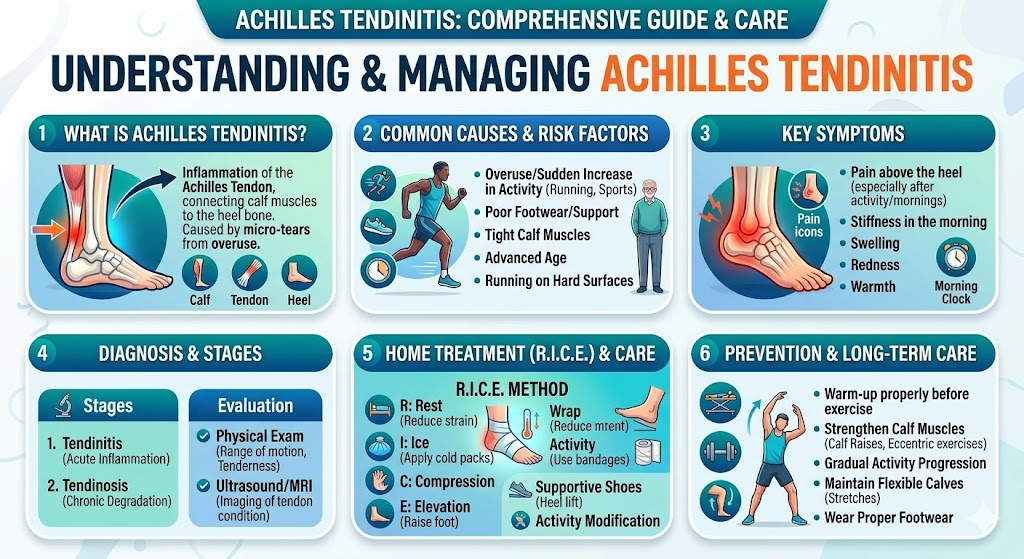
Achilles tendinitis (pronounced uh-KILL-eez ten-dih-NY-tis) is an injury affecting the Achilles tendon. This powerful band of tissue connects the calf muscles in the back of your lower leg to your heel bone. The injury is usually caused by using the tendon too much or too hard without enough time to rest, which is known as overuse. In some cases, the cause remains unclear.
Understanding the Condition
Achilles Tendinitis: A Simple Guide
Consultation Guide
Achilles tendinitis (pronounced uh-KILL-eez ten-dih-NY-tis) is an injury affecting the Achilles tendon. This powerful band of tissue connects the calf muscles in the back of your lower leg to your heel bone. The injury is usually caused by using the tendon too much or too hard without enough time to rest, which is known as overuse. In some cases, the cause remains unclear.
The condition is often called Achilles tendinopathy, which is a general term for problems affecting the tendon. It commonly affects runners who quickly increase the difficulty or distance of their runs. It is also frequently seen in middle-aged individuals who only participate in sports, such as tennis or basketball, on weekends.
The discomfort from Achilles tendinitis typically starts as a mild ache in the back of the leg or just above the heel after physical activity. After long periods of exercise, stair climbing, or sprinting, you might feel a more intense burning or aching pain. Over time, the pain may start even when you are resting.
Achilles tendinitis can make it difficult to use your affected foot. The area might feel stiff or tender, particularly in the morning, though this usually improves with light activity.
Rest and Recovery: Allow sufficient rest time, especially after intense workouts, to avoid overuse, which is the common cause of this injury.
Self-Care Principles: Continue applying principles like rest, ice, compression, and elevation (RICE) at the first sign of discomfort to manage inflammation and prevent the condition from worsening.
Diagnostic Procedures
Removing jewellery and leaving any valuables at home, especially if diagnostic imaging procedures are expected.
Book a doctor visit near me
An X-ray is a fast and painless imaging test that creates pictures of the structures inside your body, particularly bones.
What to Expect
X-ray beams pass through your body. Different materials absorb these beams in different amounts based on their density. Dense materials like bone appear white, air appears black, and fat and muscle show up as shades of gray. This technology is used to examine many parts of the body.
Ultrasound (Sonography)
Diagnostic ultrasound uses high-frequency sound waves to generate real-time pictures of the structures inside your body. These images are used to help guide diagnosis and treatment.
What to Expect
Most ultrasounds are performed using a handheld device placed outside your body, though some procedures involve placing a small device internally. The procedure is safe, using low-power sound waves with no known risks. However, sound waves do not travel well through air or bone, so ultrasound is not effective for imaging areas hidden by bone, containing gas, or objects located very deep in the body. Other imaging tests may be ordered to view these areas.
This information is for educational purposes only and is not an alternative to professional medical advice, diagnosis, or treatment. Always contact your treating physician or another qualified healthcare provider for accurate information and before starting any new treatment.
To report an error in the article, please send an email to prhealthchip@gmail.com.
Treatment Options
If the pain around the Achilles tendon continues, you should contact a healthcare professional. If the pain is suddenly severe or prevents you from moving, you might have a torn Achilles tendon (also called a rupture) and should seek immediate medical help. Severe cases can lead to these tears, which may require surgery to repair.
Preparing for Your Doctor Visit
To discuss an Achilles tendon injury, you should meet with a specialist such as a an Orthopedic Specialist.
Before your visit, you can prepare by:
Wearing loose clothing.
Achilles tendinitis can often be managed with self-care guided by a healthcare professional. Available treatments and their general duration include:
Home Remedies and Self-Care: Includes the following rest, ice, compression, and elevation (RICE) principles, and using inserts (orthotic devices) in your shoes. These steps help prevent the injury from recurring. Treatment duration is often several weeks to months, depending on the severity.
Physical Therapy and Exercises: A common approach for tendon issues that involves specific stretching and strengthening exercises to improve muscle function and stability. This typically requires several weeks of consistent sessions.
Procedures: Injections may be used to relieve pain and irritation in the area. The duration of pain relief from injections is limited due to potential side effects.
Prevention & Long-Term Wellbeing
Surgical Procedures: Required for severe cases that result in a complete tendon tear or rupture to repair the damage. The duration of surgical recovery varies, but often involves months of physical rehabilitation.
Prevention and Long-term Well-being
To help prevent Achilles tendinitis from recurring and ensure long-term tendon health, consider incorporating the following practices:
Gradual Increase in Activity: Avoid sudden increases in the distance, duration, or intensity of your physical activity, particularly running or sports. The tendon needs time to adapt to new demands.
Proper Footwear and Support: Wear well-fitting shoes with good arch support. If advised by a healthcare professional, use orthotic devices (inserts) to help cushion the heel and prevent strain on the tendon.
Stretching and Strengthening: Regularly perform stretching and strengthening exercises for your calf muscles and Achilles tendon, as recommended by a physical therapist. This improves muscle function and stability.
Tags & Topics
Notice an error or need an update?
Help us keep medical information accurate. Report incorrect info or suggest an edit.


