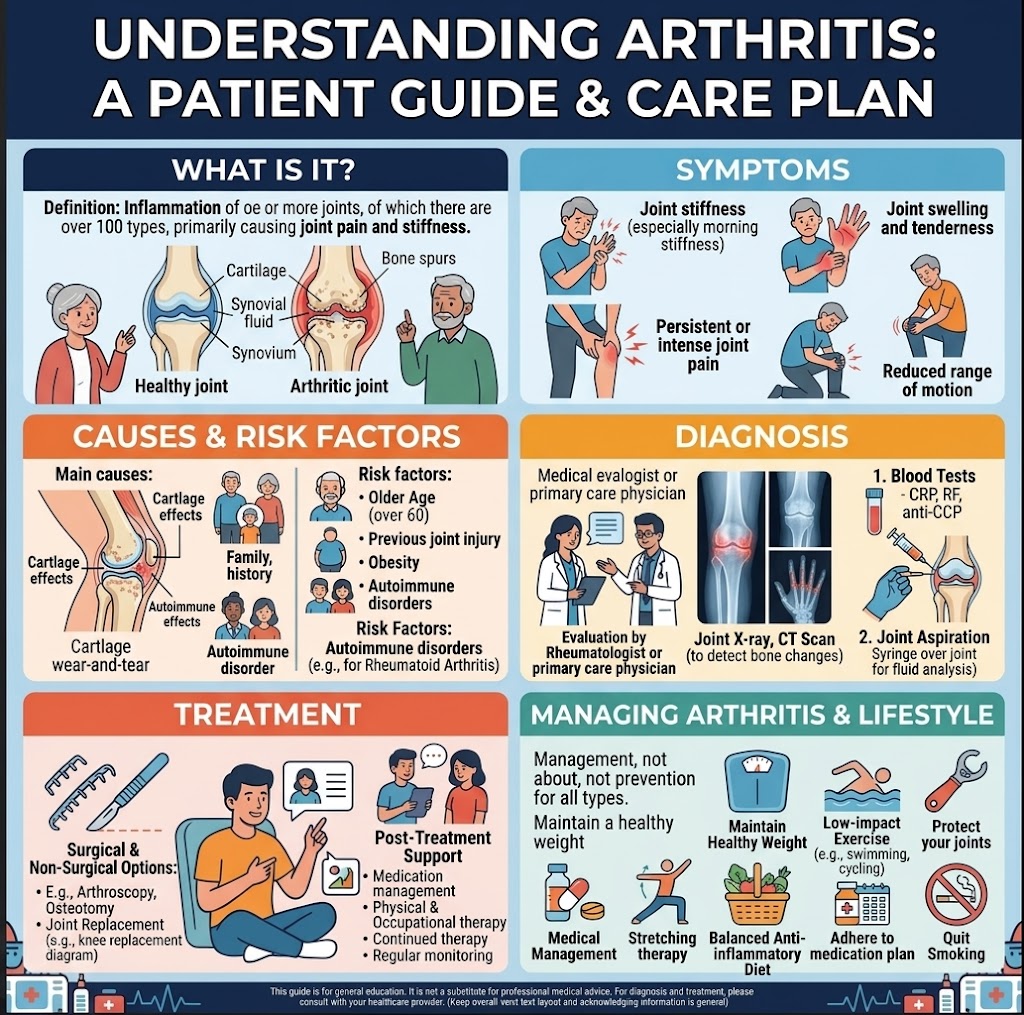
Arthritis is a condition characterized by the swelling and tenderness of one or more joints, leading to pain and stiffness that typically worsen over time. The two most common types are osteoarthritis and rheumatoid arthritis. Osteoarthritis results from the breakdown of cartilage, the protective tissue cushioning bone ends, often due to wear-and-tear. Rheumatoid arthritis is an autoimmune disease where the body's immune system mistakenly attacks the lining of the joints. Other forms can be caused by uric acid crystal buildup (gout), infections, or underlying conditions like psoriasis or lupus. Treatment aims to alleviate symptoms and improve daily function.
Understanding the Condition
Understanding Arthritis: Causes, Symptoms, and Management
Understanding the Condition
Arthritis is a condition characterized by the swelling and tenderness of one or more joints, leading to pain and stiffness that typically worsen over time. The two most common types are osteoarthritis and rheumatoid arthritis. Osteoarthritis results from the breakdown of cartilage, the protective tissue cushioning bone ends, often due to wear-and-tear. Rheumatoid arthritis is an autoimmune disease where the body's immune system mistakenly attacks the lining of the joints. Other forms can be caused by uric acid crystal buildup (gout), infections, or underlying conditions like psoriasis or lupus. Treatment aims to alleviate symptoms and improve daily function.
Common Symptoms
Joint Pain: Aches or throbbing sensations in the affected joints, which can be constant or intermittent.
Stiffness: Difficulty moving joints, particularly noticeable in the morning or after periods of rest.
Swelling: The affected joints may appear larger or puffy due to inflammation.
Redness: The skin over the affected joint might look red.
Warmth: The skin around the inflamed joint may feel warm to the touch.
Decreased Range of Motion: Difficulty in fully straightening or bending a joint.
Consultation Guide
Which Specialist to Meet
Begin with your primary care doctor, who may refer you to a rheumatologist (joint specialist), an orthopedic surgeon (bone and joint surgeon), or a physical or occupational therapist.
Preparations Before Your Visit
Before your visit, list all your symptoms, noting when they started and what makes them better or worse. Prepare a list of all current medications, supplements, and your medical history. Also, write down any questions you have for the doctor.
Book a doctor visit near me
Diagnostic Procedures
An imaging test that uses radiation to create pictures of bones. It helps detect bone damage, loss of cartilage space, and bone spurs.
What to Expect
You will be positioned on a table or stand, and the technologist will align the X-ray machine. You might need to hold still or hold your breath briefly. The procedure is quick and painless.
CT Scan (Computed Tomography)
Combines multiple X-ray images from different angles to produce detailed cross-sectional views of bones and soft tissues, offering more detail than standard X-rays.
What to Expect
You will lie on a motorized table that slides into a large, doughnut-shaped machine. You must remain still as the scanner rotates around you, potentially with buzzing sounds. Sometimes, a contrast dye is given orally or intravenously to enhance visibility.
Ultrasound (Sonography)
Uses high-frequency sound waves to create real-time images of soft tissues, including tendons, ligaments, and joint linings. It can identify inflammation, fluid, and tendon damage.
What to Expect
A clear gel is applied to the skin over the joint. A small handheld device (transducer) is pressed against the skin and moved to capture images. You may feel slight pressure, but the procedure is generally painless.
A minimally invasive surgical procedure that involves inserting a small camera (arthroscope) through tiny incisions to directly visualize the inside of a joint for diagnosis and treatment.
What to Expect
Treatment Options
Medications
Pain Relievers: Over-the-counter or prescription medications to alleviate joint pain. (Duration: As directed by a doctor, short-term or ongoing.)
Anti-inflammatory Medications: Medications that reduce inflammation and swelling in the joints, easing pain. (Duration: As directed by a doctor, short-term or ongoing.)
Immune-Modulating Medications: For certain types of arthritis, these medications help regulate the immune system's activity to reduce joint damage. (Duration: Long-term, as prescribed.)
Therapies
Physical Therapy: Exercises guided by a therapist to improve joint strength, flexibility, and range of motion. (Duration: Varies, typically weeks to months, with continued home exercises.)
Occupational Therapy: Guidance on adapting daily tasks and environments to protect joints and enhance function. (Duration: Varies, typically weeks to months, with ongoing home strategies.)
Injections: Directly delivering anti-inflammatory or lubricating substances into the affected joint to reduce pain and swelling. (Duration: Effects last weeks to months; injections typically repeated a few times a year.)
Surgical Procedures
Prevention & Long-Term Wellbeing
Performed under anesthesia, small incisions are made around the joint to insert the camera and pencil-thin surgical instruments. Images are displayed on a monitor. Recovery involves pain management and physical therapy.
Home Remedies & Lifestyle Adjustments
Heat and Cold Therapy: Apply warm compresses or baths to relax muscles and cold packs to reduce inflammation and pain. (Duration: As needed, typically 15-20 minutes per application.)
Gentle Exercise and Stretching: Engage in low-impact activities like walking, swimming, or cycling, combined with daily stretching to improve flexibility and strengthen supporting muscles. (Duration: Ongoing, daily or several times a week.)
Weight Management: Maintain a healthy body weight to reduce stress on weight-bearing joints, such as knees and hips. (Duration: Ongoing lifestyle.)
Joint Protection Techniques: Use ergonomic tools and modify daily activities to minimize strain on affected joints. (Duration: Ongoing lifestyle adaptation.)
Joint Repair: Procedures to smooth joint surfaces, remove loose cartilage, or realign bones to improve joint function. (Duration: Recovery typically takes several weeks to months, followed by physical therapy.)
Joint Fusion (Arthrodesis): Permanently fusing bones in a joint to eliminate pain by stopping movement, often used for ankles or wrists. (Duration: Healing takes several months; the fused joint will not move.)
Joint Replacement (Arthroplasty): Replacing damaged joint parts with artificial components made of metal, plastic, or ceramic, commonly for knees, hips, and ankles. (Duration: Recovery can take several months, with extensive physical therapy to regain movement and strength.)
Prevention & Risk Management
Understand Family History: Be aware if arthritis runs in your family and discuss early screening or preventive measures with your doctor.
Prevent Joint Injuries: Use proper posture and form during physical activity, wear protective gear, and avoid over-straining joints to reduce injury risk.
Maintain Healthy Weight: Keeping your weight in a healthy range reduces stress on joints, lowering the risk of developing or worsening arthritis.
Long-Term Lifestyle Management
Stay Active Regularly: Engage in gentle, low-impact exercises to maintain joint flexibility, strengthen muscles, and improve overall well-being.
Practice Mindful Movement: Listen to your body, avoid prolonged static positions, take breaks, and adjust activities to prevent joint strain and pain.
Utilize Adaptive Aids: Employ ergonomic tools and assistive devices (e.g., buttonhooks, large-handled utensils) to make daily tasks easier and protect joints.
Perform Hand Exercises: Regularly do specific exercises, like finger bends or thumb touches, to maintain flexibility and strength in hand and wrist joints.
Tags & Topics
Notice an error or need an update?
Help us keep medical information accurate. Report incorrect info or suggest an edit.


