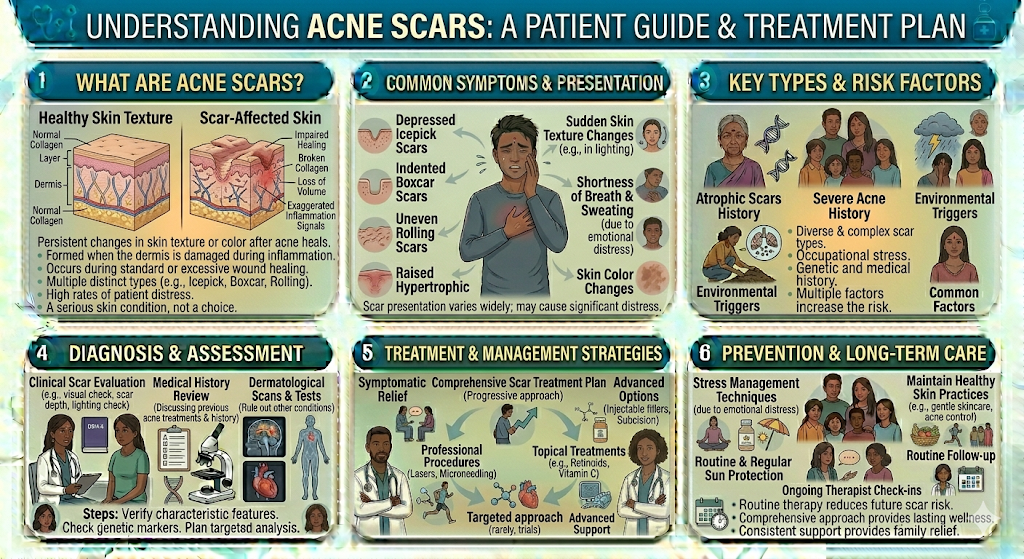
Acne scars are the permanent texture changes and indentations that can remain on the skin after severe acne, such as cystic lesions, has healed. Scarring can cause emotional distress and can be a long-term complication of the skin condition.
Consultation Guide
Acne scars are the permanent texture changes and indentations that can remain on the skin after severe acne, such as cystic lesions, has healed. Scarring can cause emotional distress and can be a long-term complication of the skin condition.
Scarring occurs as a complication of severe acne, which itself is caused by a blockage in the hair follicles.
Scarring is generally associated with blockages and inflammation that occur deep inside the hair follicles, leading to painful, cyst-like lumps (cystic lesions). The four main factors that contribute to the acne that causes scarring are:
Excess production of sebum, which is the skin's natural oil.
Hair follicles becoming plugged with a combination of oil and dead skin cells.
The presence of bacteria.
Inflammation in the skin.
Risk Factors
Factors that increase the risk of developing severe acne, and consequently, acne scarring, include:
Age: Acne is most common in teenagers, but it affects all ages.
Hormonal Changes: Shifts in hormones during puberty and midlife (especially in women) cause oil glands to enlarge and produce more sebum, which increases the likelihood of breakouts.
Genetics: A family history of acne suggests a genetic role in developing the condition.
Skin Pigmentation: People with darker skin types are more likely to experience scarring and long-term skin color changes (hyperpigmentation or hypopigmentation).
External Factors: Applying greasy or oily lotions and creams, or experiencing friction or pressure from items like tight collars or backpacks, can also increase the risk.
Which Specialist to Meet
Diagnostic Procedures
Diagnostics: Detailed Description of Procedures
Diagnosis of acne and related scarring is typically done through a physical examination of the skin. However, a specialist may order a Skin Biopsy to rule out other skin conditions or a potential infection.
Description: This procedure involves removing a small piece of skin tissue or a sample of cells for detailed analysis in a laboratory.
What to Expect
Shave Biopsy: A scalpel or razor blade is used to gently scrape off the surface layer of the skin. Stitches are generally not required.
Punch Biopsy: A special round-tipped cutting tool is used to remove deeper layers of skin tissue. Stitches may be necessary to close the small wound, depending on the sample size.
Excisional Biopsy: A scalpel is used to cut out the entire irregular area, along with a small margin of surrounding healthy skin. Stitches are typically required to close the wound.
Disclaimer: This article provides general health information and is not intended to be a substitute for professional medical advice, diagnosis, or treatment. Always consult your treating physician or another qualified healthcare provider with any questions you may have regarding a medical condition.
To report an error in the article, please send an email to errors@medicalwriter.com.
Treatment Options
Acne scars are often stubborn, and no single method is universally effective. Treatment must be highly customized based on the type of scar, the person's skin type, and how severe the scarring is.
Acne scarring manifests in various ways, typically resulting in changes to the skin's surface texture and color.
Pitted Skin: These are indentations or depressions in the skin where tissue was lost during the healing process.
Thick Scars (Keloids): These are raised, dense scars that occur when the skin produces an excessive amount of tissue during healing.
Skin Color Changes: After acne clears, the affected skin may be darker (hyperpigmented) or lighter (hypopigmented) than the surrounding area.
You should start by consulting your primary care physician. If your acne is persistent, severe, or if you are seeking treatment for existing scars, you may be referred to a specialist in skin conditions, such as a Dermatologist or a Pediatric Dermatologist.
Preparations Needed Before the Visit
Prepare a detailed history of your acne, including when the breakouts started and what types of scars you have developed.
List all prescription and non-prescription topical and oral products, vitamins, and supplements you are currently using.
Be prepared to discuss previous treatments you have tried, including what worked and what did not.
Book a doctor visit near me
Treatments for acne scars range from skin-resurfacing procedures to injectable therapies. Treatment for existing scars is often combined with therapies to prevent new acne and new scar formation.
Medication (Preventing New Scars and Breakouts)
Topical products are used to kill acne-causing bacteria, remove excess oil, and accelerate the shedding of dead skin cells that clog pores.
Duration: Ongoing, often requiring consistent, long-term use.
For women, acne flares that commonly occur before menstruation may improve when using hormonal regulation methods.
Duration: Long-term, determined by the treating physician.
Procedures and Therapies (Addressing Existing Scars)
Chemical Peel: A chemical solution is applied to the skin to remove the top layers, resulting in smoother skin, treating scars and discoloration. This cannot treat deep scars or tighten loose skin.
Duration: May require more than one treatment session for optimal results.
Dermabrasion: A fast-spinning tool is used to gently scrape off the top layer of skin, aiming to make scars, lines, and spots less noticeable.
Duration: The treated skin will be sensitive for a few weeks, and the skin color usually returns to its normal tone in about three months.
Duration: Results are temporary, and maintenance treatments are necessary.
Seek Early Intervention: Starting treatment as soon as acne develops is critical to reducing the risk of permanent scarring and emotional distress.
Maintain Consistent Skin Care: Adhering to gentle and regular skin care habits is an ongoing necessity for long-term skin health.
Ensure Treatment Adherence: Many prescription and non-prescription treatments require consistent, long-term use to maintain efficacy and prevent relapse.
Prevention & Long-Term Wellbeing
Laser Resurfacing: Uses an energy-based device, often a fractional laser, to improve skin texture, reduce scars, and correct uneven skin color. Fractional lasers are commonly preferred as they reduce recovery time and the risk of side effects.
Duration: Likely requires more than one session.
Soft Tissue Fillers: Gel-like or biodegradable substances, such as fat, are injected into depressed (pitted) scars. The filler raises the skin surface to create a smoother, more level appearance.
Prevention and Long-Term Wellbeing Strategies
Effective long-term management of acne and the prevention of new scarring relies on consistent habits and timely professional care.
Tags & Topics
Notice an error or need an update?
Help us keep medical information accurate. Report incorrect info or suggest an edit.


