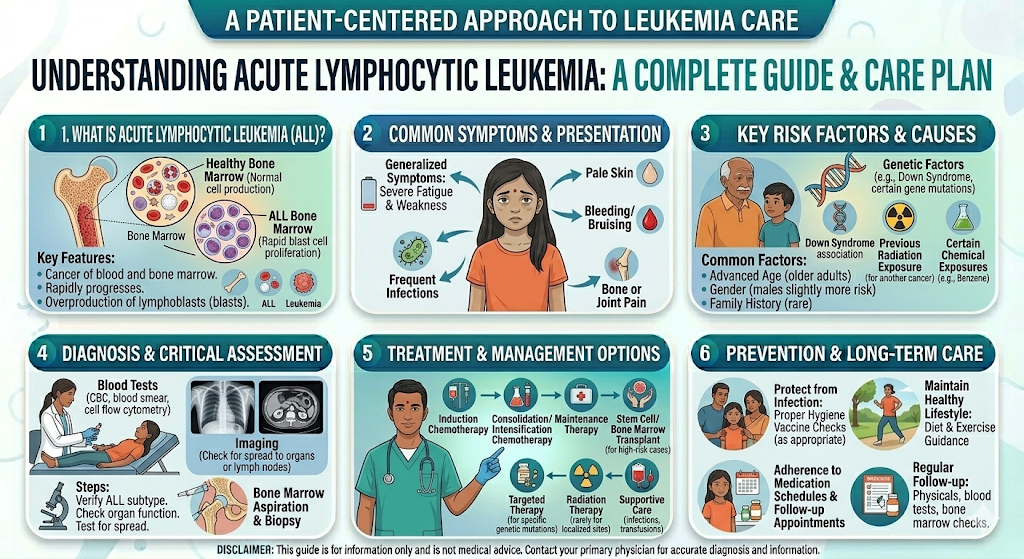
Acute lymphocytic leukemia (ALL) is a form of cancer affecting the blood and bone marrow, which is the spongy tissue inside bones where blood cells are produced. The term "acute" indicates that the disease advances rapidly and involves the creation of immature, rather than mature, blood cells. "Lymphocytic" refers to the specific type of white blood cell, called a lymphocyte, that ALL affects. ALL is also known as acute lymphoblastic leukemia.
Understanding the Condition
Acute Lymphocytic Leukemia (ALL) Overview
Acute lymphocytic leukemia (ALL) is a form of cancer affecting the blood and bone marrow, which is the spongy tissue inside bones where blood cells are produced. The term "acute" indicates that the disease advances rapidly and involves the creation of immature, rather than mature, blood cells. "Lymphocytic" refers to the specific type of white blood cell, called a lymphocyte, that ALL affects. ALL is also known as acute lymphoblastic leukemia.
Signs that may indicate acute lymphocytic leukemia include:
Bleeding from the gums
Frequent or severe nosebleeds
Getting infections often
Feeling weak, fatigued, or a general reduction in energy
Many of these symptoms can resemble those of the flu. However, flu symptoms typically get better over time. If concerning signs and symptoms persist, a doctor's visit is necessary.
If you or your child experiences persistent, concerning symptoms, you should first consult your primary care doctor or pediatrician. If leukemia is suspected, you will likely be referred to a hematologist-oncologist, a specialist in blood disorders and cancer.
Preparations Before the Visit
To make the most of your appointment, consider preparing the following:
A detailed list of all symptoms you or your child has been experiencing, and when they started.
Key personal information, including recent life changes or major stressors.
Consultation Guide
Lumps caused by swollen lymph nodes, which may be felt in areas like the neck, armpits, abdomen, or groin
ALL begins when a bone marrow cell develops mutations—changes in its DNA or genetic code—which typically instructs the cell to grow and die on a schedule. These mutations override the normal instructions, causing the bone marrow cell to keep growing and dividing uncontrollably. This process results in the production of abnormal, immature white blood cells called lymphoblasts. These abnormal cells cannot function properly and quickly accumulate, pushing out healthy blood cells.
The exact cause of the DNA mutations that lead to ALL is not fully understood.
Factors that can increase the risk include:
While there are no definitive preventative measures for acute lymphocytic leukemia, certain precautions may help manage risk factors.
Diagnostic Procedures
Diagnostics: Identifying Acute Lymphocytic Leukemia
To diagnose ALL and determine the extent of the disease, several tests and procedures are used.
Bone Marrow Aspiration and Biopsy: This is a crucial procedure for diagnosis. It involves collecting and examining bone marrow—the spongy tissue inside larger bones. This exam determines if the bone marrow is healthy and producing normal amounts of blood cells. The process usually involves two parts: a bone marrow aspiration (removing a sample of the fluid portion) and a bone marrow biopsy (removing a small piece of the solid bone tissue and marrow).
What to Expect
Lumbar Puncture (Spinal Tap): This test diagnoses certain health conditions by collecting a sample of cerebrospinal fluid (CSF), the fluid that cushions the brain and spinal cord. It can be used to check for cancer cells in the central nervous system, diagnose serious infections, or to inject chemotherapy.
What to Expect
CT Scan (Computerized Tomography Scan): This is an imaging technique that uses X-rays and a computer to create detailed, cross-sectional images (slices) of bones, blood vessels, and soft tissues inside the body. It provides more detail than a standard X-ray.
What to Expect
X-ray: This is a fast, non-painful test that captures internal images, particularly of the bones. Dense materials like bone and metal show up as white, while air appears black, and soft tissues are shades of grey.
What to Expect
Ultrasound (Sonography): This procedure uses low-power sound waves to create live pictures of structures inside the body. It is a safe procedure with no known risks.
What to Expect
Psychosocial Support: Seeking emotional and social support through counseling or support groups can help patients and families navigate the challenges of life after a cancer diagnosis.
Disclaimer: This article provides general health information and is not intended to be a substitute for professional medical advice, diagnosis, or treatment. Always consult your treating physician or another qualified healthcare provider with any questions you may have regarding a medical condition.
To report an error in the article, please send an email to errors@medicalwriter.com.
Treatment Options
ALL is the most common cancer found in children, and treatments often offer a very good chance for a cure. While it can also affect adults, the possibility of a cure is significantly lower in older patients.
Past Cancer Treatment: Children and adults who have received certain types of radiation therapy and chemotherapy for other cancers may have a higher risk.
Radiation Exposure: Exposure to extremely high levels of radiation, such as in a nuclear reactor accident, raises the risk.
Genetic Conditions: Certain genetic disorders, like Down syndrome, are linked to an increased risk of ALL.
A list of all medications, vitamins, or supplements currently being taken.
Questions you want to ask the doctor.
Book a doctor visit near me
The goal of cancer treatment is to cure the disease, shrink the cancer, or prevent it from spreading. Treatment plans are highly individualized. For ALL, treatment typically occurs in phases over a long duration, often spanning two or more years, with the initial intensive phase lasting several months.
Chemotherapy (Medication/Therapy): This is a drug treatment that uses powerful chemicals to destroy rapidly multiplying cells in the body, primarily cancer cells. It is typically used over various periods: to achieve initial remission (induction phase, lasting several weeks), to kill remaining cells (consolidation phase, lasting several months), and long-term to prevent recurrence (maintenance phase, often lasting two years or more).
CAR-T Cell Therapy (Therapy): This is a form of immunotherapy where a person’s own immune cells (T cells) are collected, genetically altered in a lab to better fight the cancer, multiplied in number, and then infused back into the bloodstream. The modified T cells are designed to target and kill specific cancer cells, potentially offering lasting anticancer results. The preparation and modification process takes several weeks before infusion.
Radiation Therapy (Therapy): This treatment uses focused beams of intense energy (most often X-rays or protons) to destroy the cancer cells' genetic material. Modern methods are precise, aiming beams directly at the cancer while minimizing harm to healthy tissue. It can be delivered externally using a machine (external beam radiation therapy) or internally by placing a small solid implant near the cancer (brachytherapy). The duration varies based on the cancer's location and stage.
Home Remedies: The provided medical information does not specify effective home remedies for treating acute lymphocytic leukemia. Treatment is complex and requires medical intervention.
Survivorship involves managing health after the intensive treatment phases. Maintaining long-term wellbeing is critical for patients who have undergone treatment for ALL.
Regular Follow-up Care: It is essential to attend all scheduled follow-up appointments to monitor for potential recurrence or late side effects of treatment.
Prevention & Long-Term Wellbeing
Bone Marrow Transplant (Surgical Procedure/Therapy): Also known as a stem cell transplant, this procedure replaces bone marrow that is no longer producing enough healthy blood cells. Before the transplant, intense therapy (like chemotherapy) is given to kill the diseased cells and malfunctioning bone marrow. Healthy blood-forming stem cells are then infused into the bloodstream, where they travel to the marrow and ideally begin producing new, healthy blood cells. This can use cells from the patient (autologous) or a donor (allogeneic). The entire process requires a long period of hospitalization and recovery.
Prevention and Long-term Wellbeing
Prevention
Currently, no known way exists to prevent most cases of ALL. However, it is advisable to limit exposure to extremely high levels of radiation, such as from nuclear reactor accidents. Additionally, individuals with certain genetic conditions, such as Down syndrome, should be closely monitored by healthcare professionals as they may have an increased risk.
Long-term Wellbeing (Survivorship)
Healthy Lifestyle: Adopting a healthy diet, engaging in regular physical activity, and strictly avoiding tobacco products can support overall recovery and health.
Tags & Topics
Notice an error or need an update?
Help us keep medical information accurate. Report incorrect info or suggest an edit.


