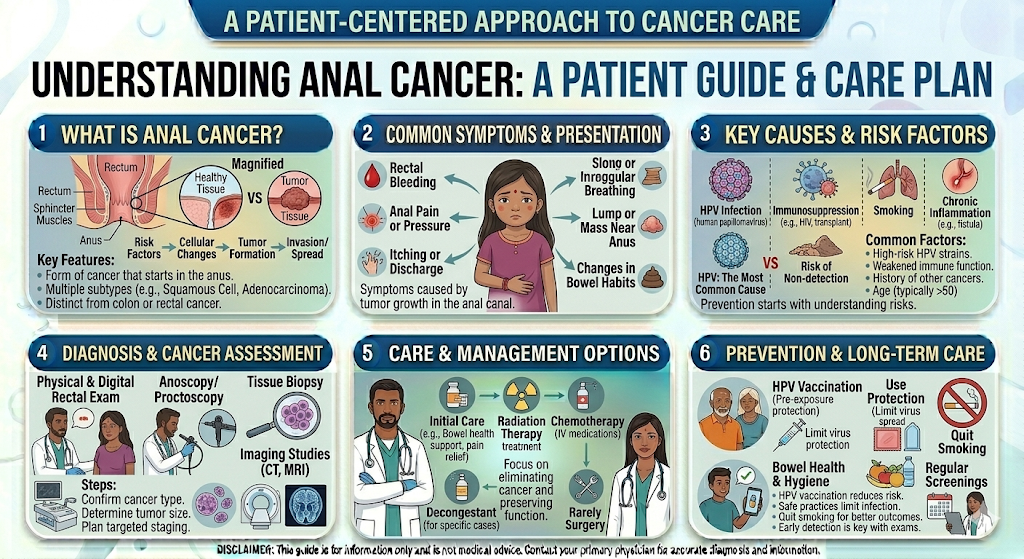
Anal cancer is a type of abnormal cell growth that begins in the anal canal. The anal canal is the short, tubular passage at the end of the rectum, which is the final exit path for stool as it leaves the body.
Understanding the Condition
Anal Cancer: A Guide for Non-Medical Readers
Anal cancer is a type of abnormal cell growth that begins in the anal canal. The anal canal is the short, tubular passage at the end of the rectum, which is the final exit path for stool as it leaves the body.
Symptoms of anal cancer can include pain, rectal bleeding, or a noticeable growth, and these signs can sometimes be mistakenly attributed to common conditions like hemorrhoids. While in the past, treatment typically involved extensive surgery, the current standard approach combines chemical medicine therapy with focused radiation treatments, often eliminating the need for surgical removal.
If you experience any concerning changes, signs and symptoms of anal cancer may include:
Bleeding from the rectum or anus.
Visible blood in the stool.
Persistent pain in the anal area.
A palpable growth or lump within the anal canal.
Ongoing anal itching.
An increase in how often you need to use the bathroom.
If you have any symptoms that cause concern, you should make an appointment with a doctor or other healthcare professional.
Start by consulting a Primary Care Physician (PCP). If necessary, they may refer you to a specialist such as:
Gastroenterologist: A doctor specializing in the digestive system.
A clear description of all your symptoms, including when they began.
Home-Based Care: These measures focus on improving bowel health, which can help manage symptoms often confused with cancer and support overall well-being.
Ongoing lifestyle changes focus on improving bowel health, which can help manage symptoms often confused with cancer and support overall well-being:
Consultation Guide
Anal cancer develops when there are specific alterations in the genetic material (DNA) of cells within the anal canal. DNA provides all the instructions for cell behavior, including when to grow, multiply, and die. These alterations cause cells to rapidly multiply and survive longer than they should, resulting in an excess of cells that may form a tumor. Over time, this tumor can damage healthy surrounding tissue or spread to other regions of the body, a process called metastatic cancer.
The primary cause of most anal cancers is the human papillomavirus (HPV). This common virus is transmitted through sexual contact. While the body’s immune system usually clears the virus naturally, in some individuals, HPV can lead to cellular changes that are precursors to cancer.
Risk Factors
Several factors can increase a person’s likelihood of developing anal cancer:
Exposure to HPV: Infection with the human papillomavirus.
Sexual History: An increased number of sexual partners, or having a partner with many sexual partners, raises the risk of acquiring HPV.
Anal Intercourse: Engaging in receptive anal sex is associated with a higher risk.
Tobacco Use: Smoking cigarettes increases the risk.
History of Related Cancers: People who have had cervical, vulvar, or vaginal cancer have a higher risk.
Weakened Immune System: Conditions such as HIV infection, or taking certain medicines (for example, after an organ transplant) that suppress the body’s immune system, increase the risk.
Anal cancer rarely spreads to distant organs. When spread does occur, it is most frequently found in the lungs and liver, making the condition more challenging to manage.
Diagnostic Procedures
Oncologist: A doctor who specializes in cancer diagnosis and treatment.
Your complete medical history, including any previous cancer diagnoses (cervical, vaginal, vulvar) and information regarding your immune system health.
All prescription and non-prescription medicines or supplements you are taking.
Book a doctor visit near me
Digital Rectal Exam (DRE): A quick physical exam where a doctor inserts a lubricated, gloved finger into the anus to feel for any abnormal growths or masses in the anal canal and rectum.
Anal Pap Test: A technique used to screen for cancer cells and precancerous cells. A healthcare professional collects cells from the anal canal with a swab, and these cells are then analyzed in a laboratory.
Anal HPV Test: This procedure involves laboratory testing of cells collected from the anal canal to detect the presence of the human papillomavirus infection.
Computed Tomography (CT) Scan: An imaging method that uses X-ray technology and computer processing to generate highly detailed cross-sectional views of internal structures, including soft tissues, bones, and blood vessels.
Positron Emission Tomography (PET) Scan: An imaging test that shows the body’s metabolic activity. A safe, radioactive tracer is injected into a vein and tends to concentrate in areas with high biochemical activity, such as cancer cells, which appear as bright spots. This scan is often performed alongside a CT or MRI scan.
Ultrasound (Sonography): A safe procedure that uses low-power sound waves to produce moving images of the body’s internal structures. It is often used to guide diagnosis, but its effectiveness can be limited when imaging areas obscured by bone or gas.
X-ray: A fast, painless test that captures images of structures inside the body by passing radiation beams through the tissue. Dense materials like bone appear white, while soft tissues appear in shades of gray.
Colonoscopy: A procedure involving the insertion of a flexible, camera-equipped tube (colonoscope) into the rectum to view the entire inner lining of the large intestine and rectum. This allows doctors to remove abnormal tissue or take small tissue samples (biopsies).
What to Expect
Digital Rectal Exam and Anal Pap/HPV Tests: These procedures are typically completed quickly during an office visit and involve minimal discomfort.
CT and X-ray Scans: You will lie down while the imaging equipment captures the necessary pictures. These are generally quick and pain-free procedures.
PET Scan: A radioactive tracer will be injected into your arm or hand. After a waiting period, you will lie on a table that moves into a doughnut-shaped scanner for approximately 30 minutes while the images are taken.
Ultrasound: For most exams, a device will be moved over your skin. You may need to wear loose clothing and remove jewelry.
Colonoscopy: Before the procedure, you will need to follow specific instructions to cleanse your colon. During the exam, sedation is typically administered to ensure your comfort.
Screening tests are sometimes recommended for individuals at high risk, such as those with a history of precancerous cells in the genital area or those on immune-suppressing medications.
Disclaimer: This article provides general health information and is not intended to be a substitute for professional medical advice, diagnosis, or treatment. Always consult your treating physician or another qualified healthcare provider with any questions you may have regarding a medical condition.
To report an error in the article, please send an email to errors@medicalwriter.com.
Treatment Options
Proctologist/Colorectal Surgeon: A specialist in surgical treatment for conditions of the rectum and anus.
Preparation Before the Visit
To ensure a productive visit, be prepared to discuss:
The goal of treatment is to cure or shrink the cancer or to prevent it from spreading.
Combined Chemical and Radiation Therapy (Chemoradiation): This is the most common approach today, using powerful chemicals to destroy fast-growing cells simultaneously with external radiation treatments aimed at the tumor.
Duration: Typically involves several weeks of concurrent treatment sessions.
Medication Therapy (Chemotherapy): Involves the use of potent chemical agents to kill cancer cells throughout the body.
Duration: Administered in cycles that may last weeks or months, and can be used at various stages of treatment.
Radiation Therapy (Radiotherapy): Uses high-energy beams to damage the genetic material of cancer cells.
External Beam Radiation: Delivered by a large machine outside the body.
Internal Radiation (Brachytherapy): Involves placing small, solid, radiation-emitting implants directly in or near the tumor.
Duration: Typically delivered over a course of several weeks.
Biological Therapy: A treatment designed to boost the body’s own defense system (immune system) to better recognize and eliminate cancer cells.
Duration: Varies significantly based on the specific type of therapy used.
Surgical Procedures:
Tumor Removal: This was historically the main treatment. Today, surgery may be used for very early-stage cancers or if combined therapy is unsuccessful.
Colostomy: A procedure where a surgeon creates an opening (stoma) in the abdomen, diverting a part of the colon to this opening and attaching a collection pouch outside the body for waste. This is often required when major surgery is necessary to remove the cancer, though current combined treatments often help patients avoid this.
Duration: Recovery from major surgery takes several weeks, and stoma care is ongoing if the colostomy is permanent.
Prevention & Long-Term Wellbeing
Dietary Adjustments: Eating foods high in fiber, such as whole grains, vegetables, and fruits, alongside drinking plenty of fluids (6 to 8 glasses daily), helps soften stools and prevents straining.
Activity: Regular exercise helps prevent constipation and reduces pressure on the anal veins. Avoid sitting for prolonged periods, especially on the toilet.
Duration: These are ongoing lifestyle changes for long-term health.
Prevention and Long-Term Well-being
To reduce the risk of anal cancer, consider the following steps:
Safer Sexual Practices: Using barrier methods (like condoms) and limiting the number of sexual partners can help prevent sexually transmitted infections, including HPV.
HPV Vaccination: Discuss the HPV vaccine with your healthcare team, as it may reduce the risk of anal and other HPV-related cancers.
Avoid Tobacco: If you do not use tobacco, don't start. If you currently use any form of tobacco, talk to a healthcare professional about quitting strategies.
Dietary Adjustments: Eating foods high in fiber, such as whole grains, vegetables, and fruits, alongside drinking plenty of fluids (6 to 8 glasses daily), helps soften stools and prevents straining.
Activity: Regular exercise helps prevent constipation and reduces pressure on the anal veins. Avoid sitting for prolonged periods, especially on the toilet.
Tags & Topics
Notice an error or need an update?
Help us keep medical information accurate. Report incorrect info or suggest an edit.


