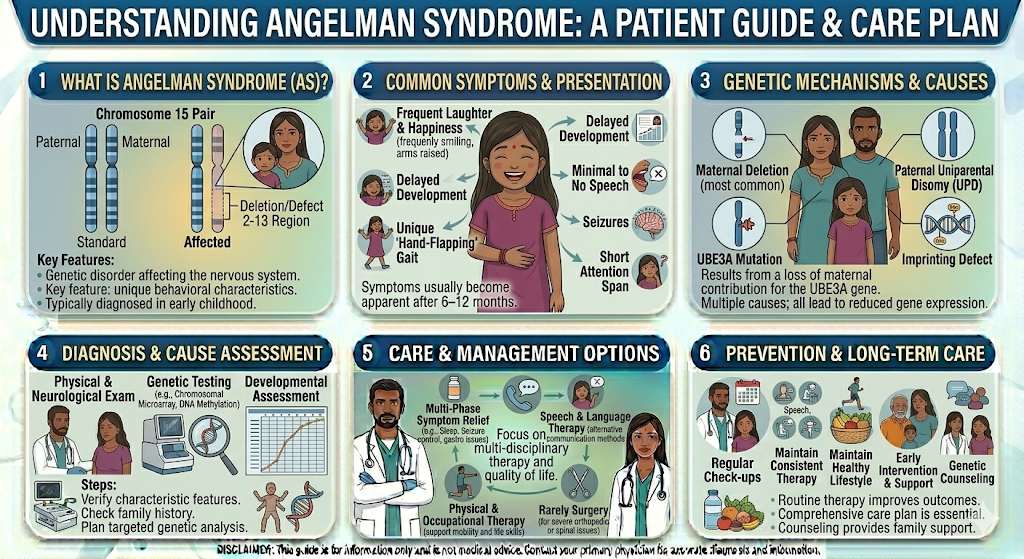
Angelman syndrome (AS) is a complex, lifelong condition caused by a change in a specific gene. It is not curable, but treatment focuses on managing the associated medical, sleep, and developmental challenges.
Understanding the Condition
Angelman Syndrome: An Overview
What is Angelman Syndrome?
Developmental delays typically become noticeable between 6 and 12 months of age. Seizures may begin later, between ages 2 and 3.
Primary symptoms include:
Developmental Delays: Failure to crawl or babble between 6 to 12 months.
Intellectual Disability: Also known as mental disability.
Speech Impairment: Minimal or no verbal communication.
Movement Difficulties: Trouble with walking, moving, or maintaining balance.
Behavioral Traits: A happy, easily excitable demeanor with frequent smiling and laughing.
Feeding and Sleep Issues: Trouble sucking or feeding in infancy, and difficulty falling asleep or staying asleep.
If you are concerned about developmental delays or symptoms consistent with Angelman syndrome, you should consult with your child’s Pediatrician first, who may then refer you to specialists such as a Pediatric Neurologist (for seizure management), a Geneticist (for diagnosis and counseling), and a Developmental Specialist.
Preparations Before Your Visit:
To help your doctor make an accurate assessment, prepare by bringing:
Detailed notes on your child’s developmental milestones, noting when delays first appeared (e.g., when they started crawling or babbling).
Records of any seizure activity, including the frequency and duration.
Information on any current feeding or sleep difficulties.
Book a doctor visit near me
Since Angelman syndrome is a lifelong condition without a cure, treatment involves the long-term management of specific symptoms and complications.
Home Remedies and Behavioral Management (Duration: Ongoing):
Hyperactivity: Management involves using behavioral strategies; specialized medicine is often not required, as hyperactivity tends to decrease naturally with age.
Sleep Troubles: Behavior therapy is a key component to help regulate sleep-wake patterns.
Since Angelman syndrome is primarily a genetic condition, prevention efforts focus on guidance for families with an increased risk. Long-term well-being centers on consistency of care to manage all associated symptoms.
Consultation Guide
Angelman syndrome (AS) is a complex, lifelong condition caused by a change in a specific gene. It is not curable, but treatment focuses on managing the associated medical, sleep, and developmental challenges.
People with Angelman syndrome are often described as having a joyful, excitable demeanor, frequently smiling and laughing.
AS is primarily caused by a change in the ubiquitin protein ligase E3A (UBE3A) gene, located on chromosome 15.
We inherit one copy of the UBE3A gene from each parent. For a small number of genes, including UBE3A, only the copy from the mother (maternal copy) is active in the brain and is necessary for brain development. Angelman syndrome occurs when the maternal copy is missing or damaged, meaning the brain does not receive the necessary information to properly control speech and movement. In rare cases, AS is caused by inheriting two copies of the gene from the father (paternal copies) instead of one from each parent.
The condition is rare, and often the cause of the genetic change is unknown. Most individuals with AS do not have a family history of the disorder. However, a family history can sometimes increase a baby's risk if the changed genes are passed down.
Consultation & Next Steps
This procedure examines your DNA—the body’s chemical instruction manual—to identify changes (mutations) in your genes that may cause illness. Genetic testing is crucial for diagnosis, risk determination, screening, and guiding medical treatment.
Genome Sequencing: If standard genetic testing is inconclusive but a genetic cause is still suspected, a more complex process called genome sequencing may be used. This involves analyzing a DNA sample, typically focusing on the protein-encoding parts of the DNA (the exome).
It is important to discuss the potential outcomes with a doctor or genetic counselor, as a positive result in a healthy person does not guarantee disease development, and a negative result does not always guarantee the absence of a disorder.
Cognitive Behavioral Therapy (CBT)
Diagnostic Procedures
Diagnosis of Angelman syndrome is primarily achieved through genetic testing.
What to Expect
Sample Collection: Genetic tests usually require a small blood sample or a cheek swab. These methods carry almost no physical risk.
Prenatal Testing: For testing during pregnancy, procedures like amniocentesis or chorionic villus sampling are used, which carry a small risk of pregnancy loss (miscarriage).
Genetic Counseling: If Angelman syndrome is a concern due to family history, consult with a geneticist or genetic counselor before or during pregnancy to understand risks, diagnostic testing, and potential outcomes.
Strategies for Long-Term Wellbeing:
Consistent Therapeutic Care: Maintain a regular schedule of physical, speech, and developmental therapies to support communication and motor skills throughout the individual's life.
Disclaimer: This article provides general health information and is not intended to be a substitute for professional medical advice, diagnosis, or treatment. Always consult your treating physician or another qualified healthcare provider with any questions you may have regarding a medical condition.
To report an error in the article, please send an email to errors@medicalwriter.com.
Treatment Options
CBT is a type of talk therapy used to help individuals learn how to manage emotional challenges and stressful life situations. It is highly structured, generally involves fewer sessions than other therapies, and often includes practice exercises or "homework". While CBT can be a useful component of care for mental health concerns, it is often used alongside other treatments.
Medication (Duration: As needed, often long-term):
Seizures: Medication is frequently necessary to control seizure activity, often starting between ages 2 and 3.
Sleep: Specific medicines may be used to address sleep difficulties and help improve sleep patterns.
Therapies (Duration: Varies, often long-term):
Developmental and Speech Therapy: Essential for addressing delays in development and limited speech.
Physical Therapy: Necessary to address balance and walking difficulties.
Behavior Therapy: Used for sleep issues and as part of overall management for emotional challenges (Cognitive Behavioral Therapy).
Nutritional Management (Duration: As needed, especially infancy):
For infants struggling with sucking and swallowing, a healthcare professional may recommend a high-calorie formula to ensure adequate weight gain.
Procedures and Surgical Interventions (Duration: Single procedure or ongoing care):
Scoliosis: The curving of the spine may require ongoing monitoring and, in some cases, bracing or surgical intervention.
Medical Management: Continue necessary medications for seizures and sleep difficulties, as these are often long-term needs.
Monitoring Complications: Ensure ongoing monitoring and intervention for potential orthopedic issues like scoliosis and nutritional concerns like obesity.
Psychosocial and Family Support: Engage in counseling or support groups to manage the emotional challenges and stress associated with a lifelong condition, providing comprehensive support for both the individual and their family.
Prevention & Long-Term Wellbeing
Obesity: Management of obesity in older children involves dietary and physical activity interventions.
Prevention and Long-Term Well-being
Prevention Strategies:
Tags & Topics
Notice an error or need an update?
Help us keep medical information accurate. Report incorrect info or suggest an edit.


