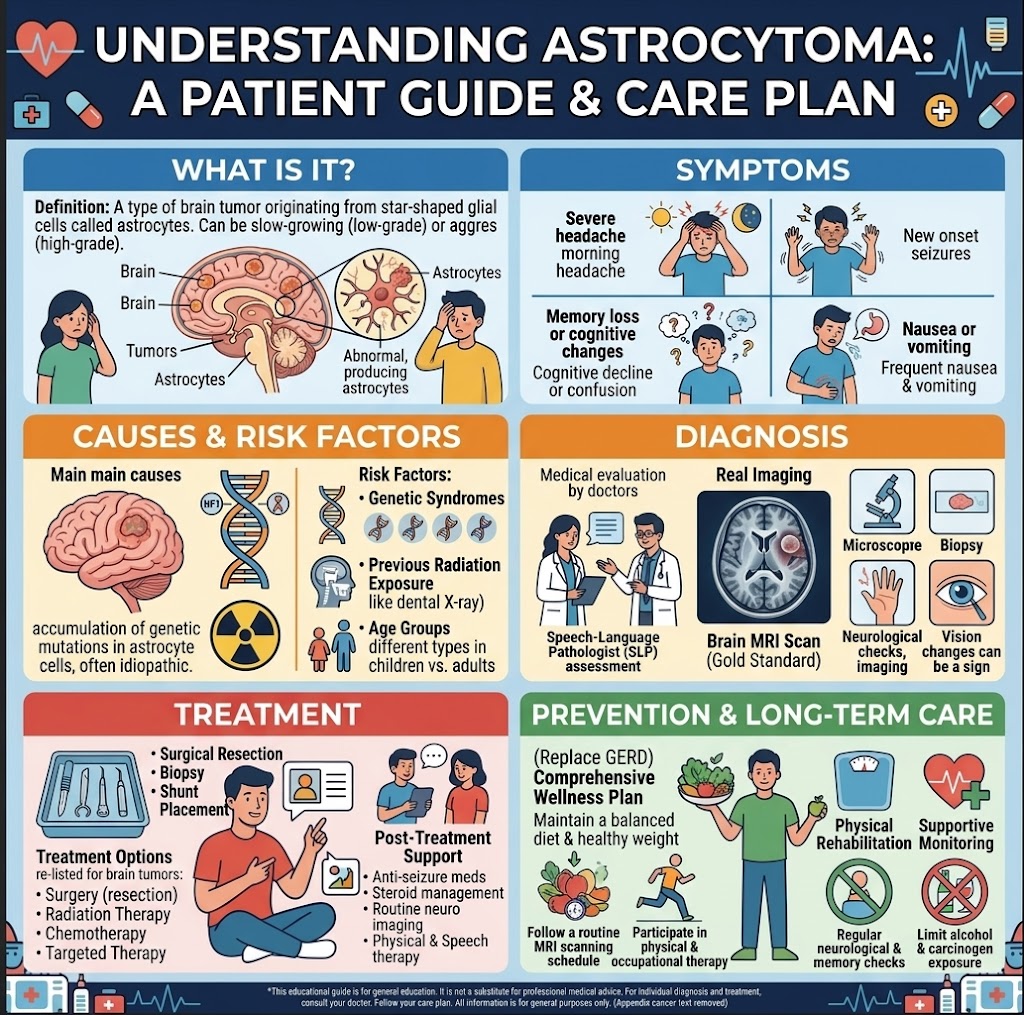
Astrocytoma is a type of tumor that starts in the brain or spinal cord. These tumors develop from star-shaped cells called astrocytes, which are crucial for supporting and protecting nerve cells. Symptoms of astrocytoma depend on where the tumor grows. A tumor in the brain might cause headaches, seizures, nausea, or changes in mood or behavior. If it’s in the spinal cord, symptoms could include weakness or difficulty moving arms or legs. Astrocytomas vary in behavior; some grow slowly and are less aggressive, while others are aggressive and spread quickly. Doctors often analyze the tumor's genetic makeup to guide the most effective treatment. These tumors are classified by grade (1 to 4) based on their growth rate. Grade 4 astrocytoma, known as glioblastoma, is the fastest-growing and most aggressive. Lower-grade tumors (1 to 3) typically grow slower and often have a better outlook. Treatment and prognosis depend on the tumor's grade, size, location, and specific molecular features.
Understanding the Condition
Astrocytoma: Understanding Brain and Spinal Cord Tumors
Understanding the Condition
Astrocytoma is a type of tumor that starts in the brain or spinal cord. These tumors develop from star-shaped cells called astrocytes, which are crucial for supporting and protecting nerve cells. Symptoms of astrocytoma depend on where the tumor grows. A tumor in the brain might cause headaches, seizures, nausea, or changes in mood or behavior. If it’s in the spinal cord, symptoms could include weakness or difficulty moving arms or legs. Astrocytomas vary in behavior; some grow slowly and are less aggressive, while others are aggressive and spread quickly. Doctors often analyze the tumor's genetic makeup to guide the most effective treatment. These tumors are classified by grade (1 to 4) based on their growth rate. Grade 4 astrocytoma, known as glioblastoma, is the fastest-growing and most aggressive. Lower-grade tumors (1 to 3) typically grow slower and often have a better outlook. Treatment and prognosis depend on the tumor's grade, size, location, and specific molecular features.
Common Symptoms
New Seizures: Often an early indicator, especially for slow-growing tumors, representing abnormal brain electrical activity.
Headaches: Mild initially, they can become more severe or persistent as the tumor grows and creates pressure.
Cognitive Changes: Subtle shifts in thinking, memory, concentration, or mood and behavior.
Speech Difficulties: Trouble finding the right words, speaking clearly, or understanding language.
Vision Problems: Blurry vision, double vision, or loss of peripheral sight, often due to pressure on optic nerves or brain areas controlling vision.
Physical Weakness or Clumsiness: Weakness or uncoordinated movements, particularly on one side of the body.
Numbness or Tingling: Sensations of pins and needles, or loss of feeling, typically in an arm or leg.
Neck or Back Pain: Pain that develops slowly and persists, if the tumor is located in the spinal cord.
Nausea and Vomiting: Especially if accompanied by headaches, indicating increased pressure within the skull.
Consultation Guide
Which Specialist to Meet
Before your visit, prepare a detailed list of your symptoms, including when they started and how they have progressed. Note any medications you are taking, your medical history, and any family history of cancer. Be ready to discuss lifestyle habits and any potential risk factors. Write down questions you have for the doctor.
Book a doctor visit near me
Doctor evaluates symptoms and medical history, performs simple physical tests (e.g., eye movements, walking, reflexes, sensation). Generally painless, takes minutes to an hour.
Brain Magnetic Resonance Imaging (MRI)
Uses strong magnets and radio waves for detailed images of the brain and spinal cord, without radiation. Helps identify tumors, swelling, or abnormalities.
Palliative Care: Specialized medical care focused on providing relief from symptoms, pain, and stress of a serious illness, improving quality of life for both the patient and their family. It is provided alongside other treatments. (Duration: Ongoing for the duration of the illness, adapting to evolving needs.)
Symptom and Side Effect Management
Integrated Support: Consider palliative care early to manage symptoms and enhance quality of life alongside active treatments.
Diagnostic Procedures
Neurological Examination
Assesses brain, spinal cord, and nerve function by checking mental status, coordination, reflexes, muscle strength, balance, and sensation.
What to Expect
What to Expect
Lie on a table inside a tube-shaped machine. Must stay still. Machine is loud, earplugs offered. Lasts 30-60 minutes.
Computed Tomography (CT) Scan
Uses X-rays from multiple angles and computer processing to create cross-sectional images of internal structures (bones, blood vessels, soft tissues).
What to Expect
Lie on a table that slides into a doughnut-shaped machine. May receive intravenous contrast dye. Quick scan, typically a few minutes.
Positron Emission Tomography (PET) Scan
Imaging using a radioactive tracer to show metabolic activity; cancer cells often "light up" due to higher activity. Often combined with CT or MRI.
What to Expect
Tracer is injected, then wait about an hour for uptake. Lie on a table inside a scanner for ~30 minutes.
A tissue sample is removed from the tumor using a needle for microscopic examination to determine tumor type, grade, and molecular features.
What to Expect
What to Expect
Tissue from biopsy or a standard blood draw. Minimal physical risk. Results may take weeks.
Lumbar Puncture (Spinal Tap)
Collection of cerebrospinal fluid (CSF) from the lower back to test for tumor cells or markers.
What to Expect
Lie on side or sit, local anesthetic applied. Thin needle inserted between lower spine bones to collect fluid. May feel pressure; takes 30-45 minutes. May need to lie flat afterward.
Treatment Options
You should initially consult your primary care doctor, who will likely refer you to specialists such as a neurologist (a doctor specializing in brain and nervous system disorders) and potentially a neuro-oncologist (a specialist in brain and spinal cord cancers), or a neurosurgeon if surgery is considered.
Preparations Before Your Visit
Performed during open surgery or via a small skull opening (stereotactic biopsy) with local anesthetic and sedation, guided by imaging. Pressure may be felt.
Analysis of DNA from tumor tissue or blood for specific gene changes influencing prognosis and treatment.
Surgical Procedures
Tumor Removal Surgery: A neurosurgeon carefully removes as much of the tumor as possible without damaging healthy brain or spinal cord tissue. The goal is complete removal, but sometimes only a portion can be safely taken out. (Duration: A single procedure, but recovery can take weeks to months.)
Stereotactic Radiosurgery: This is a non-surgical technique that delivers highly focused beams of radiation to the tumor from multiple angles, destroying tumor cells while minimizing damage to surrounding healthy tissue. (Duration: Often a single treatment session, though sometimes multiple sessions over a few days.)
External Beam Radiation: High-energy beams (like X-rays or protons) are precisely directed at the tumor from a machine outside the body to kill cancer cells and shrink the tumor. (Duration: Typically given daily for several weeks (e.g., 2-6 weeks).)
Brachytherapy (Internal Radiation): Tiny radioactive seeds or implants are temporarily or permanently placed directly into or near the tumor, delivering a high dose of radiation to a localized area. (Duration: Implants may stay for days, weeks, or permanently.)
Chemotherapy: Uses powerful drugs, given orally or intravenously, to kill fast-growing cancer cells throughout the body. Can be used alone or in combination with other treatments. (Duration: Administered in cycles (e.g., once every few weeks) over several months or longer, depending on the drug and tumor response.)
Targeted Therapy: Medications that specifically target vulnerabilities in cancer cells, often based on the tumor's genetic mutations, blocking their growth or spread with less harm to healthy cells. (Duration: Taken continuously, often for many months or years, as long as the treatment is effective and side effects are manageable.)
Biological Therapy (Immunotherapy): Treatments that boost the body's own immune system to recognize and fight cancer cells. It can unmask cancer cells or enhance the immune response. (Duration: Given in cycles over several months or years.)
Pain and Seizure Control: Adhere to prescribed medications for headaches and seizures.
Fatigue and Nausea: Manage with rest, appropriate activity, dietary adjustments, and anti-nausea medications.
Rehabilitation Support
Physical, Occupational, Speech, and Cognitive Therapies: Engage in tailored therapies to improve strength, daily living skills, communication, and cognitive function as needed.
Counseling and Support Groups: Seek professional support and connect with others to cope with emotional challenges.
Stress Reduction: Utilize mindfulness, meditation, or relaxation techniques.
Prevention & Long-Term Wellbeing
Ongoing Monitoring and Lifestyle
Regular Imaging: Attend scheduled MRI/CT scans to monitor for recurrence or progression.
Healthy Habits: Maintain a balanced diet, hydration, and adequate sleep.
Tags & Topics
Notice an error or need an update?
Help us keep medical information accurate. Report incorrect info or suggest an edit.


