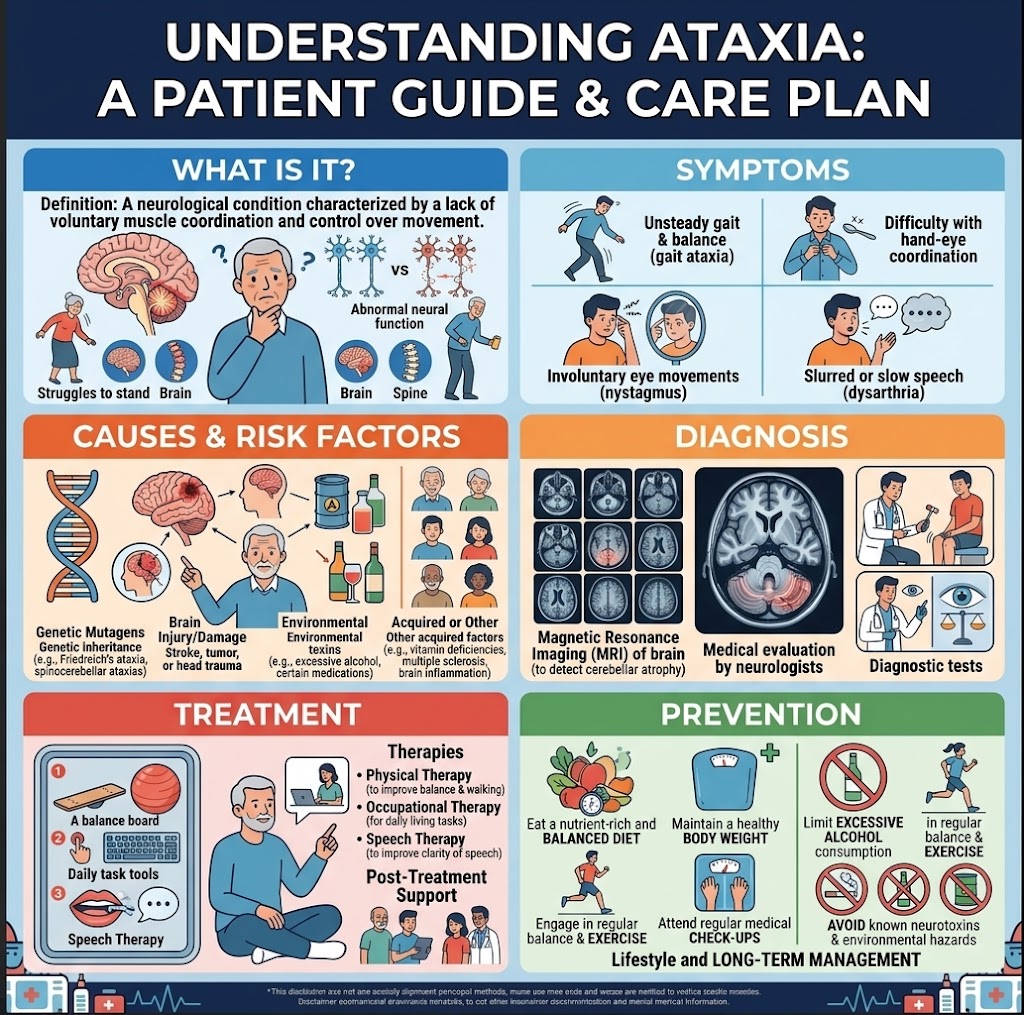
Ataxia is a neurological term that describes a lack of muscle control and coordination, leading to clumsy or unsteady movements. It is not a disease itself, but rather a clinical sign of damage to the nervous system—most commonly to the cerebellum, the area of the brain responsible for regulating balance and coordination. Ataxia can affect walking, hand coordination, speech, swallowing, and eye movements.
Understanding the Condition
Understanding Ataxia: Causes, Symptoms, and Diagnostics
Understanding the Condition
Ataxia is a neurological term that describes a lack of muscle control and coordination, leading to clumsy or unsteady movements. It is not a disease itself, but rather a clinical sign of damage to the nervous system—most commonly to the cerebellum, the area of the brain responsible for regulating balance and coordination. Ataxia can affect walking, hand coordination, speech, swallowing, and eye movements.
Common Symptoms
Unsteady Gait and Balance Issues: Difficulty walking in a straight line, stumbling, or needing to walk with the feet spread wide apart to maintain stability.
Impaired Fine Motor Skills: Trouble performing precise hand movements required for everyday tasks, such as writing, using utensils, fastening buttons, or typing.
Before your visit, keep a detailed log of your symptoms and when they began. Bring a comprehensive list of all current medications, vitamins, and supplements you are taking. Gather any personal and family medical history regarding neurological disorders, and note down specific questions about your mobility and coordination concerns.
Book a doctor visit near me
A laboratory analysis of urine to screen for systemic toxins, metabolic markers, or kidney dysfunction that could contribute to neurological symptoms.
Consultation Guide
Speech Fluency Changes: Slurred, slow, or unusually spaced speech, often called scanning speech, caused by a lack of coordination in the muscles that control vocalization.
Involuntary Eye Movements: Rapid, uncontrollable, repetitive eye movements (nystagmus) that may move up and down, side to side, or in a circular pattern, potentially affecting vision.
Difficulty Swallowing: Incoordination of the throat muscles (dysphagia), which can make swallowing food, liquids, or saliva difficult, increasing the risk of choking.
Consultation Guide
Which Specialist to Meet
An analysis of your DNA to identify inherited gene mutations that are known to cause genetic forms of ataxia.
Targeted Nutritional Supplementation: High-dose vitamin therapy administered orally or intravenously to reverse ataxia caused by specific vitamin deficiencies (e.g., Vitamin E, B1, B12). (Duration: Often lifelong if the underlying cause of the malabsorption or deficiency cannot be corrected, though acute deficiencies can show improvement within weeks.)
Treatment of Underlying Medical Causes: Addressing the root cause of acquired ataxia, such as administering therapies for autoimmune disorders, multiple sclerosis, or thyroid conditions. (Duration: Varies significantly depending on the underlying pathology, often requiring lifelong disease management.)
Surgical Decompression or Tumor Removal: Neurosurgery to remove a tumor, drain an abscess, or relieve pressure on the cerebellum caused by structural abnormalities. (Duration: A single surgical event, followed by several weeks of acute hospital recovery and months of intensive postoperative physical rehabilitation.)
Mobility Aids: The use of canes, walkers, rollators, or wheelchairs to ensure safe, independent movement and prevent falls. (Duration: Used as needed, typically on a long-term or permanent basis depending on the progressive nature of the coordination loss.)
Diagnostic Procedures
You should consult a neurologist, a medical doctor who specializes in diagnosing and treating disorders of the brain, spinal cord, and nervous system.
Preparations Before Your Visit
Neurological Examination
A comprehensive physical assessment evaluating mental status, reflexes, cranial nerve function, muscle strength, balance, and coordination.
What to Expect
During the exam, the doctor will ask you to perform simple physical movements, such as walking in a straight line, touching your nose with your finger, tracking a light with your eyes, and testing your reflex responses with a small rubber hammer. The exam is completely non-invasive and takes 30 to 60 minutes.
Magnetic Resonance Imaging (MRI)
An advanced imaging technique that uses strong magnetic fields and radio waves to create detailed, three-dimensional images of the brain and spinal cord, specifically looking for abnormalities in the cerebellum.
What to Expect
You will lie flat on a motorized table that slides into a tunnel-shaped scanner. You must remain completely still during the scan, which makes loud clicking and tapping noises. You may be given earplugs or headphones. Sometimes, an intravenous (IV) contrast dye is injected to make brain structures clearer. The procedure takes between 30 and 60 minutes.
Lumbar Puncture (Spinal Tap)
A procedure to collect cerebrospinal fluid (CSF)—the fluid that cushions the brain and spinal cord—to test for infections, inflammation, multiple sclerosis, or bleeding.
What to Expect
You will lie on your side with your knees drawn up to your chest, or sit hunched forward. The doctor will clean your lower back and numb the area with a local anesthetic. A thin needle is inserted between two lower spinal bones (vertebrae) to extract a small sample of fluid. You will feel pressure during the insertion. Afterward, you will be advised to lie flat for a few hours to prevent a headache.
What to Expect
This test is simple and carries virtually no physical risk. A healthcare professional will draw a sample of blood from a vein in your arm or collect a saliva sample using a cheek swab. The sample is then sent to a specialized laboratory, and results may take several weeks to return.
Complete Blood Count (CBC) and Metabolic Panel
Blood tests used to screen for underlying conditions such as severe vitamin deficiencies (Vitamins E, B1, B6, or B12), toxic exposure, metabolic imbalances, or thyroid dysfunction.
What to Expect
A phlebotomist will tie an elastic band around your upper arm, clean the skin, and insert a needle into a vein to collect blood samples into vials. You will feel a quick pinch. The draw takes less than five minutes, and results are typically ready within a few days.
What to Expect
You will be given a sterile cup and wipes to collect a 'clean-catch' midstream urine sample in the restroom. You will return the sample container to the healthcare team for lab analysis, which can sometimes provide rapid results within minutes.
Treatment Options
Therapies
Physical Therapy: Focuses on improving core strength, motor control, posture, and gait training to help maintain balance and walking stability. (Duration: Usually prescribed as an ongoing, long-term regimen, starting with 2 to 3 sessions per week for several months, with periodic maintenance reviews.)
Occupational Therapy: Assists with activities of daily living by introducing adaptive techniques and tools like weighted utensils, button hooks, and specialized writing aids. (Duration: Typically spans several weeks to months, with periodic adjustments as the patient's functional needs evolve.)
Speech and Language Therapy: Teaches exercises to strengthen the muscles involved in vocalization and swallowing, enhancing speech clarity and safety while eating. (Duration: Typically runs for 6 to 12 weeks per course, with home exercises practiced daily and indefinitely.)
Medical Procedures and Interventions
Prevention & Long-Term Wellbeing
Home Safety and Fall Prevention
Create a Clear Pathway: Remove tripping hazards such as loose rugs, clutter, and electrical cords from high-traffic household walking paths.
Install Safety Supports: Equip bathrooms with grab bars, place non-slip mats inside and outside the shower, and ensure handrails are securely installed on all staircases.
Optimize Home Lighting: Keep living spaces well-lit, especially pathways to the restroom at night, using motion-activated nightlights to compensate for reduced balance.
Lifestyle and Dietary Management
Avoid Alcohol and Neurotoxins: Eliminate alcohol completely, as it directly damages the cerebellum and can permanently worsen coordination issues. Avoid exposure to toxic industrial solvents and heavy metals.
Adopt a Nutrient-Dense Diet: Maintain a diet rich in essential vitamins (particularly B vitamins and Vitamin E) by eating whole grains, leafy greens, nuts, and lean proteins to support nerve health.
Engage in Safe, Regular Exercise: Participate in low-impact activities like swimming, water aerobics, or stationary cycling, which help preserve cardiovascular health and muscle strength without high fall risks.
Long-Term Neurological Monitoring
Schedule Regular Neurological Check-ups: Visit your neurologist consistently to monitor the progression of the condition, review the efficacy of your physical therapies, and adjust management strategies as necessary.
Tags & Topics
Notice an error or need an update?
Help us keep medical information accurate. Report incorrect info or suggest an edit.


