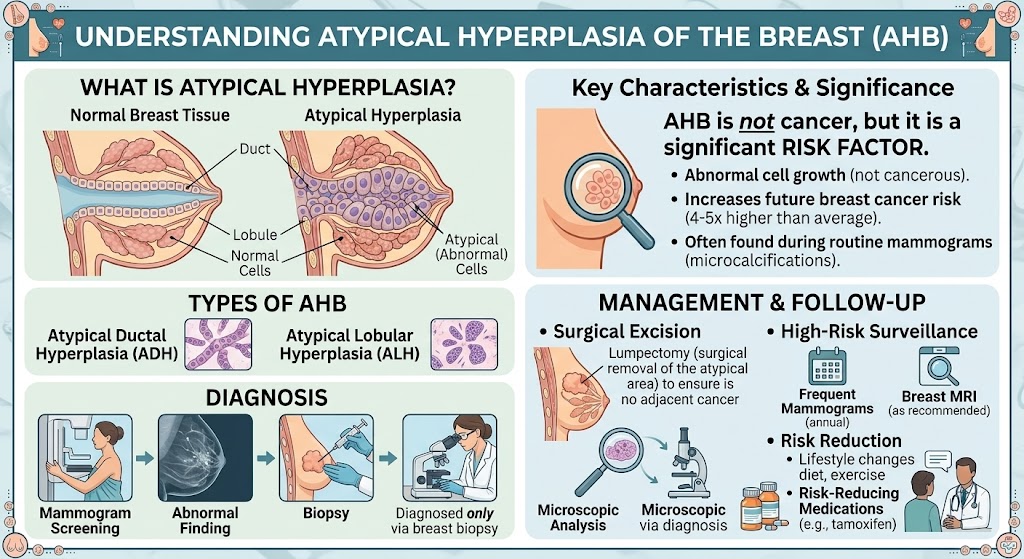
Atypical hyperplasia of the breast is a non-cancerous condition where abnormal cells build up in the breast tissue. These cells, when viewed under a microscope, look different from typical breast cells. While not breast cancer itself, atypical hyperplasia signals an increased future risk of developing breast cancer. Your medical team will help create a plan to manage this risk, often involving more frequent breast screenings and sometimes medications to reduce risk.
Understanding the Condition
Atypical Hyperplasia of the Breast: Understanding and Managing Your Risk
Understanding the Condition
Common Symptoms
Lack of Noticeable Symptoms: Atypical hyperplasia typically doesn't cause any noticeable symptoms. It is usually discovered by chance during a breast biopsy. A breast biopsy is a procedure where a small sample of breast tissue is taken for examination, often recommended after something concerning is seen on a mammogram or ultrasound, or if a breast lump or other concern requires investigation.
Consultation Guide
Which Specialist to Meet
Before your appointment, gather your medical history, including any previous breast issues, biopsies, and the dates of your last mammogram or other breast imaging. Make a list of all medications, vitamins, and supplements you are taking. Be prepared to discuss your family history of breast cancer and any symptoms or concerns you may have. Write down any questions you want to ask your doctor.
Book a doctor visit near me
A mammogram is a specialized X-ray of the breast tissue. It is a key tool used for breast cancer screening to detect changes before they cause symptoms, and for diagnosis when there are breast concerns. It can identify lumps, calcifications, and other abnormalities.
Discuss Hormone Therapy for Menopause: If you are considering or currently using hormone therapy for menopause symptoms, talk with your doctor about the potential risks and benefits, especially regarding breast cancer risk. If used, typically the lowest effective dose for the shortest duration is recommended.
Consultation Guide
Preventive Mastectomy (Risk-Reducing Mastectomy): For individuals with a very high lifetime risk of breast cancer, especially those with multiple risk factors in addition to atypical hyperplasia, removing one or both breasts surgically can significantly reduce cancer risk. This is a major surgery. (Duration: A single surgical procedure; recovery takes several weeks, and breast reconstruction, if chosen, may involve multiple surgeries over several months.)
Diagnostic Procedures
You should first consult with your primary care doctor. They may refer you to a breast specialist, such as a breast surgeon or an oncologist, for further evaluation and risk management. A radiologist is also involved in interpreting imaging tests and performing biopsies.
Preparations Before Your Visit
Needle Biopsy (often referred to as Breast Biopsy)
A needle biopsy is a medical procedure to collect a small sample of cells or tissue from a suspicious area in the breast using a thin, hollow needle. This sample is then sent to a lab for examination under a microscope to determine if the cells are benign (non-cancerous), atypical, or cancerous. Common types include fine-needle aspiration (FNA) and core needle biopsy.
What to Expect
You will typically lie down on an examination table. The doctor will clean the area and inject a local anesthetic to numb your breast, so you won't feel pain during the procedure, though you might feel pressure. An imaging technique like ultrasound or mammogram (stereotactic biopsy) will be used to guide the needle precisely to the target area. The doctor will insert the needle and remove several small tissue samples. You might hear a clicking sound during this. Once enough samples are collected, the needle is removed, and pressure is applied to stop any bleeding. A small bandage will be placed, and you may have some bruising and mild soreness for a few days.
What to Expect
You will stand in front of a special X-ray machine. A technician will position one of your breasts on a platform. Another plate will gently but firmly press your breast to flatten the tissue. This compression is necessary to get a clear image with a low dose of radiation and can be uncomfortable or briefly painful for a few seconds. The technician will take several X-ray images from different angles. This process is repeated for the other breast. Newer 3D mammograms (breast tomosynthesis) create multiple images to build a three-dimensional view, which can be more detailed. The entire procedure usually takes about 15-30 minutes.
Regular Breast Cancer Screening: Work with your doctor to establish a personalized breast cancer screening schedule. This often includes more frequent mammograms and potentially other imaging tests, given your increased risk. Discuss the benefits and potential risks of different screening options.
Breast Awareness: Become familiar with the normal look and feel of your breasts. While routine self-exams are not universally recommended for screening, knowing your body helps you notice any new or concerning changes (like lumps, skin changes, or nipple discharge) promptly. Report any changes to your doctor right away, even if you recently had a mammogram.
Treatment Options
Atypical hyperplasia of the breast is a non-cancerous condition where abnormal cells build up in the breast tissue. These cells, when viewed under a microscope, look different from typical breast cells. While not breast cancer itself, atypical hyperplasia signals an increased future risk of developing breast cancer. Your medical team will help create a plan to manage this risk, often involving more frequent breast screenings and sometimes medications to reduce risk.
Surgical Procedures
Medications
Risk-Reducing Hormone Therapy: Certain medications, often hormonal therapies, can be prescribed to lower the risk of breast cancer in individuals with atypical hyperplasia. These drugs work by blocking the effects of estrogen on breast tissue or by reducing estrogen levels in the body, as estrogen can fuel the growth of some breast cancers. (Duration: Typically taken daily for 5 to 10 years, as recommended by your doctor.)
Prevention & Long-Term Wellbeing
Excision Biopsy (Lumpectomy for Atypical Hyperplasia): This procedure involves surgically removing the area of atypical hyperplasia along with a small margin of surrounding healthy tissue. It's often performed after a needle biopsy confirms atypical cells, to ensure all atypical cells are removed and to check if there are any undetected cancer cells nearby. (Duration: A single surgical procedure; recovery typically takes a few weeks.)
Prevention and Long-Term Monitoring
Limit Alcohol Intake: If you choose to drink alcohol, limit it to no more than one drink per day. For those highly concerned about breast cancer risk, avoiding alcohol altogether may be considered, as there is no truly 'safe' amount for cancer prevention.
Maintain a Healthy Weight: Strive to maintain a healthy body weight. If you are overweight or obese, discuss safe and effective weight loss strategies with your healthcare provider, focusing on a balanced diet and increased physical activity.
Engage in Regular Physical Activity: Aim for at least 30 minutes of moderate-intensity exercise on most days of the week. If you are new to exercise, consult your doctor before starting and gradually increase your activity level.
Tags & Topics
Notice an error or need an update?
Help us keep medical information accurate. Report incorrect info or suggest an edit.


