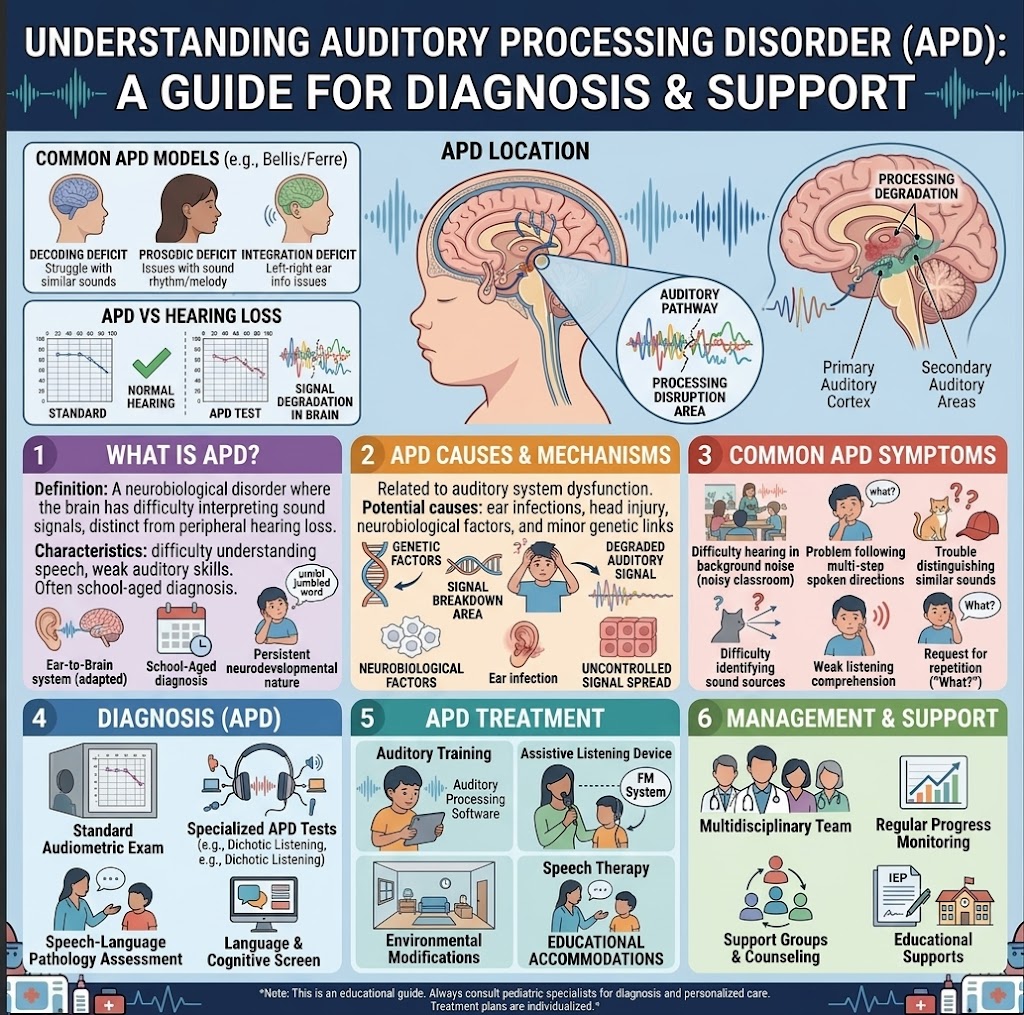
Auditory Processing Disorder (APD), also known as Central Auditory Processing Disorder (CAPD), is a condition where the brain struggles to interpret sounds, even when the ears are healthy. Unlike hearing loss caused by ear damage, APD involves how the brain processes auditory information. This means someone with APD hears sounds but struggles to understand or make sense of them, especially in noisy or complex environments. APD can affect anyone, most often children and older adults. While it can occur alongside conditions like Attention-Deficit/Hyperactivity Disorder (ADHD) or autism, APD is a distinct neurological issue. There's no cure, but various therapies and strategies can significantly improve sound processing and understanding.
Understanding the Condition
Auditory Processing Disorder (APD): A Brain-Based Hearing Challenge
Understanding the Condition
Common Symptoms
Difficulty Locating Sound: Struggling to tell where sounds are coming from.
Trouble Understanding Speech: Difficulty understanding spoken words, especially when fast, in noisy rooms, or from multiple speakers.
Challenges with Attention: Trouble focusing on auditory information, impacting attention in conversations or learning.
Reading and Spelling Difficulties: Struggling with reading and spelling, often due to how the brain processes word sounds.
Following Directions: Difficulty following spoken instructions unless they are short and simple.
Learning New Languages: Significant hurdles in acquiring new languages.
Appreciating Music: Difficulty understanding or enjoying music, including rhythm and pitch.
Remembering Spoken Information: Struggling to recall details from conversations or verbal instructions.
Social and Emotional Challenges: Feeling isolated, lonely, or depressed due to communication difficulties.
Academic and Occupational Struggles: Difficulties performing well in school or work.
Consultation Guide
Which Specialist to Meet
Before your appointment, gather any relevant medical history, especially concerning ear infections, head injuries, or birth complications. Make a detailed list of all symptoms you've noticed: when they started, how often they occur, and what situations make them better or worse. Prepare any questions you have for the specialist to ensure all your concerns are addressed.
Book a doctor visit near me
A standard hearing test is crucial to first rule out any peripheral hearing loss (damage to the ears themselves) that could explain the symptoms. This ensures the brain's processing abilities are being evaluated accurately.
Consultation Guide
Auditory Processing Disorder (APD), also known as Central Auditory Processing Disorder (CAPD), is a condition where the brain struggles to interpret sounds, even when the ears are healthy. Unlike hearing loss caused by ear damage, APD involves how the brain processes auditory information. This means someone with APD hears sounds but struggles to understand or make sense of them, especially in noisy or complex environments. APD can affect anyone, most often children and older adults. While it can occur alongside conditions like Attention-Deficit/Hyperactivity Disorder (ADHD) or autism, APD is a distinct neurological issue. There's no cure, but various therapies and strategies can significantly improve sound processing and understanding.
If you suspect Auditory Processing Disorder, consult an audiologist. An audiologist specializes in diagnosing and managing hearing and balance disorders. For children, a developmental pediatrician or speech-language pathologist may also be involved in the care team. In rare cases, if an underlying neurological cause is suspected, a neurologist might be consulted.
Preparations Before Your Visit
Safety Measures: Taking precautions to prevent head trauma and lead poisoning can mitigate known risk factors for APD and other neurological conditions. Ensure safe environments and lead-free living spaces.
Long-Term Monitoring and Support
Diagnostic Procedures
Comprehensive Hearing Test
What to Expect
An audiologist will place headphones over your ears and play a series of tones and speech sounds at various volumes. You'll be asked to respond when you hear a sound. This test is painless and typically takes about 20-30 minutes.
Auditory Processing Tests (Behavioral)
These are a battery of specialized tests conducted by an audiologist to assess how well the brain processes different aspects of sound. They evaluate skills like sound localization, auditory discrimination, auditory pattern recognition, and understanding speech in noisy environments.
What to Expect
You will wear headphones and listen to a variety of complex auditory stimuli, such as words presented with competing noise, or different sounds played to each ear. You will be asked to identify sounds, repeat words, or recognize patterns. These tests require focus and can take several hours, sometimes over multiple appointments.
Speech-in-Noise Tests
These tests specifically measure an individual's ability to understand speech when there is distracting background noise, a common challenge for people with APD.
What to Expect
You will listen to speech (words or sentences) while background noise (like cafeteria sounds or other voices) is simultaneously played through headphones. You'll be asked to repeat the words or answer questions about the sentences you heard. The noise level will vary, making it progressively more challenging.
Temporal Processing Tests
These tests assess how quickly and accurately the brain processes changes in sound over time, which is crucial for understanding speech rhythm and intonation.
What to Expect
You will listen to short, rapidly presented tones or speech sounds and be asked to identify their order or detect subtle gaps between them. This helps evaluate the brain's ability to track fast-changing auditory information.
Treatment Options
Therapies and Training
Auditory Training Programs: These structured programs involve listening exercises designed to retrain the brain to better process sounds. They can be computer-based or guided by a therapist. (Duration: Typically several months, with consistent practice (e.g., 30-60 minutes, 3-5 times a week).)
Speech-Language Therapy: A speech-language pathologist can help develop strategies for understanding language, improving listening comprehension, and enhancing communication skills. (Duration: Ongoing, often for several months to years, depending on individual needs and progress.)
Cognitive Behavioral Strategies: Learning techniques to improve attention, memory, and problem-solving skills, which can indirectly help with auditory processing challenges. (Duration: Variable, often integrated into other therapies or learned as coping mechanisms over time.)
Assistive Listening Devices and Environmental Modifications
FM Systems or Remote Microphone Systems: These devices transmit a speaker's voice directly to a receiver worn by the listener, reducing background noise and improving clarity, especially in classrooms or noisy environments. (Duration: Used as needed, long-term, for specific listening situations.)
Acoustic Modifications: Adjusting the listening environment to reduce noise and reverberation, such as using carpets, curtains, or sound-absorbing panels. (Duration: One-time setup, with long-term benefits in specific environments.)
Strategic Seating: Sitting closer to the speaker or in a less noisy part of a room to optimize listening conditions. (Duration: Ongoing, as needed, in various settings.)
Home and Educational Strategies
Clear Communication Practices: Encouraging speakers to talk clearly, at a moderate pace, and facing the person with APD. Asking for repetition or rephrasing when needed. (Duration: Ongoing, integrated into daily interactions.)
Note-Taking and Visual Aids: Using notes, visual cues, and written information to supplement spoken instructions or lectures, aiding memory and comprehension. (Duration: Ongoing, as a learning and communication tool.)
Reducing Background Noise: Minimizing distractions by turning off the TV, music, or other noise sources during important conversations or study times. (Duration: Ongoing, situational.)
Medication and Surgical Procedures
Medication: There are no medications that directly treat Auditory Processing Disorder. However, if co-occurring conditions like Attention-Deficit/Hyperactivity Disorder (ADHD) are present, medication for that condition might indirectly improve focus and attention, which can positively impact auditory processing abilities. (Duration: As prescribed for co-occurring conditions.)
Surgical Procedures: There are no surgical procedures to treat Auditory Processing Disorder itself. Surgical interventions are only relevant if there's an underlying ear problem causing a different type of hearing loss, which is distinct from APD. (Duration: Not applicable for APD.)
Managing Ear Infections: Prompt and effective treatment of repeated ear infections, especially in young children, can help protect the developing auditory system, though the direct link to APD is complex.
Regular Professional Check-ups: Ongoing follow-up with audiologists and speech-language pathologists ensures that treatment plans remain effective and are adjusted as needs change over time.
Continuous Learning and Adaptation: Individuals with APD and their families can benefit from continually learning new coping strategies and adapting communication styles to maximize understanding and participation.
Building a Support Network: Connecting with support groups or counselors can help manage feelings of isolation, loneliness, or depression that may arise from communication challenges.
Advocacy and Education: Educating teachers, employers, and family members about APD helps create more understanding and supportive environments, ensuring appropriate accommodations are provided.
Prevention & Long-Term Wellbeing
Prevention
Healthy Prenatal Care: For pregnant individuals, avoiding alcohol, drugs, and tobacco can help reduce risks associated with birth issues like low birth weight or premature birth, which are sometimes linked to APD.
Tags & Topics
Notice an error or need an update?
Help us keep medical information accurate. Report incorrect info or suggest an edit.


