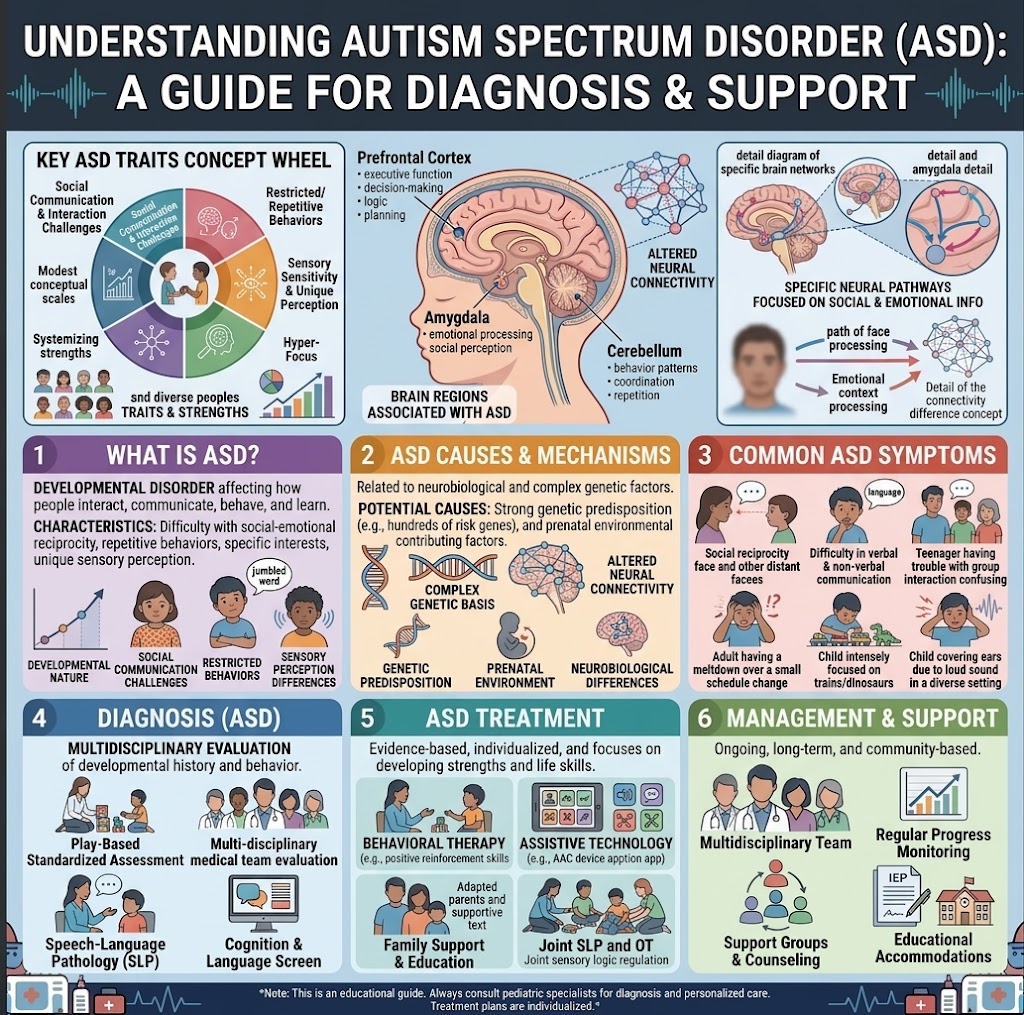
Autism spectrum disorder (ASD) is a brain development condition affecting how individuals perceive others, socialize, and communicate. It involves challenges in social interaction, communication, and often includes limited or repetitive behaviors. The "spectrum" highlights the wide range and varying severity of symptoms. ASD typically begins in early childhood, impacting social and functional abilities. Early treatment, especially during preschool, significantly improves outcomes, though there is no cure. Individuals with ASD may also experience digestive issues and selective eating, potentially leading to nutritional concerns.
Understanding the Condition
Autism Spectrum Disorder: Understanding the Condition
Understanding the Condition
Autism spectrum disorder (ASD) is a brain development condition affecting how individuals perceive others, socialize, and communicate. It involves challenges in social interaction, communication, and often includes limited or repetitive behaviors. The "spectrum" highlights the wide range and varying severity of symptoms. ASD typically begins in early childhood, impacting social and functional abilities. Early treatment, especially during preschool, significantly improves outcomes, though there is no cure. Individuals with ASD may also experience digestive issues and selective eating, potentially leading to nutritional concerns.
Common Symptoms
Limited Social Interaction: Avoids eye contact, shows little facial expression, prefers playing alone, often doesn't respond to their name or attempts at cuddling.
Speech Difficulties: May have delayed speech, lose words or sentences, use unusual voice tones (singsong, robot-like), or repeat phrases without understanding.
Conversational Struggles: Struggles to start or continue conversations, only speaks to make demands, or finds simple questions/directions hard to understand.
Interpreting Others: Has trouble understanding non-verbal cues like facial expressions, body language, or varying tones of voice.
Emotional Awareness: May not express emotions or seem aware of others' feelings, and doesn't point out objects to share interest.
Social Behavior: Can be withdrawn, aggressive, or disruptive in social settings.
Repetitive Actions: Engages in repeated body movements like rocking, spinning, or hand-flapping.
Fixated Interests: Develops intense, specific interests.
Resistance to Change: Insists on strict routines and becomes distressed by minor changes.
Sensory Sensitivities: Shows unusual reactions (over or under) to sensory input like sounds, lights, or textures.
Consultation Guide
Which Specialist to Meet
For suspected ASD, consult a pediatrician who can refer to specialists such as a developmental pediatrician, child psychologist or psychiatrist, neurologist, speech-language pathologist, or occupational therapist. Adults can start with their primary care doctor for referrals to psychiatrists or neurologists specializing in neurodevelopmental conditions.
Preparations Before Your Visit
A physical exam may include hearing/vision tests and genetic testing to rule out other conditions (e.g., Fragile X, Rett syndrome) with similar symptoms or co-occurring issues.
Symptom-Targeted Medication: No medication treats ASD itself, but some manage co-occurring conditions like anxiety, depression, hyperactivity, sleep problems, or aggression. (Duration: As prescribed, often long-term with monitoring.)
Managing Co-occurring Conditions: Promptly addressing medical (e.g., gastrointestinal symptoms) and mental health conditions (e.g., anxiety) with appropriate interventions.
Community & Family Support
Social Skills Development and Support: Providing opportunities for social interaction and ongoing training helps build friendships and reduce isolation.
Family Support: Education, resources, and emotional support for families are crucial.
Advocacy and Awareness: Advocating for inclusive environments and raising awareness fosters community understanding and acceptance.
Diagnostic Procedures
Developmental Screening
Pediatricians monitor development during routine check-ups for missed milestones or ASD-related behaviors, often using parent questionnaires.
What to Expect
Your pediatrician will ask about your child's communication, behavior, and social skills; you might complete a brief questionnaire.
Comprehensive Diagnostic Evaluation
If screening raises concerns, a team of specialists (e.g., developmental pediatricians, psychologists) conducts a detailed assessment involving observation, parent interviews, and specialized tests.
What to Expect
You will provide an in-depth developmental, medical, and family history. Your child will engage in structured activities to assess social, communication, and play skills; specialists will observe interactions and behaviors.
Standardized Diagnostic Tools
Research-backed assessments, such as the Autism Diagnostic Observation Schedule (ADOS) and Autism Diagnostic Interview-Revised (ADI-R), used by trained professionals.
What to Expect
During ADOS, a clinician interacts with your child using play-based and conversational tasks to observe communication, social interaction, and repetitive behaviors. For ADI-R, parents/caregivers answer a structured interview about developmental history relevant to ASD.
What to Expect
Your child will have a physical exam. Hearing/vision tests may occur. Blood or saliva samples might be taken for genetic analysis if suspected.
Nutritional Guidance: Addressing selective eating and ensuring a balanced diet is crucial, especially with common gastrointestinal issues. Restrictive diets require medical/nutritional supervision. (Duration: Ongoing, lifelong dietary management.)
Parent Education and Support
Parent Training Programs: Provides parents/caregivers with strategies to support child development and manage behaviors at home. (Duration: Short-term courses, with ongoing support groups available.)
Early Intervention: Early diagnosis and treatment, especially in preschool, significantly improve behavior, skill, and language development.
Structured Environment and Routines: Creating predictable routines and an organized environment reduces anxiety and supports daily functioning and learning.
Ongoing Therapy and Education: Continued therapies (speech, occupational, behavioral) and educational support throughout life help individuals adapt and learn new skills.
Transition Planning: Planning for transitions to adolescence and adulthood, covering education, vocational training, and independent living.
Treatment Options
Keep a detailed log of observed behaviors (onset, frequency, impact), any missed developmental milestones, or lost skills. Bring a list of medications, past medical history, family history, and any questions you have.
Book a doctor visit near me
Therapies
Applied Behavior Analysis (ABA): Teaches new skills and reduces challenging behaviors using positive reinforcement; breaks tasks into small steps. (Duration: Often intensive, many hours per week over several years.)
Speech and Language Therapy: Improves verbal and non-verbal communication, language comprehension, effective word use, and conversational abilities. (Duration: Ongoing, as needed, potentially lifelong.)
Occupational Therapy: Develops daily living skills, motor skills, and addresses sensory sensitivities for better everyday participation. (Duration: Ongoing, months to several years.)
Social Skills Training: Teaches appropriate social interaction, understanding social cues, managing emotions, and building relationships. (Duration: Varies from short-term (weeks-months) to ongoing.)
Cognitive Behavioral Therapy (CBT): Helps identify and change negative thought patterns/behaviors contributing to anxiety, depression, or aggression. (Duration: Structured, typically several weeks to months.)
Prevention & Long-Term Wellbeing
Dietary and Nutritional Approaches
Ongoing Support & Development
Lifestyle & Health Management
Healthy Lifestyle: A balanced diet, regular physical activity, and adequate sleep are vital for overall health, especially for those with selective eating or co-occurring health issues.
Prevention
No Known Prevention: There is no known way to prevent ASD. Research into prenatal vitamins and environmental influences continues, but clear preventative measures are not established.
Tags & Topics
Notice an error or need an update?
Help us keep medical information accurate. Report incorrect info or suggest an edit.


