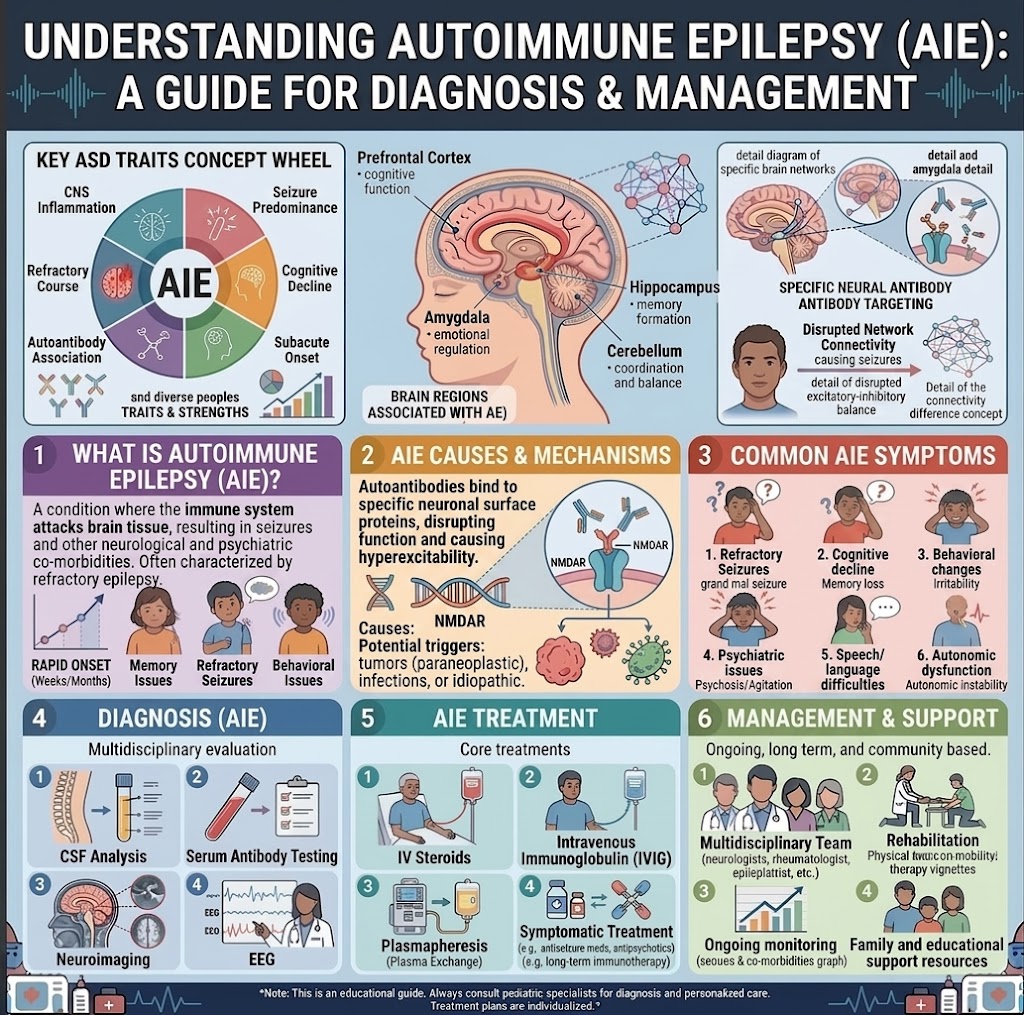
Autoimmune epilepsy is a condition where seizures occur because your body's immune system mistakenly attacks its own healthy brain cells. Normally, the immune system protects you from harmful invaders like viruses and bacteria. In this type of epilepsy, specific immune proteins called antibodies wrongly target parts of the brain, leading to swelling (inflammation) and seizures. Standard seizure medications often aren't enough to control these seizures. Instead, treatments that calm the overactive immune system, called immunotherapy, are typically used. Early immunotherapy can help reduce brain inflammation and improve seizure control, sometimes stopping them completely.
Understanding the Condition
Common Symptoms
Focal Seizures: These are the most common type. They can cause a temporary change or loss of awareness, where a person might stare blankly or not respond. Other focal seizures don't affect awareness but can cause one part of the body to shake, create a feeling of déjà vu, or trigger symptoms like nausea or flashing lights.
Other Associated Symptoms: These can include difficulties with memory and thinking, changes in personality or behavior, uncontrolled or clumsy body movements, unusual eye movements, and changes in automatic body functions like heart rate and blood pressure.
Consultation Guide
Which Specialist to Meet
Before your visit, prepare a detailed list of your symptoms, including when they started, how often they occur, and what they feel like. Bring a complete medical history, including any other medical conditions you have, a list of all medications you are currently taking (including over-the-counter drugs and supplements), and a list of any questions you have for the doctor.
Book a doctor visit near me
Ongoing Medical Supervision: Regular follow-ups with your specialist are crucial to monitor your condition, adjust treatments, and manage any persistent seizures or other associated symptoms. Treatment plans are often individualized and may evolve over time.
Consultation Guide
Understanding Autoimmune Epilepsy: When Your Immune System Causes Seizures
Understanding the Condition
Autoimmune epilepsy is a condition where seizures occur because your body's immune system mistakenly attacks its own healthy brain cells. Normally, the immune system protects you from harmful invaders like viruses and bacteria. In this type of epilepsy, specific immune proteins called antibodies wrongly target parts of the brain, leading to swelling (inflammation) and seizures. Standard seizure medications often aren't enough to control these seizures. Instead, treatments that calm the overactive immune system, called immunotherapy, are typically used. Early immunotherapy can help reduce brain inflammation and improve seizure control, sometimes stopping them completely.
Faciobrachial Dystonic Seizures: These specific seizures cause muscles on one side of the face and the arm on the same side of the body to contract or spasm.
You should consult a neurologist, especially one who specializes in epilepsy (an epileptologist). Depending on the underlying cause, an immunologist may also be involved in your care.
Preparations Before Your Visit
Immunotherapy: These medicines aim to reduce the immune system's attack on the brain. When started early, they can significantly reduce inflammation and improve seizure control. For some individuals, these treatments can stop seizures entirely, while for others, seizures may continue to some extent. (Duration: Treatment duration varies based on the individual's response and the underlying cause, often lasting several months to years, with ongoing evaluation.)
Diagnostic Procedures
EEG (Electroencephalogram)
An EEG is a non-invasive test that measures the electrical activity in your brain. Your brain cells communicate through tiny electrical signals, and the EEG records these signals as wavy lines on a computer or paper. This activity is constant, even during sleep. The test helps doctors identify unusual brain activity patterns that might indicate epilepsy or other seizure conditions.
What to Expect
During an EEG, several small, flat metal discs (electrodes) will be attached to your scalp with a sticky paste. These electrodes are connected by wires to a machine that records your brain's electrical activity. The procedure is painless and usually takes between 30 to 60 minutes, though longer recordings (ambulatory or video EEGs) might be necessary. You may be asked to do certain things like open and close your eyes, breathe deeply and rapidly, or look at a flashing light, as these can sometimes trigger brain activity that helps in diagnosis. You will simply relax in a chair or lie on a bed during the test.
Treatment Options
Severe or Resistant Seizures: Seizures that happen many times a day, don't respond well to typical seizure medications, or last longer than five minutes (or occur back-to-back without the person fully waking up) are serious and need urgent medical attention. The latter is known as status epilepticus.
Medications
Standard Anti-Seizure Medications: While these medications are a primary treatment for many types of epilepsy, they are generally less effective on their own for autoimmune epilepsy. They may be used in combination with immunotherapy or to manage residual seizures. (Duration: Can be long-term, potentially for life, depending on seizure control.)
Surgical Procedures
Epilepsy Surgery: This procedure is considered when anti-seizure medications (and often immunotherapy) have not successfully controlled seizures, especially if the seizures consistently originate from a single, identifiable area in the brain. The goal is to either stop seizures completely or significantly reduce their frequency and severity. (Duration: After surgery, patients typically need to continue taking anti-seizure medications for at least two years, with the possibility of gradually reducing or stopping them later based on medical advice.)
Cancer Screenings: Some cases of autoimmune epilepsy are triggered by certain cancers. Regular cancer screenings, as recommended by your doctor, can help detect tumors early. Timely treatment of cancer may prevent the immune system from attacking brain cells and potentially reduce the risk of this type of epilepsy.
Long-Term Management and Monitoring
Emergency Care for Severe Seizures: If you experience a seizure lasting longer than five minutes, or if seizures occur one after another without regaining consciousness (status epilepticus), seek immediate emergency medical attention. These situations are serious complications of epilepsy.
Prevention & Long-Term Wellbeing
Prevention
Tags & Topics
Notice an error or need an update?
Help us keep medical information accurate. Report incorrect info or suggest an edit.


