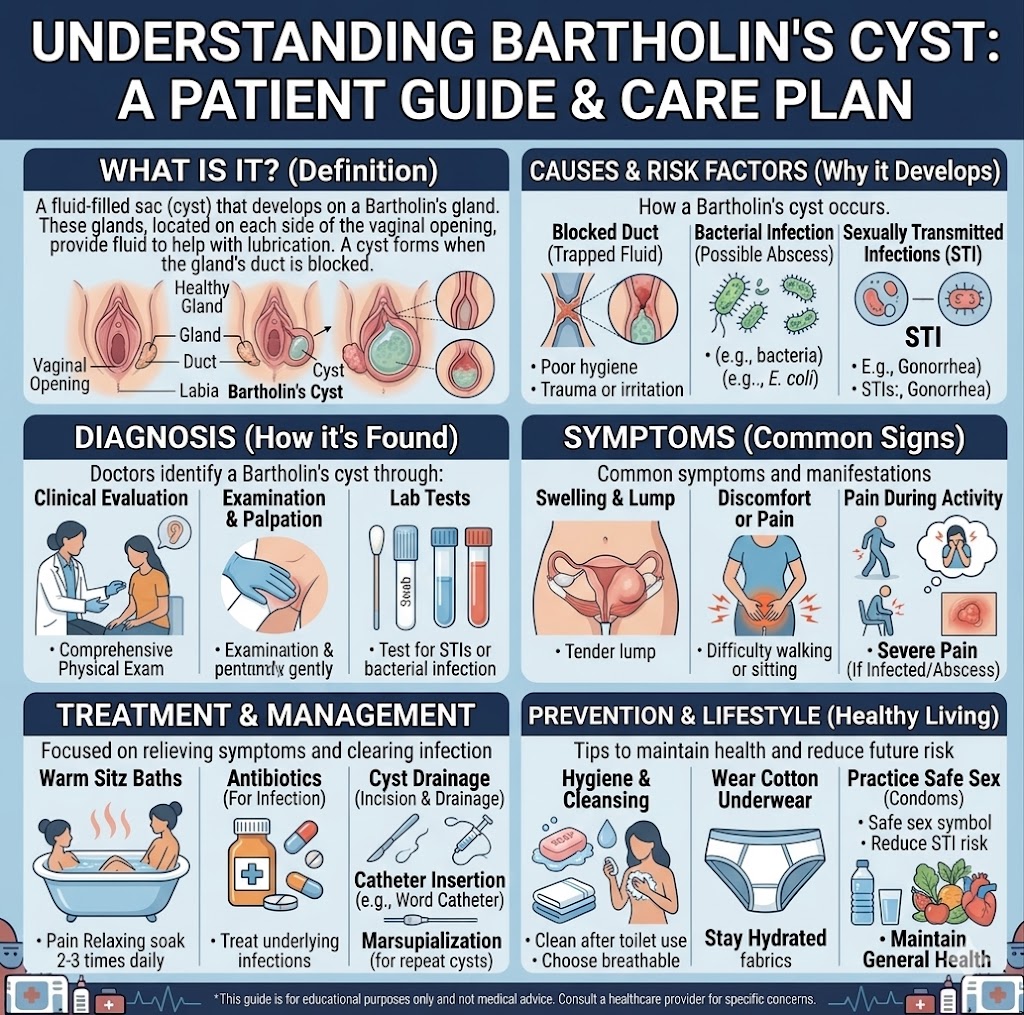
A Bartholin's cyst is a fluid-filled sac that forms when one of the two Bartholin's glands, located just inside the vaginal opening, becomes blocked. These glands normally produce a lubricating fluid. When blocked, the fluid builds up, causing a cyst to form. While often small and harmless, a cyst can sometimes grow larger, become painful, or get infected.
Understanding the Condition
Bartholin's Cyst: Understanding and Managing a Common Condition
Understanding the Condition
A Bartholin's cyst is a fluid-filled sac that forms when one of the two Bartholin's glands, located just inside the vaginal opening, becomes blocked. These glands normally produce a lubricating fluid. When blocked, the fluid builds up, causing a cyst to form. While often small and harmless, a cyst can sometimes grow larger, become painful, or get infected.
Common Symptoms
Small, Painless Lump: Many Bartholin's cysts are small and don't cause any symptoms. You might notice a soft, painless lump near the vaginal opening.
Before your visit, make a list of your symptoms, including when they started and how often they occur. Be prepared to discuss your medical history, any other health conditions you have, and all medications (including over-the-counter and supplements) you are currently taking. Write down any questions you have for the doctor.
Book a doctor visit near me
Prompt Treatment of Symptoms: If you notice a lump or experience discomfort in the Bartholin's gland area, address it early. Warm soaks (sitz baths) can often help resolve small, uninfected cysts.
Follow-up with Doctor: If you have a history of Bartholin's cysts, or if symptoms recur, worsen, or don't improve with home care, always consult your doctor for evaluation and appropriate management.
Consultation Guide
Pain or Discomfort: If the cyst grows larger, it can cause discomfort when walking, sitting, or during sexual activity. The pain level can vary.
Redness and Swelling (if infected): If the cyst becomes infected, it can turn into an abscess. This causes noticeable redness, swelling, and tenderness in the affected area.
Fever (if infected): An infected cyst (abscess) can lead to a fever, indicating your body is fighting off an infection.
Drainage: Sometimes, an infected cyst may rupture on its own, releasing fluid or pus. This can bring relief from pain and pressure.
Consultation Guide
Which Specialist to Meet
During a pelvic exam, you will lie on an exam table with your feet in stirrups. The doctor will first examine your vulva (external genital area). Then, they will gently insert a speculum into your vagina to separate its walls, allowing them to view your cervix. They may also perform a manual exam by inserting gloved fingers into your vagina while pressing on your abdomen to feel your uterus and ovaries. The procedure is generally quick, lasting only a few minutes, and may cause some pressure or mild discomfort. A Pap test, which screens for cervical cancer, is often done at the same time.
Needle Biopsy (Rarely performed for Bartholin's cysts)
A needle biopsy involves removing a small sample of cells or tissue using a thin needle. This procedure is typically not needed for a Bartholin's cyst unless there's a concern about a more serious condition, especially for women over 40, to rule out other types of growths.
Diagnostic Procedures
You should consult with a primary care doctor or a gynecologist (a doctor specializing in female reproductive health). They can accurately diagnose the condition and recommend the appropriate treatment.
Preparations Before Your Visit
A pelvic exam is a routine check-up of your sexual and reproductive health. It allows your doctor to visually and physically examine your vulva, vagina, cervix, uterus, and ovaries to identify any unusual changes or conditions, such as a Bartholin's cyst.
What to Expect
What to Expect
If a needle biopsy is necessary, the doctor will first numb the area with a local anesthetic to minimize discomfort. A long, thin needle is then carefully inserted into the suspicious area to collect cells or a small piece of tissue. You might feel some pressure during the sample collection. Once the sample is taken, it is sent to a laboratory for testing to look for signs of cancer or other abnormalities. The procedure is generally quick, and you may experience some mild soreness afterward.
Treatment Options
Sitz Baths (Warm Soaks): Soaking in a few inches of warm water in a bathtub (sitz bath) several times a day can help small cysts drain on their own. The warm water helps to reduce discomfort and may encourage the cyst to open and drain. (Duration: 15 to 20 minutes, 3 to 4 times a day for several days)
Pain Relief: Over-the-counter pain relievers can help manage any discomfort or mild pain associated with the cyst. (Duration: As needed, following package directions)
Antibiotics: If the cyst becomes infected and forms an abscess, your doctor may prescribe antibiotics to treat the bacterial infection. These medications help eliminate the bacteria causing the infection. (Duration: Typically 7 to 10 days, as prescribed by your doctor)
Procedures (Office-Based or Minor Surgical)
Incision and Drainage (I&D): For larger, painful, or infected cysts (abscesses), the doctor may make a small cut (incision) in the cyst to allow the fluid or pus to drain out. This provides immediate relief from pressure and pain. (Duration: Single procedure, healing takes several weeks)
Word Catheter Insertion: After draining a cyst, a small, soft rubber tube (Word catheter) may be inserted into the cyst opening. This catheter has a tiny balloon at its tip that is inflated with a small amount of water to keep the opening patent, allowing continuous drainage and helping a new drainage channel to form. (Duration: Stays in place for up to 4-6 weeks, then removed by a doctor)
Marsupialization: If cysts are recurrent, marsupialization may be performed. The doctor makes a small incision, drains the cyst, and then stitches the edges of the skin around the opening to create a small, permanent pouch. This helps to prevent future fluid buildup. (Duration: Single surgical procedure, healing takes several weeks)
Surgical Procedures (Rare)
Bartholin's Gland Excision (Bartholinectomy): In very rare cases, especially if other treatments haven't worked or cysts keep recurring, the entire Bartholin's gland may be surgically removed. This is typically a last resort. (Duration: Single surgical procedure, healing takes several weeks)
Avoid Self-Treatment of Infected Cysts: Do not attempt to squeeze or puncture an infected cyst yourself, as this can worsen the infection and lead to complications.
Regular Self-Checks: Be aware of your body and perform occasional self-checks to notice any new lumps or changes in the genital area. Early detection can lead to simpler treatment.
Prevention & Long-Term Wellbeing
Prevention and Self-Care
Good Hygiene: Maintain good personal hygiene, especially in the genital area. While not a direct prevention for blockages, it can help reduce the risk of infection if a cyst does form.
Tags & Topics
Notice an error or need an update?
Help us keep medical information accurate. Report incorrect info or suggest an edit.


