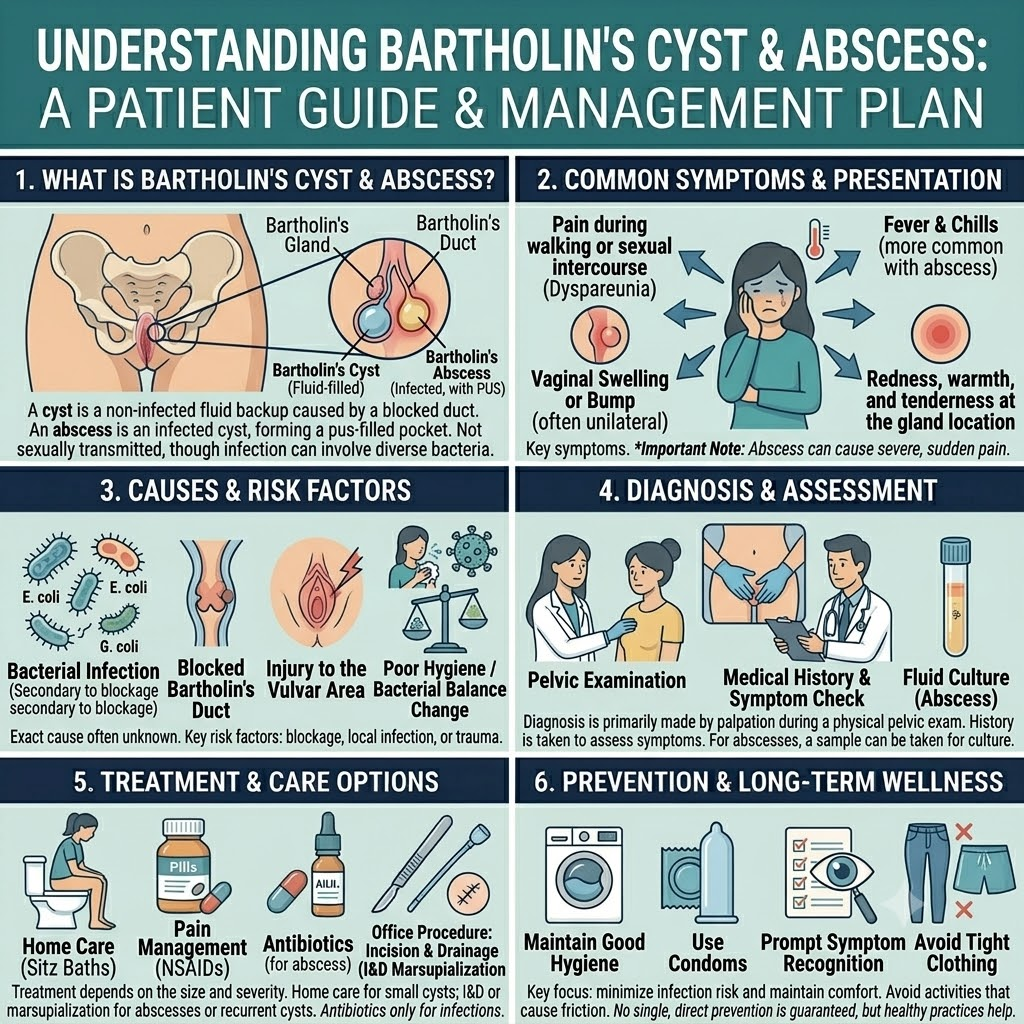
Bartholin's glands are two small glands located on each side of the vaginal opening. They produce lubricating fluid. If their tiny openings become blocked, fluid builds up, causing a usually painless swelling called a Bartholin's cyst. If this trapped fluid gets infected, it forms a painful collection of pus called an abscess. Both are common. Treatment depends on the cyst's size, pain, and infection. Management can range from home care to medical procedures or antibiotics.
Understanding the Condition
Bartholin's Cyst: Understanding and Managing Vaginal Lumps
Understanding the Condition
Common Symptoms
Small, Non-Infected Cyst: Small cysts might go unnoticed. If one grows, you may feel a soft lump near your vaginal opening. It's often painless but can be tender.
Before your visit, be prepared to describe your symptoms in detail, including when they started, how severe they are, and any home remedies you've tried. Be ready to share your medical history, including any current medications, allergies, and past health conditions. It’s also helpful to note if you've experienced any fever or discharge.
Book a doctor visit near me
Sitz Baths or Warm Compresses: Soaking the affected area in a few inches of warm water in a bathtub (sitz bath) or applying warm, moist compresses to the cyst. This helps promote natural drainage and reduce discomfort. (Duration: Do this 3-4 times a day for 10-20 minutes at a time, for several days, until symptoms improve.)
Consultation Guide
Infected Cyst (Abscess): An infected cyst can develop quickly. It causes severe pain, making walking, sitting, or intercourse difficult. The area will be very tender, red, warm, and swollen. You might also develop a fever or notice pus draining. These typically appear on one side of the vaginal opening.
Consultation Guide
Which Specialist to Meet
You will lie on an exam table, often with your feet in stirrups. The doctor will first visually inspect your vulva. Then, a speculum will be gently inserted into your vagina for a view of your cervix. A Pap test may be done. Finally, the doctor will gently press on your abdomen while feeling inside your vagina (and sometimes rectum) to check internal organs for lumps or tenderness. The exam is quick and may cause some pressure or mild discomfort.
A needle biopsy is a procedure where a very thin needle is used to collect a small sample of tissue or fluid from a suspicious lump. This sample is then sent to a laboratory for detailed examination under a microscope to determine if the cells are benign (non-cancerous) or malignant (cancerous). This is usually recommended for new lumps, especially in women over 40, to rule out more serious conditions.
Diagnostic Procedures
You should see a general practitioner or family doctor first, who may then refer you to a gynecologist, a doctor specializing in women's reproductive health, if further treatment or diagnosis is needed.
Preparations Before Your Visit
A pelvic exam is a routine check of your female reproductive organs, including the vulva (external area), vagina, cervix, uterus, and ovaries, as well as the rectum. It helps your doctor assess overall reproductive health and identify any abnormalities like cysts, infections, or growths.
What to Expect
What to Expect
The skin over the lump will be cleaned and numbed with local anesthetic. A thin needle is then carefully guided into the lump to collect a tissue or fluid sample. You might feel pressure but minimal pain. After the sample is taken, a bandage is applied. Mild soreness or bruising at the site is common for a day or two.
Treatment Options
Bartholin's glands are two small glands located on each side of the vaginal opening. They produce lubricating fluid. If their tiny openings become blocked, fluid builds up, causing a usually painless swelling called a Bartholin's cyst. If this trapped fluid gets infected, it forms a painful collection of pus called an abscess. Both are common. Treatment depends on the cyst's size, pain, and infection. Management can range from home care to medical procedures or antibiotics.
Medications
Antibiotics: If the cyst is infected and has formed an abscess, your doctor will prescribe antibiotics to clear the bacterial infection and prevent it from spreading. (Duration: Typically a 7-10 day course, or as directed by your doctor. It's crucial to complete the entire course of medication.)
Procedures and Surgical Interventions
Incision and Drainage: For larger, painful, or infected cysts, a minor surgical procedure drains the fluid or pus through a small incision. A small balloon catheter may be inserted and left to keep the opening draining and prevent closure. (Duration: The procedure itself is quick, usually under local anesthesia. If a catheter is used, it typically remains in place for up to 6 weeks to promote proper healing and prevent recurrence.)
Marsupialization: If cysts recur frequently, an incision is made, and the cyst's edges are stitched to the surrounding skin, creating a small, permanent opening for fluid to drain freely, preventing future blockages. (Duration: This is a permanent solution. The surgical site typically heals within a few weeks.)
Self-Monitoring and Awareness: Regularly check for new lumps, swelling, or discomfort. Early detection aids simpler treatment.
Prompt Medical Attention for Changes: If a new lump is painful, grows rapidly, or doesn't improve with home care in a few days, contact your doctor. For new lumps in women over 40, seek prompt medical attention to rule out serious conditions.
Prevention & Long-Term Wellbeing
Gland Removal (Bartholinectomy): In rare, severe, or recurrent cases, the entire Bartholin's gland may be surgically removed, usually as a last resort. (Duration: May require a short hospital stay; full recovery takes several weeks.)
Prevention
Maintain Good Hygiene: Gentle, regular washing of the vaginal area helps reduce bacterial buildup and blockage risk. Avoid harsh soaps or douches.
Long-Term Monitoring
Tags & Topics
Notice an error or need an update?
Help us keep medical information accurate. Report incorrect info or suggest an edit.


