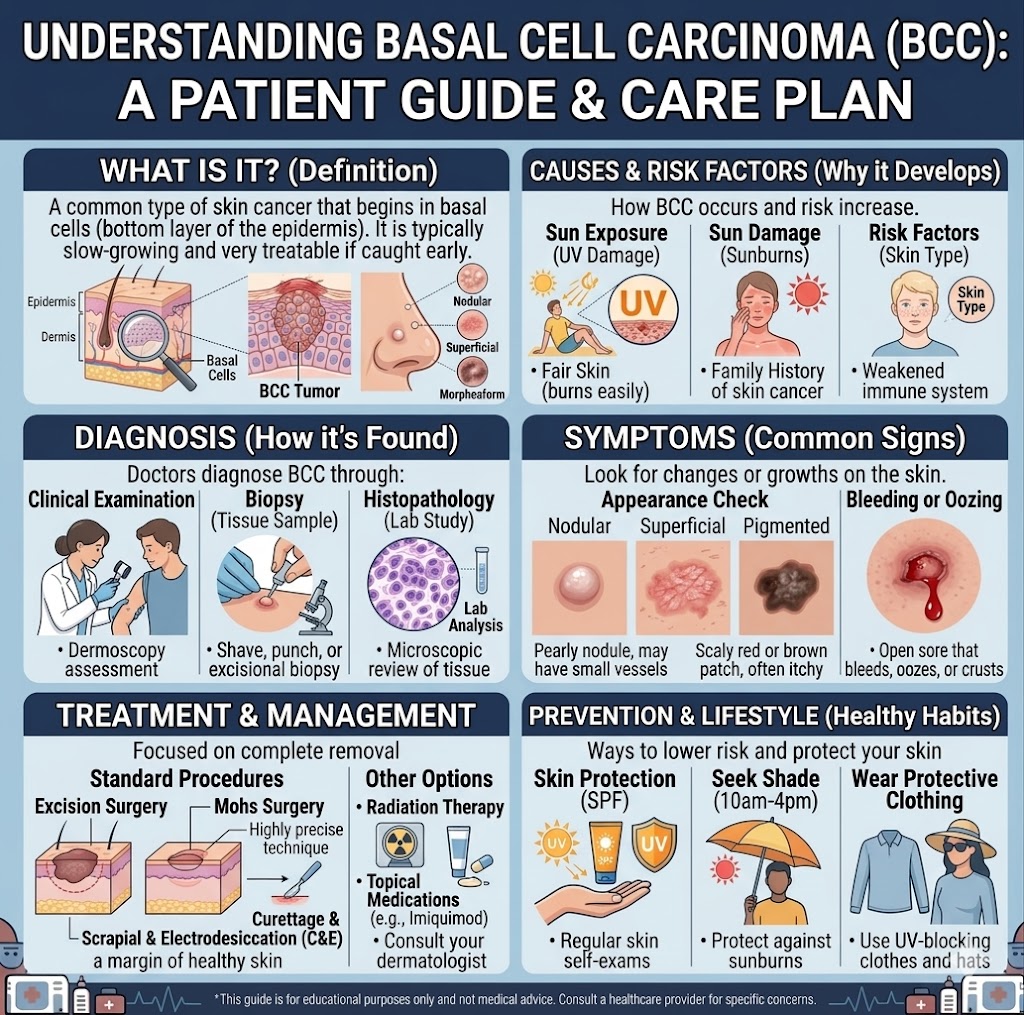
Basal cell carcinoma (BCC) is the most common type of skin cancer. It starts in the basal cells, which are located at the bottom of the outermost layer of your skin (the epidermis). These cells are responsible for producing new skin cells as old ones die off. While BCC often appears as a slightly shiny or transparent bump on sun-exposed areas like the face and neck, it can also present in other ways. The primary cause of basal cell carcinoma is damage to the skin from ultraviolet (UV) light, mainly from sun exposure or tanning beds.
Understanding the Condition
Basal Cell Carcinoma: A Guide to Understanding Skin Cancer
Understanding the Condition
Common Symptoms
New Skin Growth or Non-Healing Sore: Any new growth or a sore on the skin that doesn't heal or repeatedly scabs and reopens could be a sign of basal cell carcinoma. These changes are often called lesions.
Appearance on White Skin: On lighter skin tones, basal cell carcinoma often appears as a skin-colored or pink bump, which might be pearly or translucent. It can also look like a flat, scaly patch, or a scar-like area.
Appearance on Brown and Black Skin: On darker skin tones, basal cell carcinoma may appear as a brown or glossy black bump, sometimes with a rolled border. It can also look like a non-healing sore or a shiny, firm growth. These lesions are more likely to appear on less sun-exposed areas in people with darker skin.
Location: Basal cell carcinoma most commonly develops on areas of the body that receive significant sun exposure, such as the face, neck, scalp, ears, shoulders, and hands. Less frequently, it can appear on parts of the body usually protected from the sun, including the genitals.
Consultation Guide
Which Specialist to Meet
Before your appointment, it's helpful to make a list of your symptoms, including when you first noticed them, how they have changed over time, and any associated discomfort. Note down your medical history, any medications you are taking, and significant sun exposure history. Be prepared to discuss your concerns openly with your doctor.
Book a doctor visit near me
Consultation Guide
Basal cell carcinoma (BCC) is the most common type of skin cancer. It starts in the basal cells, which are located at the bottom of the outermost layer of your skin (the epidermis). These cells are responsible for producing new skin cells as old ones die off. While BCC often appears as a slightly shiny or transparent bump on sun-exposed areas like the face and neck, it can also present in other ways. The primary cause of basal cell carcinoma is damage to the skin from ultraviolet (UV) light, mainly from sun exposure or tanning beds.
Routine Dermatological Check-ups: If you have a history of basal cell carcinoma or other skin cancers, or if you have risk factors such as extensive sun exposure, your doctor may recommend regular skin examinations by a dermatologist. These check-ups help detect any new cancers early when they are most treatable.
Diagnostic Procedures
If you notice any new or changing skin growths, a general practitioner is a good first point of contact. They can evaluate your concerns and may refer you to a dermatologist, a doctor specializing in skin conditions, for further assessment and diagnosis.
Preparations Before Your Visit
A skin biopsy is a procedure where a small sample of skin cells or tissue is removed from the suspicious area. This sample is then sent to a laboratory to be examined under a microscope by a pathologist to check for cancer cells. A biopsy is the most definitive way to diagnose basal cell carcinoma.
What to Expect
Before any biopsy, your doctor will clean the area and inject a local anesthetic to numb the skin, so you will not feel pain during the procedure, only some pressure. There are several types of skin biopsies:* **Shave Biopsy:** A scalpel or razor blade is used to carefully scrape off the outermost layers of the skin. This method is often used for growths that are raised above the skin surface. Stitches are usually not needed, and the wound typically heals with a small scab.* **Punch Biopsy:** A special circular cutting tool is used to remove a small, deeper cylinder of skin tissue. This allows for examination of all layers of the skin. Depending on the size of the removed tissue, one or two stitches might be needed to close the wound.* **Excisional Biopsy:** A scalpel is used to cut out the entire suspicious growth along with a small margin of surrounding healthy skin. This procedure removes a larger, deeper sample. Stitches are typically required to close the wound, and a small scar will form. For all biopsies, you'll receive instructions on how to care for the wound afterward to prevent infection and promote healing.
Treatment Options
Surgical Procedures
Surgical Excision: This common procedure involves cutting out the cancerous tumor along with a small border of healthy surrounding skin to ensure all cancer cells are removed. The wound is then closed with stitches. (Duration: Typically a single outpatient procedure, healing usually takes a few weeks.)
Mohs Micrographic Surgery: Mohs surgery is a precise technique where thin layers of skin containing the cancer are progressively removed and examined under a microscope immediately. This process continues until no cancer cells are seen, preserving as much healthy tissue as possible. It is particularly useful for cancers on the face, large cancers, or those with unclear borders. (Duration: Performed as an outpatient procedure, it can take several hours depending on the extent of the cancer removal.)
Curettage and Electrodesiccation: This involves scraping away the cancer cells with a special instrument (curette) and then using an electric needle to destroy any remaining cancer cells and stop bleeding. This process is usually repeated a few times. (Duration: Typically a single outpatient procedure.)
Radiation Therapy: Radiation therapy uses high-energy beams to kill cancer cells. It's often used for basal cell carcinomas that are difficult to remove surgically, or for patients who are not candidates for surgery. It can also be used after surgery to destroy any remaining cancer cells. (Duration: Typically given in multiple short sessions over several weeks.)
Targeted Therapies and Immunotherapy
Targeted Therapy: These medications specifically target certain pathways in cancer cells to stop their growth and spread. They are usually reserved for advanced basal cell carcinomas or those that have spread. (Duration: Ongoing, as determined by your doctor, often for several months or longer.)
Immunotherapy: Immunotherapy helps your body's own immune system recognize and fight cancer cells. It can be used for advanced basal cell carcinomas or for recurrent cases. (Duration: Involves a series of infusions or oral medications over several months or longer.)
Topical Medications: Certain creams or gels can be applied directly to the skin to treat superficial basal cell carcinomas. These medications work by either stimulating an immune response to destroy cancer cells or by interfering with cancer cell growth. (Duration: Applied daily for several weeks to several months, as prescribed by your doctor.)
Photodynamic Therapy (PDT)
Photodynamic Therapy: This two-step treatment involves applying a special light-sensitizing medication to the skin, which is then activated by a specific type of light, often from a laser. The activated medication kills the cancer cells while minimizing damage to healthy tissue. (Duration: May involve one or more treatment sessions, each lasting a few hours, with repeat treatments if necessary.)
Prevention & Long-Term Wellbeing
Prevention
Sun Protection: Limit your exposure to the sun, especially during peak hours (10 a.m. to 4 p.m.). Seek shade whenever possible. Wear protective clothing, including broad-brimmed hats, long-sleeved shirts, and sunglasses. Apply a broad-spectrum sunscreen with an SPF of 30 or higher daily, and reapply every two hours or after swimming/sweating. Avoid tanning beds and sunlamps, as they emit harmful UV radiation.
Long-Term Monitoring
Regular Skin Self-Exams: Become familiar with your skin and routinely check your entire body for any new growths, changes in existing moles or spots, or sores that don't heal. Pay attention to areas that get a lot of sun exposure. If you notice anything suspicious, contact your doctor promptly.
Tags & Topics
Notice an error or need an update?
Help us keep medical information accurate. Report incorrect info or suggest an edit.


