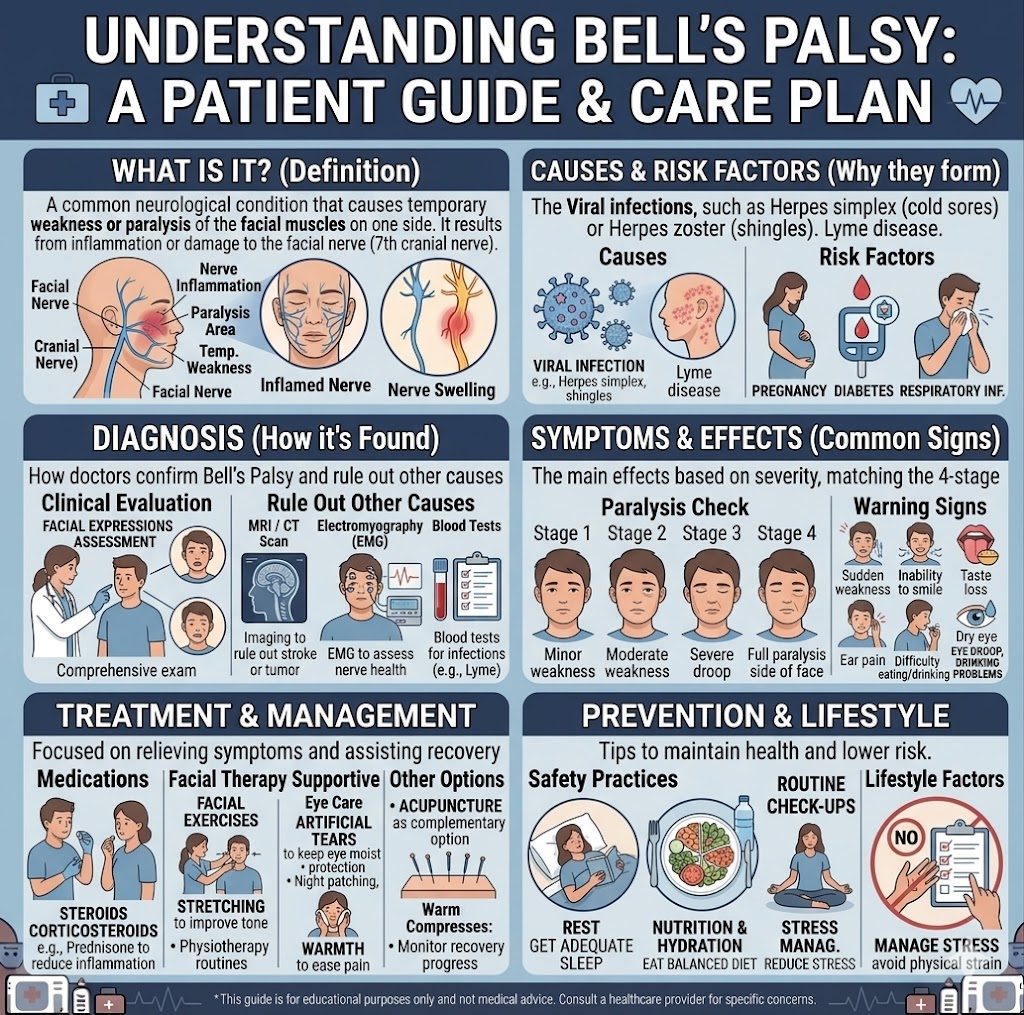
Bell's Palsy is a condition that causes sudden weakness or complete paralysis in the muscles on one side of the face. This often results in half of the face appearing to droop, making common expressions like smiling difficult and affecting the ability to close the eye on the affected side. While its precise cause isn't fully known, experts believe it's due to inflammation and irritation of the nerve that controls facial muscles, frequently triggered by a viral infection. Most individuals experience temporary weakness that gradually improves over weeks, with complete recovery typically occurring within six months. Rarely, some symptoms may persist, or the condition might recur.
Understanding the Condition
Bell's Palsy: Understanding Sudden Facial Weakness
Understanding the Condition
Bell's Palsy is a condition that causes sudden weakness or complete paralysis in the muscles on one side of the face. This often results in half of the face appearing to droop, making common expressions like smiling difficult and affecting the ability to close the eye on the affected side. While its precise cause isn't fully known, experts believe it's due to inflammation and irritation of the nerve that controls facial muscles, frequently triggered by a viral infection. Most individuals experience temporary weakness that gradually improves over weeks, with complete recovery typically occurring within six months. Rarely, some symptoms may persist, or the condition might recur.
Common Symptoms
Facial Weakness or Paralysis: Ranges from mild weakness to total inability to move one side of the face, developing quickly within hours to days.
Facial Drooping and Difficulty with Expressions: Noticeable drooping of one side of the face, making it hard to smile, frown, or close the eye on the affected side.
Pain: Pain or discomfort around the jaw, or in or behind the ear, on the affected side.
Increased Sound Sensitivity: Sounds may seem louder or more intense in the ear on the affected side.
Loss of Taste: A diminished sense of taste, particularly on the front part of the tongue.
Changes in Tear and Saliva Production: The affected eye may become excessively dry or watery, and saliva production might be altered.
Important Safety Note: Seek immediate medical attention if you experience any type of sudden facial weakness or paralysis. While Bell's Palsy is not caused by a stroke, its symptoms can be similar, and a stroke requires urgent medical care.
Consultation Guide
Which Specialist to Meet
Your primary care physician is the first point of contact for evaluating your symptoms. They may then refer you to a neurologist (a doctor specializing in conditions of the brain and nervous system) for further diagnosis, management, and to rule out other potential causes. An ophthalmologist (eye specialist) may also be consulted to manage any eye-related complications, such as dryness or irritation.
Preparations Before Your Visit
Before your appointment, prepare a detailed list of your symptoms, including when they started and how they have changed. Note any recent illnesses, infections, or stressful events. Be ready to discuss your full medical history, including any other health conditions and all medications or supplements you are currently taking. It's also helpful to write down any questions you have for your doctor.
Book a doctor visit near me
A CT scan uses specialized X-ray equipment and computer processing to create detailed cross-sectional images (slices) of bones, blood vessels, and soft tissues inside the body. While Bell's Palsy is typically diagnosed based on symptoms and physical examination, a CT scan may be used to rule out other serious conditions that can mimic Bell's Palsy, such as a stroke, tumor, or other structural issues affecting the facial nerve.
An X-ray is a quick, painless imaging test that uses radiation to capture images of internal body structures, particularly bones. While X-rays are generally not used to diagnose Bell's Palsy directly, they might be ordered in certain situations to rule out other underlying causes of facial symptoms, especially if a bone-related issue or injury in the head or neck region is suspected.
Corticosteroids: Anti-inflammatory medications given orally to reduce swelling around the facial nerve. These are most effective when started within the first few days of symptom onset. (Duration: Typically prescribed for 1 to 2 weeks, with a tapering dose.)
Warm Compress and Gentle Massage: Applying a warm, moist cloth to the affected side of the face and gently massaging the facial muscles can help soothe pain and improve circulation. (Duration: As needed for comfort and symptom relief.)
Consultation Guide
You will lie on a narrow table that slides into a large, doughnut-shaped machine. You will need to remain very still during the scan, which usually takes a few minutes. You might hear humming or clicking noises as the machine operates. In some instances, a contrast dye might be administered intravenously or orally to enhance the visibility of certain structures, which may cause a warm sensation or a metallic taste in your mouth.
You will be asked to stand or lie in a specific position on a table, and an X-ray machine will send a beam through the targeted area of your body. A detector on the other side captures the image. You will need to remain still for a few seconds during the exposure. The procedure is typically very quick and causes no discomfort.
Antiviral Medications: May be prescribed, sometimes in combination with corticosteroids, if a viral infection is strongly suspected as the underlying cause. (Duration: Typically prescribed for 7 to 10 days.)
Awareness of Risk Factors: If you have conditions such as diabetes, high blood pressure, or are pregnant, be aware that these can increase your susceptibility. Promptly discuss any new facial weakness with your healthcare professional.
Consistent Eye Protection: If your affected eye does not close fully, continue rigorous eye care, including lubricating drops, ointments, and protective eyewear, to prevent dryness, irritation, and potential vision issues.
Diagnostic Procedures
Electromyography (EMG)
EMG is a diagnostic test used to evaluate the health of muscles and the motor neurons (nerve cells) that control them. It measures the electrical activity of muscles in response to nerve stimulation.
What to Expect
During a needle EMG, a small, thin needle electrode is inserted directly into specific facial muscles. This electrode records the electrical activity within the muscle both at rest and during muscle contraction. You might feel a brief sting or mild discomfort during the needle insertion. Another part of the EMG, a nerve conduction study, involves placing sticky electrodes on your skin to measure how quickly and strongly electrical signals travel along your facial nerves. You may feel small electrical pulses, which are usually mild.
CT Scan (Computed Tomography)
What to Expect
What to Expect
Treatment Options
Medications
Pain Relievers: Over-the-counter pain medications can help manage any discomfort or pain around the jaw or ear. (Duration: As needed for pain.)
Surgical Procedures
Facial Nerve Decompression: This surgical procedure, used very rarely and only in specific, severe cases, aims to relieve pressure on the facial nerve. It carries risks and is generally considered only after other treatments have been exhausted or when severe nerve compression is clearly identified. (Duration: A single procedure, followed by a recovery period.)
Prevention & Long-Term Wellbeing
Physical Therapy: Gentle exercises designed to stimulate facial muscles, improve range of motion, and prevent permanent tightening or shortening of muscles (contractures) as the nerve recovers. (Duration: Ongoing, as needed, potentially for several months, depending on recovery.)
Eye Care: Essential for protecting the affected eye, which may not close completely. This includes using lubricating eye drops during the day, eye ointments at night, and wearing an eye patch or protective glasses. (Duration: Until the ability to fully close the eye improves.)
Prevention
General Health Management: While Bell's Palsy isn't directly preventable, maintaining overall health and addressing viral infections promptly may reduce the risk, as it's often linked to common viruses. Support your immune system through healthy living.
Adherence to Physical Therapy: If prescribed, consistently perform facial exercises to support nerve regeneration, maintain muscle tone, and encourage optimal recovery of facial symmetry.
Monitoring for Recurrence: Though rare, Bell's Palsy can recur. Be vigilant for any new episodes of facial weakness and report them to your doctor immediately, especially if there's a family history of recurrence.
Emotional Support: Coping with changes in facial appearance can be emotionally challenging. Seek support from family, friends, or a professional counselor if you experience distress or anxiety.
Tags & Topics
Notice an error or need an update?
Help us keep medical information accurate. Report incorrect info or suggest an edit.


