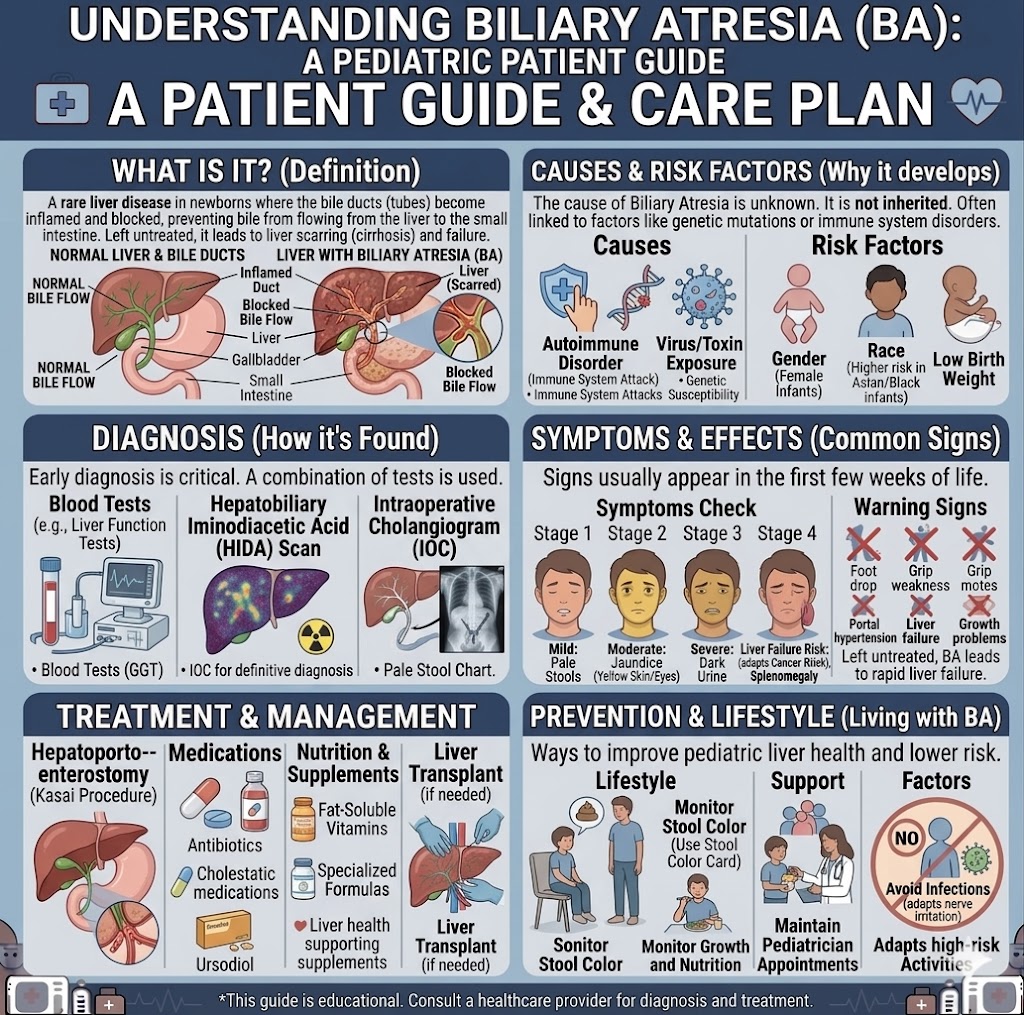
Biliary atresia is a rare and serious liver condition affecting newborns, where the tiny tubes (bile ducts) that carry digestive fluid (bile) from the liver to the small intestine are either inflamed, blocked, or didn't form correctly. When bile can't drain, it builds up in the liver, causing severe damage, scarring, and eventually a condition called cirrhosis. This can lead to liver failure if not treated. It affects about 1 in 10,000 to 20,000 live births and is a leading cause of liver transplants in children. While babies often look healthy at birth, signs like yellow skin and eyes (jaundice) and pale stools usually appear within the first few weeks.
Understanding the Condition
Biliary Atresia: Understanding a Rare Liver Condition in Babies
Understanding the Condition
Common Symptoms
Before your visit, note any symptoms your baby is experiencing, including the exact color of their skin, eyes, urine, and especially their stools (taking photos of stools can be helpful). Keep a record of feeding patterns and any changes in behavior. Prepare a list of questions to ask the doctor.
Book a doctor visit near me
Recognize Warning Signs: Parents should be vigilant for persistent jaundice, pale stools, and dark urine in newborns, and seek immediate medical evaluation if these symptoms appear beyond two weeks of age.
Regular Medical Check-ups: Children who have undergone a Kasai procedure require ongoing monitoring by a specialized medical team to track liver function, identify complications, and determine the timing for potential liver transplant.
Consultation Guide
Biliary atresia is a rare and serious liver condition affecting newborns, where the tiny tubes (bile ducts) that carry digestive fluid (bile) from the liver to the small intestine are either inflamed, blocked, or didn't form correctly. When bile can't drain, it builds up in the liver, causing severe damage, scarring, and eventually a condition called cirrhosis. This can lead to liver failure if not treated. It affects about 1 in 10,000 to 20,000 live births and is a leading cause of liver transplants in children. While babies often look healthy at birth, signs like yellow skin and eyes (jaundice) and pale stools usually appear within the first few weeks.
Persistent Jaundice: Yellowing of the skin and whites of the eyes that lasts longer than two weeks after birth. Unlike common newborn jaundice that fades, this type is caused by bile blockage and tends to worsen or deepen in color.
Pale, Gray, or White Stools: Bile gives stool its normal brown color. When bile flow is blocked, stools become very light, often described as 'putty-colored' or clay-like.
Dark Yellow or Tea-Colored Urine: As a substance called bilirubin builds up in the blood due to bile blockage, it passes into the urine, making it appear unusually dark.
Swollen Belly or Firm Liver: If the condition isn't detected and treated early, the liver and sometimes the spleen can become enlarged and feel firm when gently touched.
Poor Weight Gain or Irritability: As the liver struggles to function, babies may not feed well, gain weight slowly, or appear unusually fussy and irritable.
Consultation Guide
Which Specialist to Meet
You should seek care from a pediatrician, who may refer you to a pediatric gastroenterologist (a doctor specializing in children's digestive and liver conditions) and potentially a pediatric surgeon or a liver transplant team.
Preparations Before Your Visit
Diagnostic Procedures
Alanine Aminotransferase (ALT) and Aspartate Aminotransferase (AST) Blood Tests
These are blood tests that measure levels of certain enzymes (ALT and AST) found mainly in the liver. When liver cells are damaged or irritated, these enzymes can leak into the bloodstream, causing their levels to rise. High levels can indicate liver injury.
What to Expect
A small amount of blood will be drawn from a vein, usually in your baby's arm or hand. The sample is then sent to a lab for analysis. The procedure is quick, similar to a routine blood test.
This blood test measures the levels of bilirubin, a yellow substance produced when red blood cells break down. Bilirubin is processed by the liver and normally excreted. High levels of bilirubin can indicate problems with the liver or bile ducts, preventing proper excretion.
What to Expect
Similar to ALT/AST tests, a small blood sample will be taken from your baby, usually from a vein. The sample will then be analyzed to determine the bilirubin levels in the blood.
HIDA Scan (Hepatobiliary Iminodiacetic Acid Scan)
A HIDA scan is an imaging test that tracks the flow of bile. A special radioactive tracer is injected, which travels to the liver, mixes with bile, and then moves into the gallbladder and bile ducts. This helps doctors see if the bile ducts are open and functioning correctly.
What to Expect
Your baby will receive a small injection of a safe radioactive tracer into a vein. Then, a special camera will take pictures over time to observe how the tracer moves from the liver, through the bile ducts, and into the small intestine. This process can take a few hours, and your baby may need to be still for the images.
A liver biopsy involves taking a tiny tissue sample from the liver for examination under a microscope. This helps doctors identify signs of damage, disease, or inflammation characteristic of biliary atresia.
What to Expect
Your baby will typically receive sedation or anesthesia. A small incision may be made, and a thin needle will be guided through the skin into the liver to collect a tissue sample. The procedure is usually quick, and your baby will be monitored closely afterward for a few hours.
An ultrasound uses high-frequency sound waves to create images of internal organs. For biliary atresia, it can help visualize the liver, gallbladder, and bile ducts to look for abnormalities or blockages.
What to Expect
A gel will be applied to your baby's belly, and a handheld device (transducer) will be gently moved over the skin. The sound waves bounce off internal structures and create images on a screen. The procedure is non-invasive and usually takes about 15-30 minutes.
Kasai Procedure (Hepatoportoenterostomy): This surgery aims to create a new pathway for bile to drain from the liver into the small intestine. The surgeon removes the blocked bile ducts outside the liver and connects a loop of the baby's small intestine directly to the liver where bile ducts should emerge. It does not cure biliary atresia but can significantly slow liver damage. (Duration: Best results occur when performed ideally within the first 60 days of life. It can delay the need for a liver transplant for many years, sometimes into adulthood.)
Treatment Options
Surgical Procedures
Liver Transplant: If the Kasai procedure is unsuccessful or if liver damage progresses despite the surgery, a liver transplant becomes necessary. This involves replacing the diseased liver with a healthy liver from a deceased donor or a portion of a healthy liver from a living donor. (Duration: A liver transplant is a major surgery with lifelong commitment to anti-rejection medications and regular medical follow-ups.)
Nutritional Support: Babies with biliary atresia often have difficulty absorbing fats and fat-soluble vitamins due to poor bile flow. Specialized formulas and vitamin supplements are given to ensure proper growth and development. (Duration: As advised)
Prevention & Long-Term Wellbeing
Early Detection and Monitoring
Lifestyle and Family Support
Specialized Nutrition: Ensure the child follows a prescribed nutritional plan, including vitamin supplements, to support growth and compensate for malabsorption issues associated with compromised bile flow.
Emotional and Psychological Support: Caring for a child with a chronic liver condition can be challenging. Families should seek support from healthcare providers, support groups, and mental health professionals to cope with the emotional toll.
Vaccinations and Infection Prevention: Children with liver disease are more vulnerable to infections. Ensuring up-to-date vaccinations and practicing good hygiene are crucial for their long-term health.
Tags & Topics
Notice an error or need an update?
Help us keep medical information accurate. Report incorrect info or suggest an edit.


