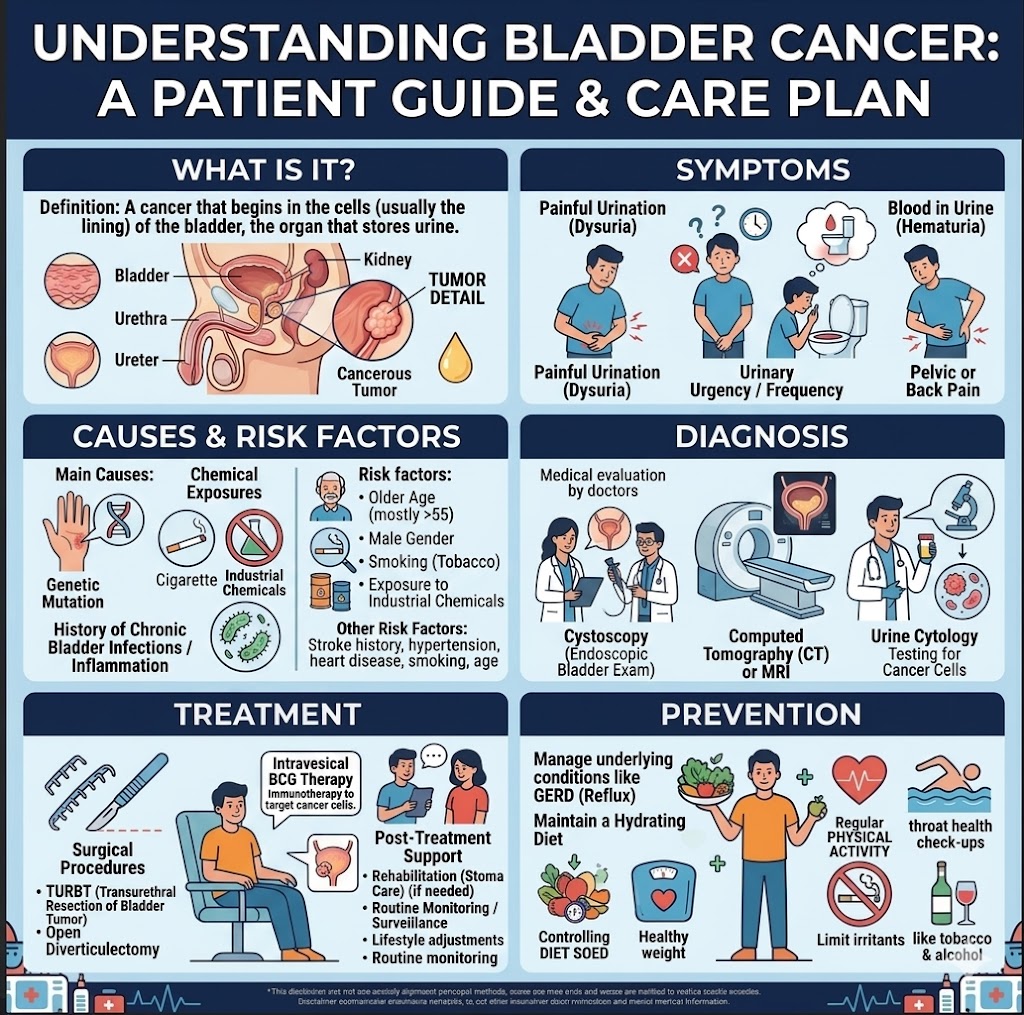
Bladder cancer is a common type of cancer that starts in the cells lining the inside of your bladder. The bladder is a hollow, muscular organ in your lower abdomen designed to store urine. Most bladder cancers begin in these lining cells, called urothelial cells, which are also found in the kidneys and the tubes (ureters) connecting kidneys to the bladder. While urothelial cancer can occur in kidneys or ureters, it's far more common in the bladder. This cancer begins when these cells develop DNA changes, causing them to multiply rapidly and form a tumor. Most bladder cancers are caught early when they are highly treatable. However, even early-stage cancers can return, making long-term follow-up essential.
Understanding the Condition
Understanding Bladder Cancer
Understanding the Condition
Bladder cancer is a common type of cancer that starts in the cells lining the inside of your bladder. The bladder is a hollow, muscular organ in your lower abdomen designed to store urine. Most bladder cancers begin in these lining cells, called urothelial cells, which are also found in the kidneys and the tubes (ureters) connecting kidneys to the bladder. While urothelial cancer can occur in kidneys or ureters, it's far more common in the bladder. This cancer begins when these cells develop DNA changes, causing them to multiply rapidly and form a tumor. Most bladder cancers are caught early when they are highly treatable. However, even early-stage cancers can return, making long-term follow-up essential.
Common Symptoms
Blood in urine (hematuria): Urine may appear bright red, cola-colored, or sometimes normal, with blood detected only through lab tests. This is the most common symptom.
Frequent urination: Feeling the need to urinate more often than usual.
Painful urination: Discomfort or burning during urination.
Consultation Guide
Which Specialist to Meet
Start by seeing your primary care doctor. If bladder cancer is suspected, you'll likely be referred to a urologist (a doctor specializing in urinary tract conditions) or an oncologist (a cancer specialist).
Preparations Before Your Visit
If you notice discolored urine or other worrying symptoms, schedule an appointment. Before your visit, note down all your symptoms, including when they started and how often they occur. Be prepared to discuss your medical history, any medications you take, and your lifestyle habits, such as smoking.
Book a doctor visit near me
External Beam Radiation Therapy: Uses high-energy beams (like X-rays) from a machine outside the body to target and destroy cancer cells. It can be a primary treatment, or used after surgery to kill remaining cells, or to manage symptoms. (Duration: Daily treatments, typically five days a week, for several weeks.)
Monitor for Symptoms: Be vigilant for any return of symptoms, such as blood in urine or changes in urination patterns, and report them to your doctor promptly.
Consultation Guide
You'll lie on a table that slides into a CT scanner. The contrast dye injection may cause a warm sensation. Images are taken as the dye moves through your system. You'll need to remain still and might be asked to hold your breath briefly.
Diagnostic Procedures
A procedure where a doctor uses a thin, flexible tube with a camera (cystoscope) to look inside your bladder and urethra. This helps identify abnormal areas or growths.
What to Expect
Performed in a clinic or hospital, often with numbing gel or sedation. The tube is gently inserted through the urethra into the bladder. Specialized light may be used after a special dye is introduced into the bladder, causing cancer cells to glow red, making them easier to spot.
An X-ray imaging test for the urinary tract (kidneys, ureters, bladder). A special contrast dye is injected into a vein to highlight these organs and show their size, shape, and function.
What to Expect
A general imaging test using X-rays to create detailed cross-sectional images of internal organs, bones, and blood vessels. Provides more detail than standard X-rays for diagnosing disease or injury.
What to Expect
You lie on a table that moves through the scanner. Depending on the area being scanned, you might receive contrast dye. You'll need to remain still, and possibly hold your breath. The scan is typically quick and painless.
A quick imaging test using radiation to produce images of your heart, lungs, and chest bones. Used to detect issues like lung masses, infections, or fluid buildup.
What to Expect
You stand or sit against a plate, and a technician positions you. You'll be asked to take a deep breath and hold it for a moment while the X-ray is taken. It's a very brief, painless procedure.
A nuclear imaging test where a small amount of radioactive tracer is injected into your bloodstream. This tracer accumulates in areas of bone where there is unusual activity, helping to find cancer spread, infections, or hidden injuries.
What to Expect
After the tracer injection, you'll wait a few hours. Then, you'll lie still on a table while a special camera scans your body to detect the tracer and create images of your bones. The scan itself can take up to an hour.
Neobladder Reconstruction: A type of urinary diversion where a surgeon uses a piece of your intestine to create a new bladder, placed in the same location as the original. This allows for voluntary urination. (Duration: Performed during or after radical cystectomy. Long-term adjustment and training are required.)
Regular Follow-Up Care: Even after successful treatment, bladder cancer has a high chance of returning. Regular follow-up tests, including cystoscopies and urine tests, are typically needed for many years to detect any recurrence early.
Treatment Options
Surgical Procedures
Partial Bladder Removal (Partial Cystectomy): Removes only the cancerous part of the bladder, leaving the rest intact. This is rarely done, typically for small, isolated tumors. (Duration: Varies, typically a single procedure.)
Complete Bladder Removal (Radical Cystectomy): Removal of the entire bladder. In men, this often includes the prostate and seminal vesicles. In women, it may include the uterus, ovaries, fallopian tubes, and part of the vagina. A new way for urine to leave the body (urinary diversion) is then created. (Duration: A single, extensive surgery. Recovery takes several weeks to months.)
Chemotherapy (Systemic): Uses powerful drugs, given orally or intravenously, to kill fast-growing cancer cells throughout the body. Can be used before surgery to shrink tumors, after surgery to kill remaining cells, or as a primary treatment. (Duration: Cycles of treatment over several weeks or months, depending on the specific drugs and cancer stage.)
Intravesical Chemotherapy/Immunotherapy: Specific drugs are instilled directly into the bladder through a catheter. This targets cancer cells lining the bladder with fewer body-wide side effects. (Duration: Typically weekly treatments for several weeks, followed by maintenance treatments for months or years.)
Hyperthermic Intraperitoneal Chemotherapy (HIPEC): A specialized treatment for cancers that have spread to the abdominal lining. After visible cancer is surgically removed, heated chemotherapy liquid is circulated directly within the abdominal cavity to kill remaining microscopic cancer cells. (Duration: Performed as part of a single complex surgery.)
Prevention & Long-Term Wellbeing
Prevention
Avoid Smoking: Smoking cigarettes, cigars, or pipes introduces harmful chemicals into your body, some of which are excreted in urine and can damage the bladder lining. Quitting smoking is one of the most effective ways to reduce risk.
Limit Chemical Exposure: If you work with chemicals (especially in industries like dyes, rubber, leather, textiles, or paint), strictly follow safety guidelines to minimize exposure. Your kidneys filter these chemicals, which then pass through the bladder.
Eat a Healthy Diet: A diet rich in colorful fruits and vegetables provides antioxidants that may help reduce overall cancer risk.
Long-Term Monitoring
Tags & Topics
Notice an error or need an update?
Help us keep medical information accurate. Report incorrect info or suggest an edit.


