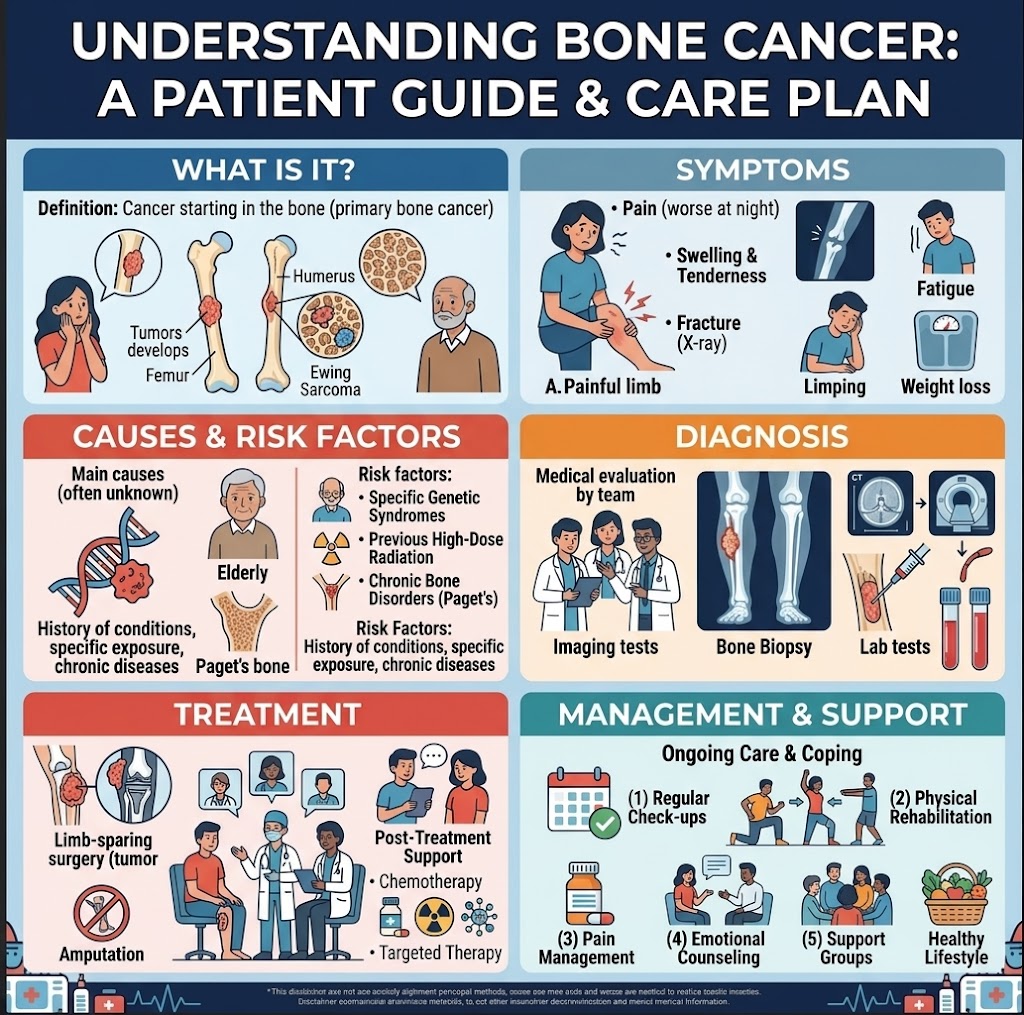
Bone cancer is a rare disease where abnormal cells begin to grow within a bone. While it can occur in any bone, it most commonly affects the thighbone. It’s crucial to understand that 'bone cancer' specifically refers to cancer that originates in the bone itself. It does not include cancer that started elsewhere in the body (like the lungs or breast) and later spread to the bones; such cases are named for their original location, for example, 'lung cancer that has spread to the bones.' Different types of bone cancer exist, with some primarily affecting children and young adults, while others are more common in middle-aged and older adults. Treatment often combines surgery, radiation, and chemotherapy, tailored to the specific type of cancer, its location, and individual patient factors.
Understanding the Condition
Bone Cancer: Understanding a Rare Condition
Understanding the Condition
Common Symptoms
If you experience concerning symptoms, start by consulting your primary care doctor. They may refer you to specialists such as an orthopedic oncologist (a surgeon specializing in bone tumors), a medical oncologist (a doctor specializing in cancer treatment with medication), and a radiation oncologist (a doctor specializing in cancer treatment with radiation).
Preparations Before Your Visit
Before your visit, make a detailed list of all your symptoms, noting when they began and how they've changed. Prepare a list of any questions you have for the doctor. Be ready to discuss your complete medical history, including any family history of cancer, and bring copies of any relevant medical records or previous test results.
Book a doctor visit near me
No Known Prevention: Currently, there are no established ways to prevent bone cancer, as the causes of most types are unknown. Therefore, focusing on early detection through awareness of symptoms and managing known risk factors is crucial.
Consultation Guide
Weakened Bone: Bones may become fragile and weakened by the cancer, making them more susceptible to breaking from minor injuries or everyday activities that wouldn't normally cause a fracture.
Fatigue: A general feeling of extreme tiredness or lack of energy that does not improve with rest and can significantly impact daily activities.
Managing Risk Factors: If you have inherited genetic syndromes (like Li-Fraumeni syndrome or hereditary retinoblastoma) or certain bone conditions (like Paget's disease of bone or fibrous dysplasia) that increase your risk, discuss regular screenings and monitoring with your doctor.
Long-Term Monitoring and Support
Diagnostic Procedures
A quick, painless imaging test that uses a small amount of radiation to create pictures of the inside of your body, primarily showing bones and dense structures to identify bone abnormalities.
What to Expect
You will be asked to stand or lie on a table, and a technician will position you to capture images of the affected area. You'll need to stay very still for a few moments while the X-ray machine takes the pictures. The process is brief and usually takes less than 15 minutes.
CT Scan (Computed Tomography)
A detailed imaging technique that uses multiple X-ray beams and computer processing to create cross-sectional 'slices' of your bones, blood vessels, and soft tissues, offering much more detail than a standard X-ray.
What to Expect
You will lie on a motorized table that slides into a large, doughnut-shaped machine. The table moves slowly through the scanner while X-ray beams rotate around you, taking images. You might be asked to hold your breath briefly at certain times. The procedure is generally painless and takes 10-30 minutes.
A nuclear imaging test that uses a small amount of a radioactive substance (tracer) injected into your bloodstream to detect changes in bone metabolism. Areas with faster metabolism, like those affected by cancer or injury, absorb more tracer and show up as 'hot spots' on the images.
What to Expect
A small amount of radioactive tracer is injected into a vein, and you'll wait a few hours for it to be absorbed by your bones. Then, you'll lie on a table while a special camera scans your entire body, creating images of your skeleton. The scan itself typically takes 30-60 minutes.
PET Scan (Positron Emission Tomography Scan)
An imaging test that helps reveal the metabolic or biochemical function of the body's tissues and organs. It uses a radioactive tracer that collects in areas with high metabolic rates, often indicating active disease like cancer. PET scans are frequently combined with CT or MRI for clearer, more comprehensive images.
What to Expect
A radioactive tracer is injected into your arm, and you'll rest quietly for about an hour as your body absorbs it. Then, you'll lie on a narrow table that slides into a doughnut-shaped scanner. The scan takes about 30 minutes, during which you must remain completely still.
A crucial procedure where a long, thin needle is used to remove a small sample of cells or tissue directly from the suspicious area in the bone. This sample is then sent to a laboratory to be examined under a microscope by a pathologist to confirm the presence of cancer and determine its type.
What to Expect
After numbing the skin over the area, the doctor will insert a needle through the skin and into the bone or tissue to collect the sample. Imaging guidance (like X-ray or CT) is often used to precisely guide the needle. You might feel some pressure or a brief pinch. The procedure usually takes 15-60 minutes, followed by a period of observation.
Alkaline Phosphatase (ALP) Blood Test
A common blood test that measures the levels of an enzyme called alkaline phosphatase, which is primarily produced in the liver and bones. While not specific for bone cancer, abnormal levels can indicate issues with bone health or other conditions, prompting further investigation.
What to Expect
A healthcare professional will draw a small sample of blood, usually from a vein in your arm, using a needle. This is a quick and routine procedure, typically taking only a few minutes.
Regular Follow-Up Care: After treatment, regular check-ups, imaging scans (like X-rays, CTs, or MRIs), and blood tests are crucial to monitor for any recurrence of cancer or new issues. This comprehensive care can continue for many years.
Emotional and Psychological Support: Coping with a bone cancer diagnosis and its treatment can be challenging. Seeking support from counselors, support groups, or trusted family and friends can significantly help manage stress, anxiety, and maintain mental well-being.
Treatment Options
Bone cancer is a rare disease where abnormal cells begin to grow within a bone. While it can occur in any bone, it most commonly affects the thighbone. It’s crucial to understand that 'bone cancer' specifically refers to cancer that originates in the bone itself. It does not include cancer that started elsewhere in the body (like the lungs or breast) and later spread to the bones; such cases are named for their original location, for example, 'lung cancer that has spread to the bones.' Different types of bone cancer exist, with some primarily affecting children and young adults, while others are more common in middle-aged and older adults. Treatment often combines surgery, radiation, and chemotherapy, tailored to the specific type of cancer, its location, and individual patient factors.
Swelling and Pain: Persistent swelling and tenderness, sometimes with a noticeable lump, in the area around the affected bone. This pain may worsen at night or with activity and might not be relieved by typical pain medication.
Surgical Procedures
Tumor Removal Surgery: The primary goal is to surgically remove the cancerous tumor. This may involve removing only the tumor along with a margin of healthy tissue (limb-sparing surgery) or, in some cases, amputating the affected limb if the tumor is large, has spread extensively, or cannot be removed otherwise. Surgeons strive to preserve as much healthy bone and function as possible. (Duration: A single surgical procedure, with hospital stay and recovery varying from days to several weeks, followed by rehabilitation that can last several months.)
Therapies
Radiation Therapy: This treatment uses high-energy beams, often X-rays or protons, precisely aimed at the tumor to kill cancer cells and shrink tumors. Modern techniques focus on delivering radiation directly to the cancer while minimizing harm to surrounding healthy tissues. (Duration: Typically administered daily over several weeks (e.g., 5 days a week for 3-7 weeks), with the exact number of sessions depending on the cancer type, size, and location.)
Medications
Chemotherapy: Involves powerful chemical drugs that circulate throughout the body to kill fast-growing cancer cells. These drugs can be given before surgery to shrink tumors, after surgery to kill any remaining cancer cells, or for cancer that has spread to other parts of the body. (Duration: Administered in cycles, usually over several months to a year, with periods of treatment followed by rest to allow the body to recover from side effects.)
Physical Rehabilitation: For those who undergo surgery, especially limb-sparing procedures, physical therapy and rehabilitation are vital to help restore strength, movement, and function to the affected limb, significantly improving overall quality of life.
Healthy Lifestyle: Maintaining a balanced, nutritious diet, engaging in regular, appropriate physical activity (as advised by your care team), and avoiding tobacco and excessive alcohol can support overall health during and after cancer treatment.
Prevention & Long-Term Wellbeing
Unexplained Weight Loss: Losing a noticeable amount of weight without actively trying through diet or exercise changes.
- Consultation Guide
Which Specialist to Meet
Prevention
Tags & Topics
Notice an error or need an update?
Help us keep medical information accurate. Report incorrect info or suggest an edit.


