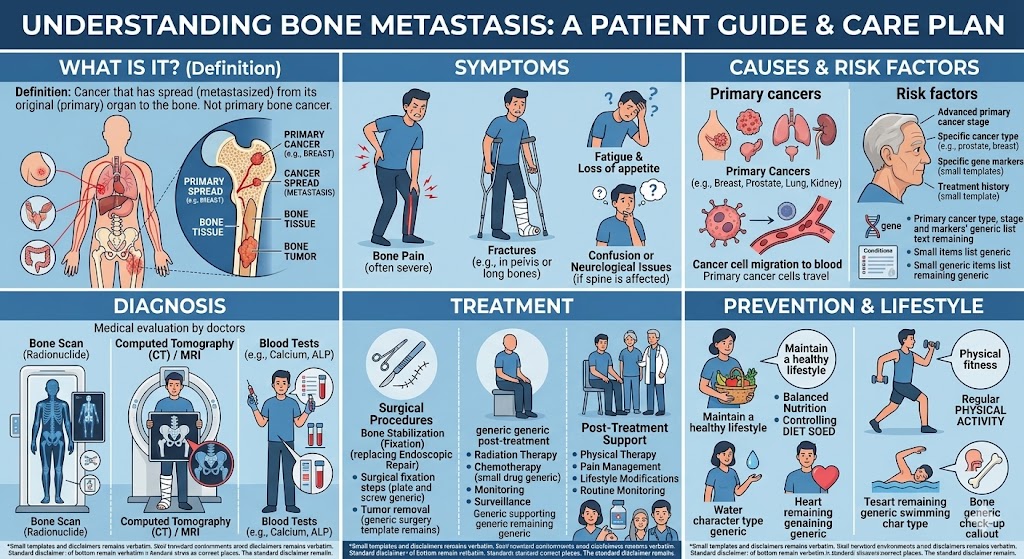
Bone metastasis happens when cancer cells break away from the original tumor—such as in the breast, prostate, or lungs—and travel through the bloodstream or lymphatic system to settle in a bone. This condition can weaken your skeletal structure, cause pain, and make bones more prone to breaking. Although it is rarely curable, advanced medical treatments can help control the cancer, manage pain, protect your bones, and maintain your quality of life.
Understanding the Condition
Common Symptoms
Bone Pain: This is often the earliest sign. It usually begins as a dull, persistent ache that may worsen at night, during movement, or while resting.
Fragile Bones and Fractures: Cancer weakens the bone tissue, making it easy for a break to occur from a minor fall, normal daily movement, or even just standing.
Spinal Cord Compression: If cancer spreads to the spine, it can press on the spinal cord. This can lead to back pain, numbness, tingling, or weakness in your arms and legs, and a loss of bowel or bladder control.
Before your appointment, write down all your symptoms, when they started, and how severe they are. Bring a detailed summary of your previous cancer treatments, copies of past imaging scans, and a list of all your current medications. Prepare a list of questions regarding your symptom relief options and treatment goals.
Book a doctor visit near me
Consultation Guide
Understanding Bone Metastasis: Causes, Diagnosis, and Management
Understanding the Condition
Bone metastasis happens when cancer cells break away from the original tumor—such as in the breast, prostate, or lungs—and travel through the bloodstream or lymphatic system to settle in a bone. This condition can weaken your skeletal structure, cause pain, and make bones more prone to breaking. Although it is rarely curable, advanced medical treatments can help control the cancer, manage pain, protect your bones, and maintain your quality of life.
High Blood Calcium (Hypercalcemia): As cancer breaks down bone tissue, calcium is released into the blood. This can cause nausea, constipation, extreme thirst, confusion, and muscle weakness.
Consultation Guide
Which Specialist to Meet
You should consult an oncologist (cancer specialist), an orthopedic oncologist (a surgeon specializing in bone cancers), or a radiation oncologist. Your primary care doctor can help coordinate this care.
Preparations Before Your Visit
Bone-Building Medications: These drugs help strengthen the bones, slow down the damage caused by cancer cells, and reduce the risk of future fractures. (Duration: Typically administered via an injection or IV infusion every few weeks or months, often continuing long-term as part of your overall cancer management.)
Diagnostic Procedures
A nuclear imaging test that looks at your entire skeleton to find areas where bones are breaking down or repairing themselves rapidly.
What to Expect
You will receive an injection of a safe, tiny amount of radioactive liquid (tracer) into a vein. You will then wait 2 to 4 hours while your bones absorb it. After this, you will lie still on a flat table while a special camera passes over your body to detect where the tracer has gathered, showing up as 'hot spots' on a computer screen.
CT Scan (Computerized Tomography)
An imaging test that uses a computer to combine multiple X-ray angles into highly detailed, cross-sectional pictures of your bones, organs, and tissues.
What to Expect
You may be asked to drink a contrast dye or receive it through an IV. You will lie on a narrow table that slides into a doughnut-shaped scanner. You must lie very still for 10 to 30 minutes, and you may be asked to hold your breath for a few seconds to avoid blurring the images.
PET Scan (Positron Emission Tomography)
An imaging scan that uses a tiny amount of radioactive sugar to identify cells with abnormally high metabolic rates, helping pinpoint active cancer sites.
What to Expect
You will receive an IV injection of a radioactive tracer and rest quietly for about an hour while your body absorbs it. You will then lie on a table that slowly glides into the PET scanner. The process is painless and takes about 30 to 45 minutes, during which you must remain completely still.
A quick, standard imaging test that uses a small dose of radiation to capture high-contrast pictures of dense structures like bones.
What to Expect
A technician will position your body against a flat plate or have you lie on a table. A protective lead apron may be placed over your body. You will need to hold your breath and remain completely still for a second while the image is captured. The entire process takes only a few minutes.
Regular Follow-Up Scans: Attend all scheduled imaging appointments (X-rays, bone scans) and blood tests to monitor bone stability and catch any new cancer spread early.
Treatment Options
Medications
Systemic Chemotherapy: Powerful cancer-fighting drugs designed to target and kill fast-growing cancer cells throughout your entire body. (Duration: Given in cycles consisting of a treatment period followed by a rest period, typically lasting 3 to 6 months per course.)
Pain Management Therapies: An array of non-opioid and prescription medications used to control bone pain and keep you comfortable. (Duration: Tailored to your individual needs and adjusted continuously based on your pain levels.)
Surgical and Interventional Procedures
Cryoablation: A minimally invasive procedure where thin metal probes are inserted directly into the tumor. A gas is passed through the probes to freeze and destroy the cancer cells, relieving pain. (Duration: A single outpatient procedure lasting 1 to 2 hours.)
Bone Stabilization Surgery: Surgeons use metal plates, screws, or rods to stabilize bones that are fractured or severely weakened by cancer. (Duration: A one-time surgery requiring a hospital stay, followed by 6 to 12 weeks of recovery and rehabilitation.)
Joint Replacement: If bone damage is located in a joint, such as the hip, the diseased joint is surgically removed and replaced with a metal, ceramic, or plastic artificial joint. (Duration: A one-time surgery followed by several months of physical therapy to restore movement.)
External Beam Radiation: High-energy beams aimed precisely at the affected bone to destroy cancer cells and provide significant pain relief. (Duration: Usually delivered in brief daily sessions over 1 to 3 weeks.)
Prevention & Long-Term Wellbeing
Bone Health and Nutrition
Calcium and Vitamin D Intake: Incorporate foods rich in calcium and vitamin D, or take doctor-approved supplements to help maintain the strength of your remaining healthy bone tissue.
Safe, Low-Impact Exercise: Engage in gentle, physician-approved weight-bearing activities like walking to help preserve muscle strength, bone density, and balance.
Long-Term Monitoring and Safety
Fall Prevention Strategies: Modify your living space to prevent falls. Remove tripping hazards like loose rugs, install safety grab bars in bathrooms, and ensure all pathways are well-lit.
Emotional and Mental Support
Cancer Support Groups: Connect with local or online support groups for individuals living with advanced cancer to share experiences and build a strong emotional support network.
Tags & Topics
Notice an error or need an update?
Help us keep medical information accurate. Report incorrect info or suggest an edit.


