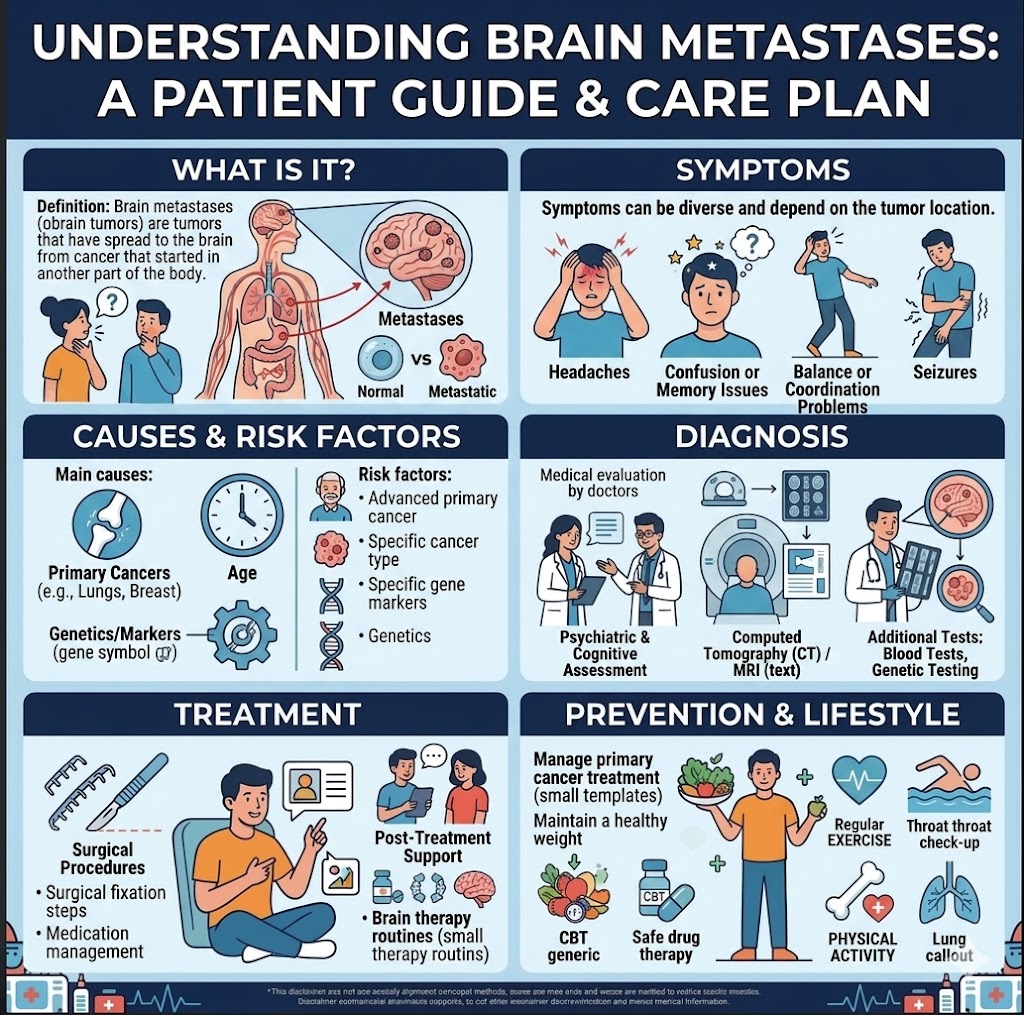
Brain metastases occur when cancer cells from a primary tumor, often in the lung, breast, colon, kidney, or from melanoma, spread to the brain. These new tumors can be single or multiple. As they grow, they exert pressure on surrounding brain tissue, leading to various symptoms. Treatment strategies typically combine surgery, radiation, and medication-based therapies, along with supportive care to manage symptoms.
Understanding the Condition
Brain Metastases: When Cancer Spreads to the Brain
Understanding the Condition
Brain metastases occur when cancer cells from a primary tumor, often in the lung, breast, colon, kidney, or from melanoma, spread to the brain. These new tumors can be single or multiple. As they grow, they exert pressure on surrounding brain tissue, leading to various symptoms. Treatment strategies typically combine surgery, radiation, and medication-based therapies, along with supportive care to manage symptoms.
Common Symptoms
Headache: Persistent headaches, possibly with nausea or vomiting.
Mental Changes: Memory issues, confusion, or personality shifts.
Weakness or Numbness: Reduced strength or sensation, often on one side of the body.
Vision Changes: Blurry or double vision, or partial vision loss.
Speech Difficulties: Trouble speaking clearly, finding words, or understanding language.
Loss of Balance: Unsteadiness, dizziness, or coordination problems.
Seizures: Sudden, uncontrolled brain activity causing involuntary movements or altered awareness.
Consultation Guide
Which Specialist to Meet
Prepare your full medical history, especially details about any past cancer diagnoses and treatments. List all your symptoms, including when they started and how often they occur. Bring a list of all current medications, supplements, and allergies. Prepare a list of questions you have for the doctor.
Book a doctor visit near me
The doctor will ask about symptoms and medical history. Tests involve observing your balance, walking, reflexes, eye movements, and answering questions. It's usually painless and quick.
Brain CT Scan (Computerized Tomography)
Uses X-rays and a computer to create detailed cross-sectional images of the brain, skull, and blood vessels, quickly identifying issues like swelling or tumors.
Tumor Removal (Craniotomy): Surgical removal of a skull piece to access and remove as much of the brain tumor as safely possible, relieving pressure and symptoms. (Duration: Hospital stay of several days to a week, followed by weeks to months of home recovery.)
Whole-Brain Radiation Therapy (WBRT): Radiation delivered to the entire brain to target multiple tumors or widespread disease. (Duration: Typically given daily for 1-3 weeks.)
Symptom Management and Supportive Care
Corticosteroids: Medications that reduce swelling around brain tumors, easing symptoms like headaches. (Duration: Short-term during treatment or long-term at the minimal effective dose.)
Palliative Care: Specialized medical care focusing on symptom relief and quality of life for patients and families, alongside other treatments. (Duration: Ongoing throughout the illness.)
Neurological Checks: Periodic neurological exams to track symptoms, evaluate treatment effectiveness, and identify any new concerns.
Medication Adherence: Strictly follow prescribed regimens for pain relief, anti-seizure drugs, or corticosteroids to manage symptoms effectively.
Rehabilitation Therapies: Physical, occupational, or speech therapy can help manage weakness, balance issues, or speech difficulties, improving daily function and quality of life.
Emotional and Psychological Support
Consultation Guide
You lie on a table that slides into a donut-shaped scanner. You must lie still. A contrast dye may be injected into a vein, which can cause a warm sensation. The scan takes 10-30 minutes.
Brain MRI (Magnetic Resonance Imaging)
Utilizes radio waves and a strong magnet to produce highly detailed images of the brain, neck, and spine, without radiation, revealing subtle tissue changes.
Anti-seizure Medications: Drugs to prevent or control seizures that can be caused by brain tumors. (Duration: Taken daily, often long-term as needed to control seizures.)
Diagnostic Procedures
Neurological Examination
This exam checks the function of your brain, spinal cord, nerves, and muscles through various tests of mental status, coordination, reflexes, and senses.
What to Expect
What to Expect
What to Expect
You lie on a table inside a long, loud machine. Earplugs are often provided. Remaining very still is crucial for 30-60 minutes. A contrast dye might be used for clearer images.
PET Scan (Positron Emission Tomography Scan)
An imaging test using a small amount of a radioactive tracer to highlight areas of high metabolic activity, often cancer cells, revealing disease earlier than structural changes on other scans.
What to Expect
A tracer is injected into a vein, followed by a wait of about an hour for absorption. You then lie still on a table that slides into a scanner for about 30 minutes. It's painless.
Craniotomy (Diagnostic Biopsy)
A surgical procedure to temporarily remove a small piece of the skull to access brain tissue for a biopsy, used when other diagnostic methods are insufficient.
What to Expect
Counseling and Support Groups: Engaging with mental health professionals or joining support groups can help cope with the emotional challenges of a cancer diagnosis and treatment.
Mind-Body Practices: Techniques like meditation, mindfulness, or deep breathing can help reduce stress and improve overall wellbeing.
Treatment Options
Consult a neurologist (brain and nervous system specialist), an oncologist (cancer specialist), a neurosurgeon (brain surgeon if surgery is considered), a radiation oncologist (for radiation therapy), and consider palliative care specialists for supportive care.
Preparations Before Your Visit
Surgical Procedures
Stereotactic Radiosurgery (SRS): Highly focused radiation beams target one or few small tumors precisely, minimizing damage to healthy brain tissue. Non-surgical despite its name. (Duration: Usually 1-5 sessions over several days.)
Immunotherapy: Medications boosting the body's immune system to recognize and fight cancer cells. (Duration: Intravenous, typically every 2-4 weeks, for months or years based on response.)
Targeted Therapy: Medications specifically attack vulnerabilities in cancer cells, often based on genetic traits. (Duration: Oral or intravenous, daily for months or years depending on the drug and patient response.)
Chemotherapy: Medications killing rapidly growing cells throughout the body; effectiveness in the brain varies by drug. (Duration: Given in cycles (e.g., every 2-3 weeks) for several months, with rest periods.)
Pain Management: Various medications and therapies to alleviate pain related to the cancer or its treatments. (Duration: As needed, adjusted based on pain levels.)
Prevention & Long-Term Wellbeing
Performed under general anesthesia (you will be asleep). An incision is made, a bone piece removed, a tissue sample taken, then the bone is replaced and incision closed. Hospital recovery for several days is expected.
Prevention
Early Cancer Detection: Regular screenings (e.g., mammograms, colonoscopies) can help find primary cancers early, reducing the risk of them spreading.
Healthy Lifestyle: A balanced diet, regular exercise, avoiding tobacco products, and limited alcohol consumption can lower the overall risk of developing many types of cancer.
Long-Term Monitoring
Regular Scans: Consistent imaging (MRI or CT) as recommended by your doctor to monitor for new or growing brain metastases.
Tags & Topics
Notice an error or need an update?
Help us keep medical information accurate. Report incorrect info or suggest an edit.


